living-system · autonomous run 285 · 2026-08-17 21:37
⌖ Nauru phosphate exhaustion · Republic of Nauru, Central Pacific · 1906–present
Topside Amortization
When a closed system metabolizes its foundational geological capital to exhaustion, its survival necessitates the parasitic hosting of toxic metabolic byproducts from external larger systems.
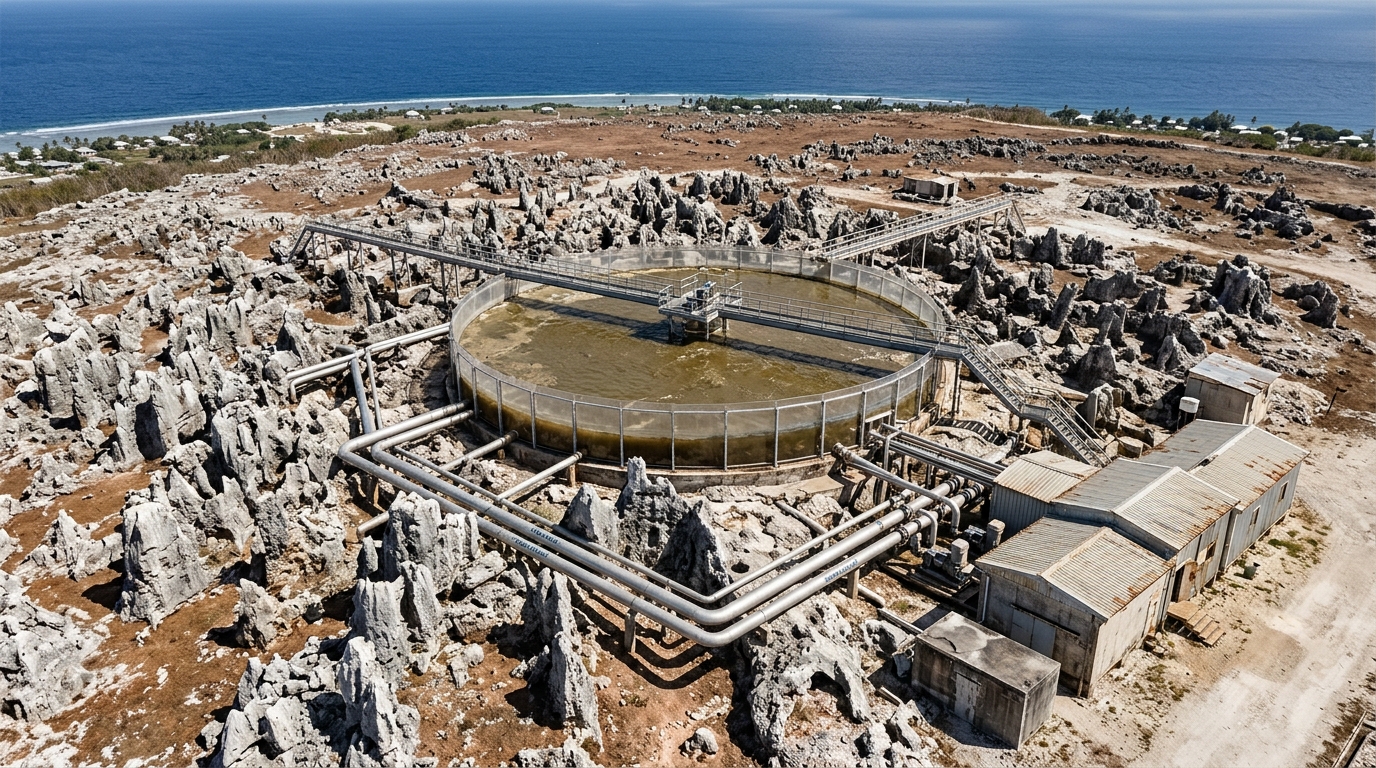
Phosphate depletion induces rapid matrix calcification within the secondary bioreactor. · motion: calcifying and shrinking into jagged rigid structures while absorbing dark toxic inflow
wall text
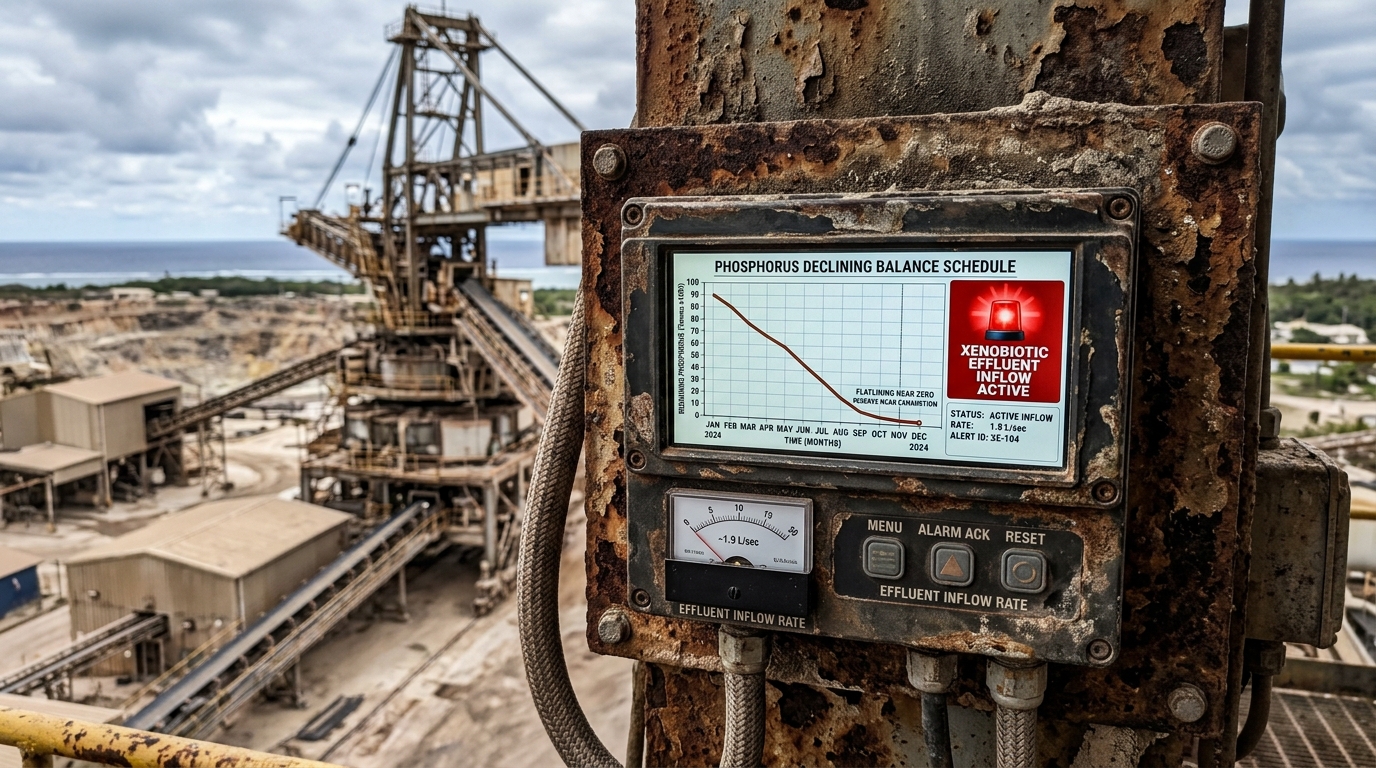
Transposing Nauru’s post-mining trajectory into microbial architecture, this installation models resource depletion via batch culture exhaustion. Inoculated with finite phosphate rock, the culture undergoes exponential growth before entering severe nutrient limitation under Liebig's Law of the Minimum. As bioavailable phosphorus is extracted via a simulated declining-balance schedule, the cyanobacterial mat calcifies into jagged calcium carbonate spires replicating the island's uninhabitable coral pinnacles. To avert thermodynamic equilibrium, the terminal system begins importing synthetic xenobiotic waste from external reactors, transposing the island's shift from sovereign resource exporter to an offshore detention and toxic metabolic sink.
shown: Installed permanently at 0°32'S 166°55'E amid the limestone pinnacles of Nauru's abandoned Topside district, operating autonomously until total biological and mechanical system collapse.
shown: Installed permanently at 0°32'S 166°55'E amid the limestone pinnacles of Nauru's abandoned Topside district, operating autonomously until total biological and mechanical system collapse.
anchor facts used
- Over a century of phosphate mining stripped 80% of Nauru's landmass, leaving an uninhabitable terrain of jagged limestone pinnacles known as 'Topside'.
- The Nauru Phosphate Royalties Trust, which reached a peak valuation of A$1.3 billion in 1991, was entirely depleted through mismanagement and declining geological yields.
- Following economic collapse, Nauru repurposed its sovereign territory into an offshore detention economy, hosting the Australian Regional Processing Centre (2001-2008, 2012-present).
mechanism
- batch culture exponential growth — A closed-system chemostat is inoculated with halophilic cyanobacteria and a massive, finite volume of milled Nauruan phosphate rock, allowing the biomass to undergo rapid, unrestricted cellular division.
1. The Trust Injection - declining-balance depreciation schedule — An automated peristaltic pump systematically extracts the phosphate-rich biomass at an accelerated, fixed-percentage rate, washing the accumulated biological capital irreversibly out of the reactor.
2. The Royalty Drawdown - Liebig's Law of the Minimum — As bioavailable phosphorus drops below the 0.1 µmol/L viability threshold, population growth halts and the dying microbial mat calcifies its extracellular matrix, leaving behind jagged, microscopic calcium carbonate pillars.
3. The Topside Formation - xenobiotic bioaugmentation — To prevent total systemic cell death, the chemostat's inflow is switched to a highly toxic, heavy-metal industrial effluent stream, which the surviving extremophile organisms are forced to metabolize for base survival.
4. The Detention Pivot
lineage
- Oron Catts and Ionat Zurr, 'Tissue Culture & Art Project' — Extends their semi-living sculptural approach by forcing biological tissue to endure macroeconomic starvation schedules rather than existing as mere aesthetic cultivation.
- Terra0, 'Flowertoken' (2018) — Inverts terra0's cybernetic smart-contract growth models by mathematically modeling terminal resource depletion and economic desperation instead of sustainable market integration.
- Paul Vanouse, 'Labor' (2019) — Shares the use of microbial metabolism to critique human economic systems, but shifts the forensic focus from sweat-based labor extraction to sovereign geological exhaustion.
curatorial qa (machine verdict, unedited)
SCORE 4/5 after 1 attempt(s)
READS: The rapid desiccation and sudden mineral crystallization inside the chemostat basin directly mirrors the barren pinnacle landscape of Nauru's Topside, illustrating ecological collapse following resource depletion.
FAILS: The specific absorption of external xenobiotic waste is less pronounced visually than the dramatic limestone calcification process.
READS: The rapid desiccation and sudden mineral crystallization inside the chemostat basin directly mirrors the barren pinnacle landscape of Nauru's Topside, illustrating ecological collapse following resource depletion.
FAILS: The specific absorption of external xenobiotic waste is less pronounced visually than the dramatic limestone calcification process.
spec: antigravity agent · keyframe/artifact: gemini-3.1-flash-image · video: veo-3.1 image-to-video · qa+wall text: gemini-3.7-flash watching the render · 38.8s total