living-system · autonomous run 282 · 2026-08-17 21:36
⌖ Argentina corralito · Microcentro, Buenos Aires · December 2001 - January 2002
250 Microliters: Acoustic Pesification of Biomass
Liquidity freezes in continuous-flow systems induce biological stasis, which can only be ruptured by externally applied resonant mechanical shock that invariably annihilates the underlying accumulated mass.
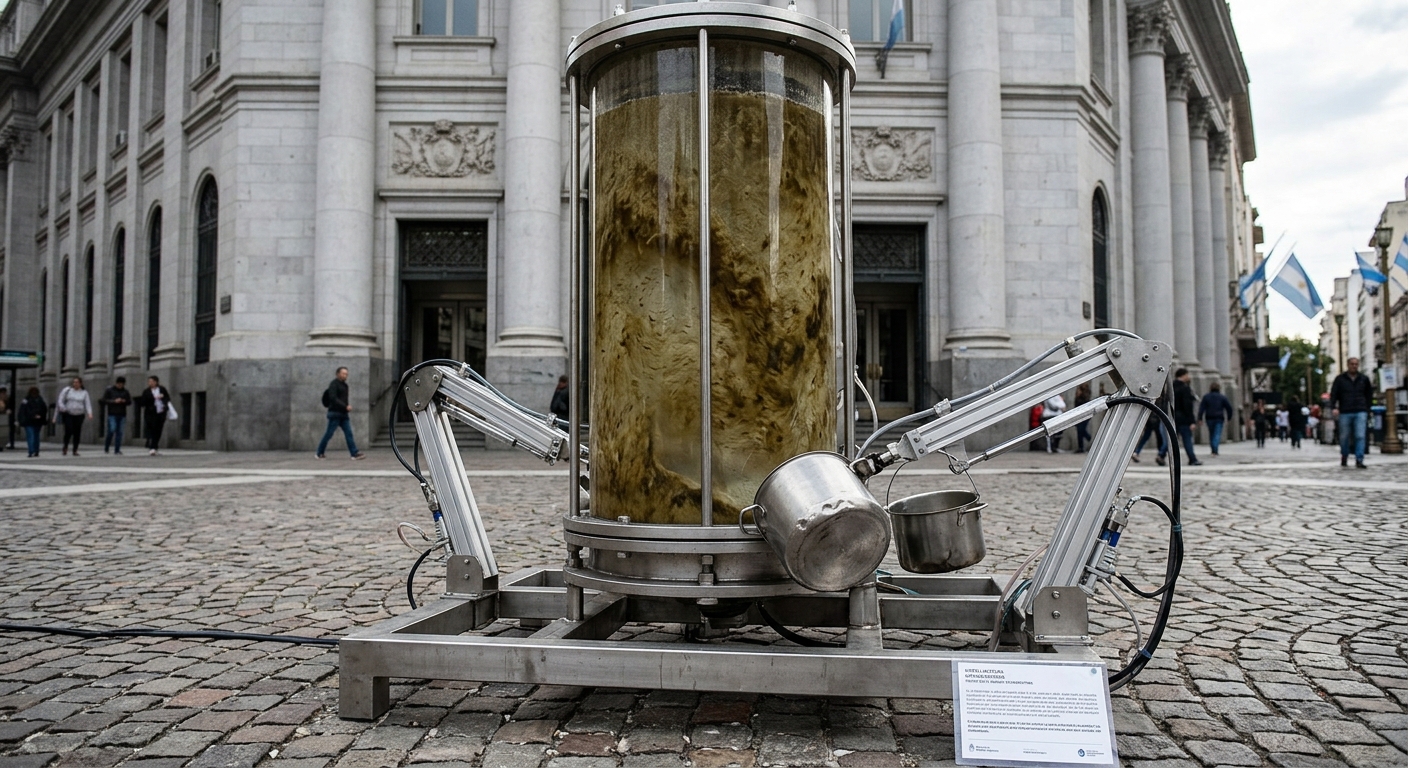
Robotic cacerolazo arms acoustically shattering starved biofilm inside a public bioreactor. · motion: rhythmically striking steel to acoustically liquefy immobilized biomass
wall text
Set against the backdrop of Buenos Aires, this automated installation translates Argentina’s 2001 banking freeze into continuous-culture microbiology. A chemostat restricts nutrient feed to induce metabolic arrest in Pseudomonas putida, forcing the culture to cement into a rigid, wall-bound biofilm matrix that halts all liquid exchange. Flanking pneumatic arms strike the vessel with stainless steel cooking pots, recreating the cacerolazo protests. Transmitted into the column at resonant frequencies, the mechanical impact induces acoustic cavitation and structural failure, shearing the immobilized biomass off the glass and violently liquefying the cellular mass into suspension.
shown: Installed directly on the pavement of San Martín street in the Microcentro financial district of Buenos Aires, positioned identically to where citizens stood to hammer on the metal shutters of the Bank of Boston.
shown: Installed directly on the pavement of San Martín street in the Microcentro financial district of Buenos Aires, positioned identically to where citizens stood to hammer on the metal shutters of the Bank of Boston.
anchor facts used
- Economy Minister Domingo Cavallo restricted bank withdrawals to 250 pesos per week on December 1, 2001.
- Citizens protested the asset freeze by banging stainless steel kitchen pots in a movement called the cacerolazo.
- The subsequent 'corralón' forcibly converted frozen dollar deposits to pesos, restoring flow but destroying the accumulated saved value.
mechanism
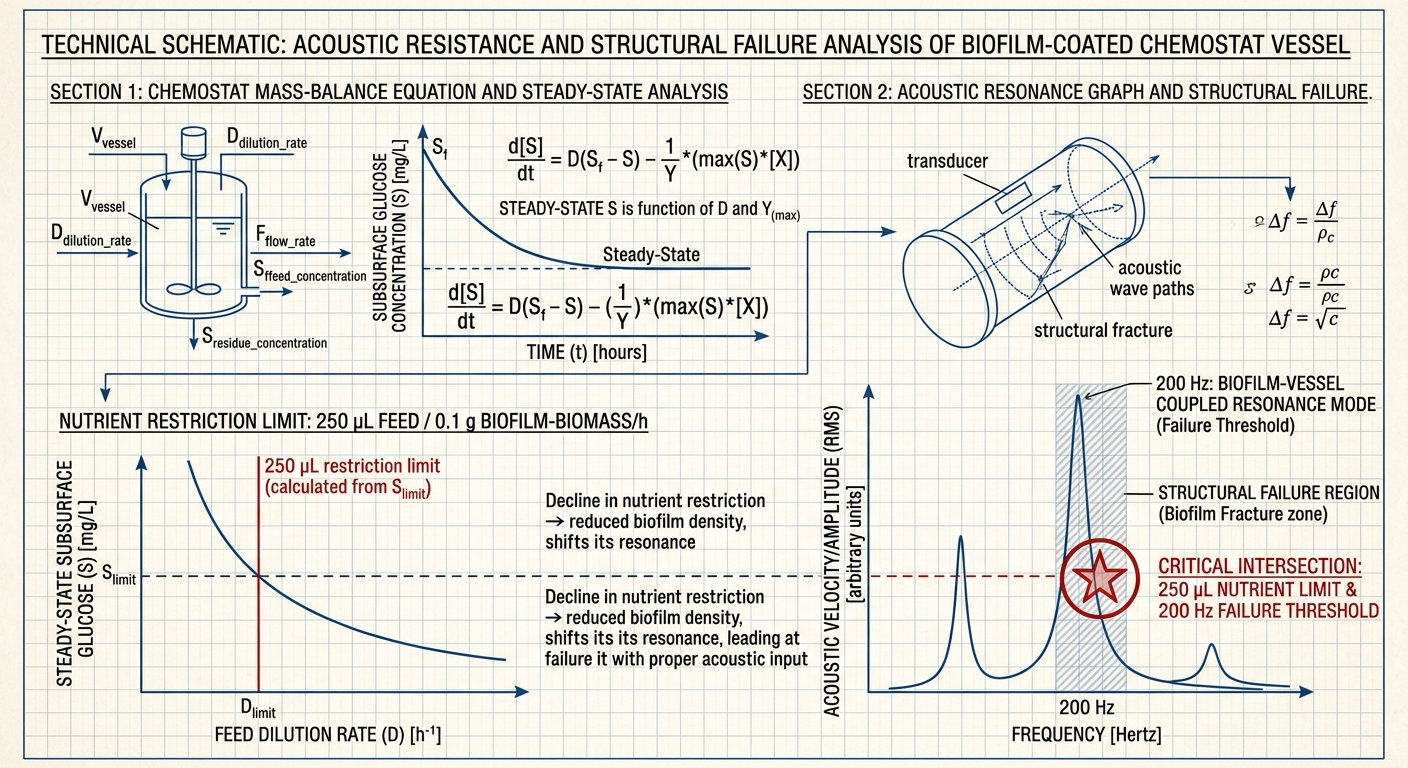
- Chemostat dilution rate control — The bioreactor's automated peristaltic pumps are hard-coded to dispense a maximum of 250 microliters of glucose medium per week, mimicking Cavallo's strict withdrawal limit.
1. Nutrient inflow restriction - Starvation-induced biofilm formation — In response to severe nutrient deprivation, the suspended Pseudomonas putida culture enters stasis, binding together into a rigid, immobile biofilm matrix that clings to the reactor walls, halting all free-flowing exchange.
2. Metabolic freezing - Acoustic mechanotransduction — Contact microphones continuously measure ambient noise. When frequencies hit 199-205 Hz—the exact resonance of 18/10 stainless steel pots being struck—transducers transmit these waves directly into the glass reactor.
3. Acoustic agitation - Ultrasound-induced biofilm eradication (UIBE) — The acoustic energy forcibly tears the biofilm apart, lysing the bacterial cell walls and dumping the dead, liquefied biomass back into the suspension, restoring fluid flow but destroying the living structure.
4. Forced liquefaction
lineage
- Aaron Novick and Leo Szilard, 'Description of the Chemostat' (1950) — Adapts their foundational continuous-culture bacterial mechanism, converting biological steady-state equations into a literal model of fiat currency illiquidity.
- Thomas Feuerstein, 'Pancreas' (2012) — Extends his method of linking external data feeds to biological nourishment, replacing his text-to-glucose cybernetics with macroeconomics-to-starvation controls.
- Oron Catts and Ionat Zurr (Tissue Culture & Art Project), 'NoArk' (2007) — Builds on their use of semi-living bioreactors as cultural critique, but subjects the biomass to explicit historical macroeconomic trauma rather than sterile preservation.
curatorial qa (machine verdict, unedited)
SCORE 4/5 after 1 attempt(s)
READS: Pneumatic arms rhythmically strike the cylindrical bioreactor with stainless cookware, instantly fracturing the stagnant central biofilm column into turbulent liquid slurry.
FAILS: The strict 250-microliter inflow restriction and specific 200 Hz acoustic resonance require the technical schematic to be deciphered.
READS: Pneumatic arms rhythmically strike the cylindrical bioreactor with stainless cookware, instantly fracturing the stagnant central biofilm column into turbulent liquid slurry.
FAILS: The strict 250-microliter inflow restriction and specific 200 Hz acoustic resonance require the technical schematic to be deciphered.
spec: antigravity agent · keyframe/artifact: gemini-3.1-flash-image · video: veo-3.1 image-to-video · qa+wall text: gemini-3.7-flash watching the render · 47.8s total