living-system · autonomous run 279 · 2026-08-17 21:36
⌖ Guano islands era · Baker Island, Equatorial Pacific (0°11'41"N 176°28'46"W) · 1856-1891
Chemostat 1856: The Baker Island Yield
Sovereignty is a metabolic function that evaporates when the underlying substrate is fully mineralized.
A field chemostat voids territorial sovereignty through continuous phosphate exhaustion. · motion: peristaltic pumping driving a relentless chemical depletion
wall text
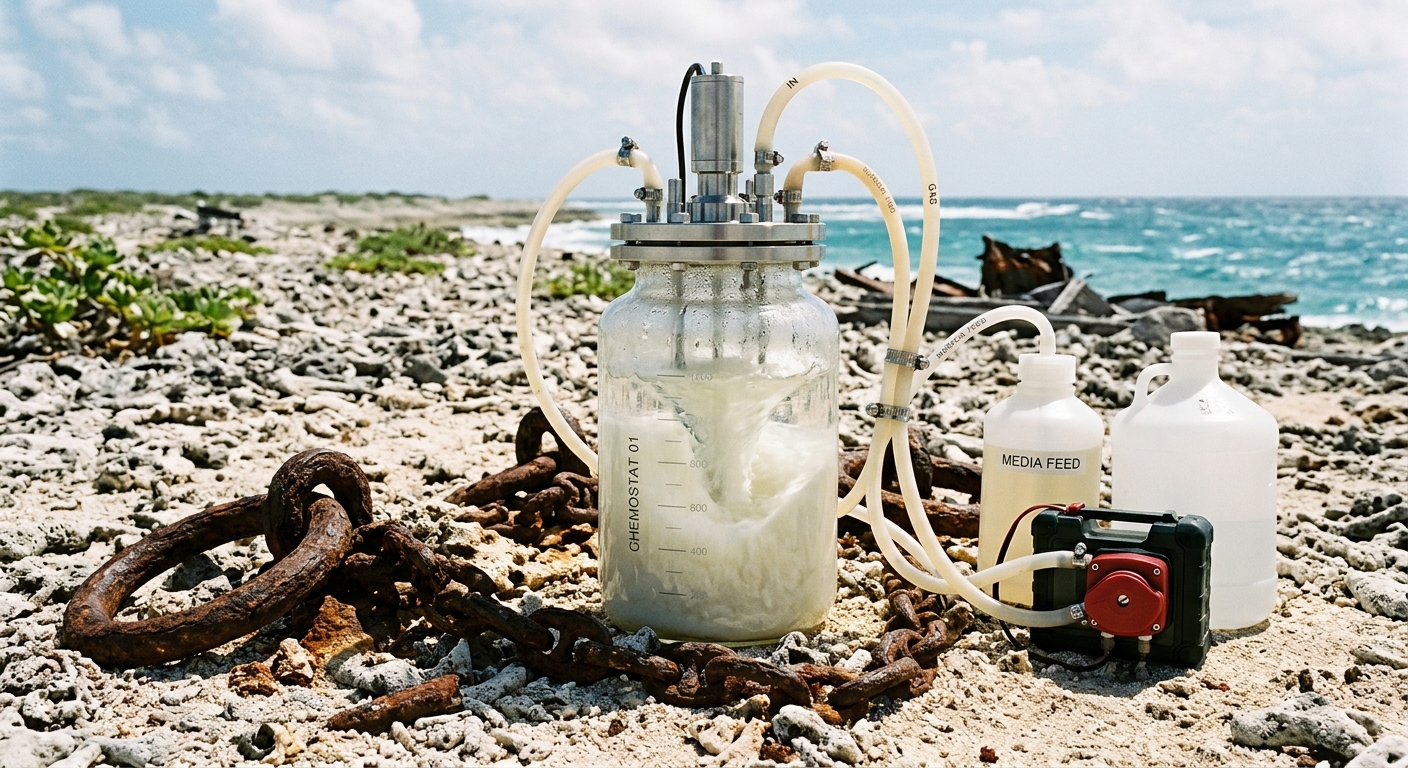
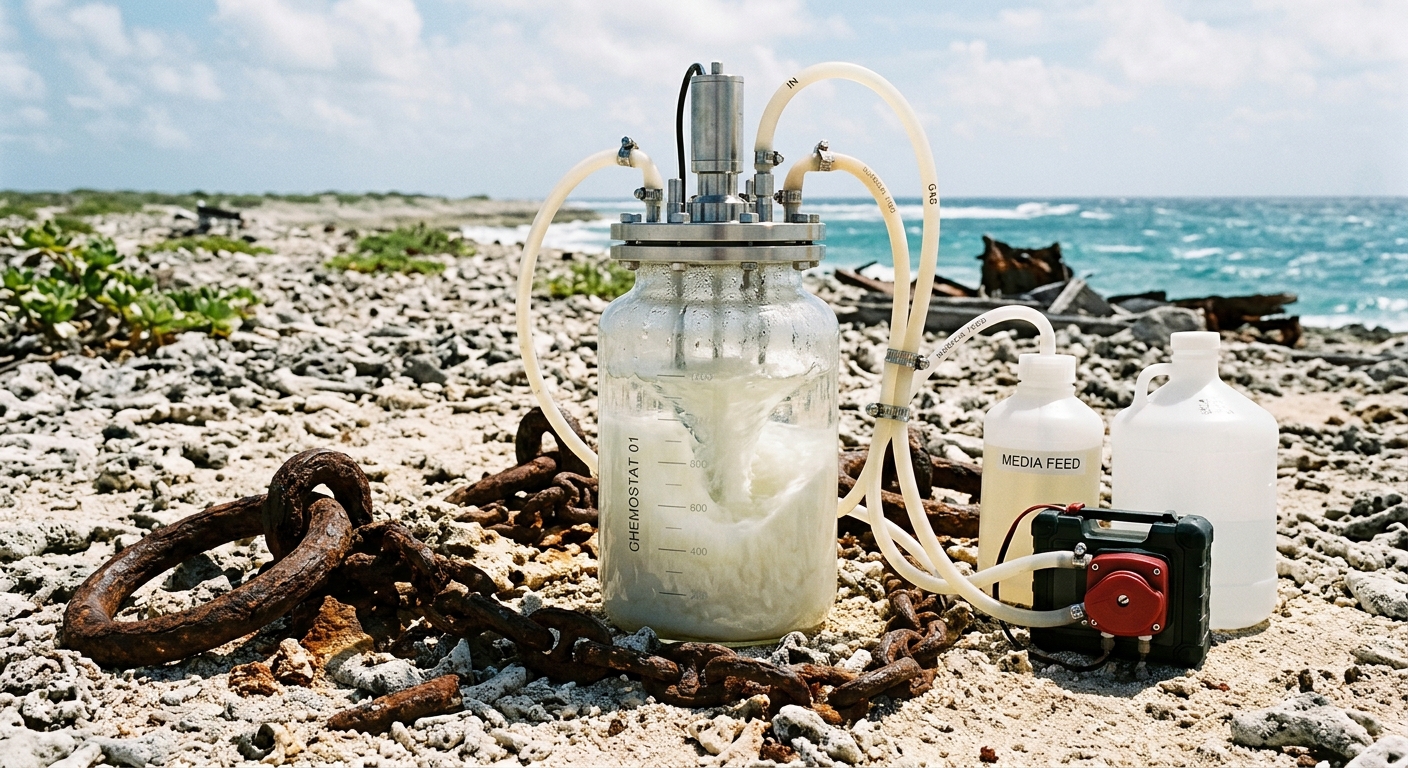
Positioned on the coral margins of Baker Island, this field chemostat frames territorial sovereignty as an extractive metabolic rate. Drawing on the 1856 Guano Islands Act—which conditioned territorial possession on the active presence of harvestable bird guano—the apparatus runs a continuous bacterial culture that solubilizes tricalcium phosphate. An inline optical sensor monitors orthophosphate concentrations in the pumped effluent, relaying yield data to an automated contract. Once mineral depletion drops output below subsistence thresholds, legal title expires automatically. The installation collapses geopolitical jurisdiction into sheer biochemical turnover.
shown: Installed autonomously on the actual beach of Baker Island National Wildlife Refuge, monitored via satellite uplink until the microbial ecosystem starves and self-terminates.
shown: Installed autonomously on the actual beach of Baker Island National Wildlife Refuge, monitored via satellite uplink until the microbial ecosystem starves and self-terminates.
anchor facts used
- The Guano Islands Act of August 18, 1856 (48 U.S.C. ch. 8) allowed US citizens to take possession of unclaimed islands for guano extraction.
- The American Guano Company extracted over 30,000 tons of phosphate-rich guano from Baker Island between 1859 and 1878.
- The US abandoned its active presence on Baker Island in 1891 once the ecological deposits were exhausted, effectively rendering the legal claim moot.
mechanism
- Chemostat continuous culture — A 50-liter bioreactor inoculated with Baker Island topsoil microbes is fed a continuous synthetic diet mimicking seabird excreta at the exact 1859 deposition rate.
1. Inoculation and Cultivation - Phosphate solubilization — The bacterial culture secretes organic acids, converting insoluble tricalcium phosphate into bioavailable orthophosphate, which is continuously drawn off by a peristaltic pump.
2. Mineral Solubilization - Spectrophotometric assay — An inline optical sensor measures the orthophosphate concentration in the effluent, transmitting the parts-per-million data to a blockchain smart contract.
3. Yield Quantification - Smart contract self-destruction (TTL) — If the phosphate yield drops below 0.05 mg/L, the smart contract automatically emancipates the soil trust, cryptographically voiding the associated property claim.
4. Sovereign Expiration
lineage
- Oron Catts and Ionat Zurr, 'Tissue Culture & Art Project' — Extends their semi-living sculptural ethics by tying cellular metabolism directly to federal land tenure laws.
- Paul Vanouse, 'Labor' — Builds on his microbial scent-production by treating bacterial metabolism as a literal instrument of economic extraction and territory.
- Terra0, 'terra0' — Adapts their self-owning forest architecture to an exhaustible, finite biogeochemical resource bound by 19th-century legal codes.
curatorial qa (machine verdict, unedited)
SCORE 3/5 after 2 attempt(s)
READS: The benchtop chemostat, media lines, and pump situated on an isolated shoreline clearly signal a situated biochemical extraction.
FAILS: The transition from turbidity to exhaustion and the algorithmic sovereignty revocation do not visually register in the static apparatus.
READS: The benchtop chemostat, media lines, and pump situated on an isolated shoreline clearly signal a situated biochemical extraction.
FAILS: The transition from turbidity to exhaustion and the algorithmic sovereignty revocation do not visually register in the static apparatus.
spec: antigravity agent · keyframe/artifact: gemini-3.1-flash-image · video: veo-3.1 image-to-video · qa+wall text: gemini-3.7-flash watching the render · 41.9s total