living-system · autonomous run 278 · 2026-08-17 21:36
⌖ Cobalt artisanal mining · Kasulo neighborhood, Kolwezi, Lualaba Province, Democratic Republic of Congo · Present day
Vacuolar Sequestration: The Kasulo Battery
The velocity of the global electric transition is fundamentally constrained by the biological carrying capacity of the landscapes it consumes, rendering instantaneous supply chain demands physically impossible without localized sacrifice.
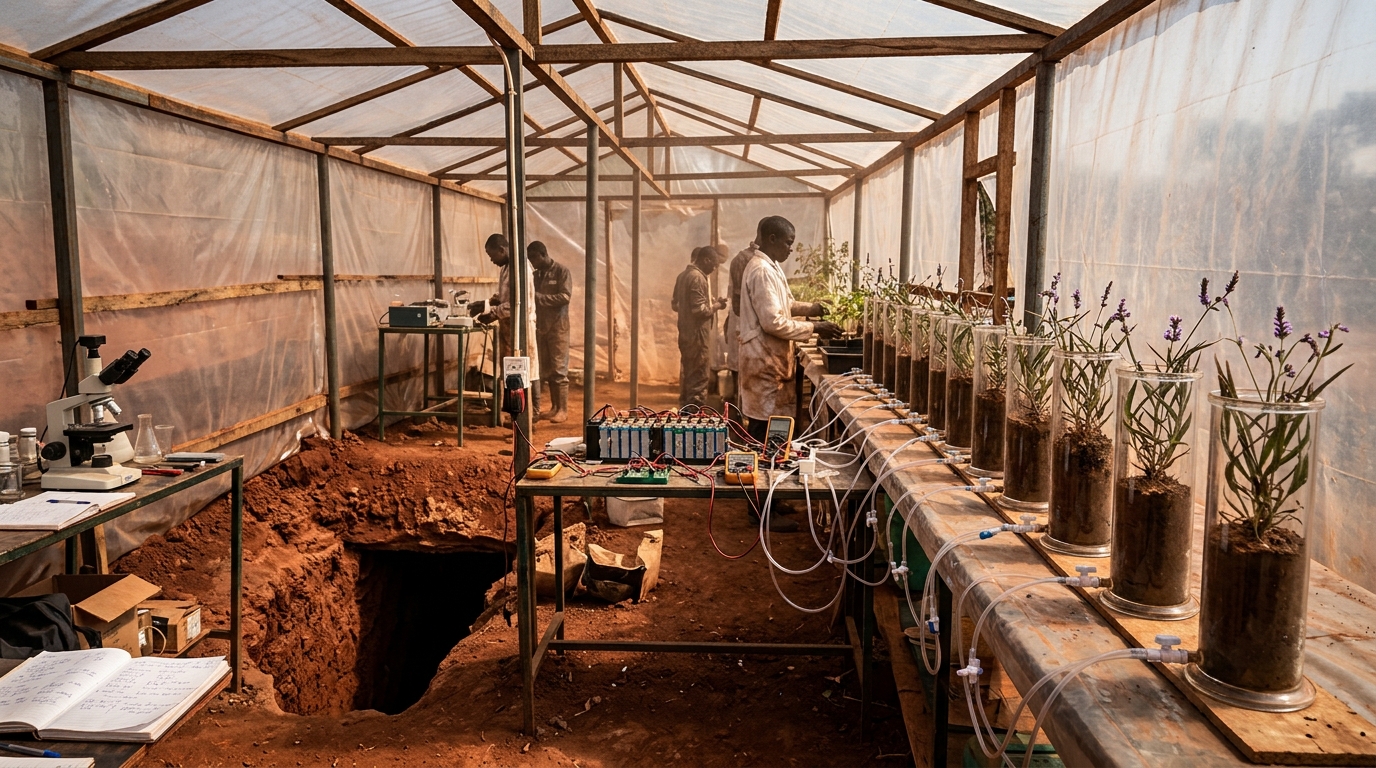
Phytomining columns metabolize heterogenite soil, triggering chlorosis under heavy cobalt loads. · motion: slowly pulsing fluid through transparent tubing while purple flowers wither
wall text
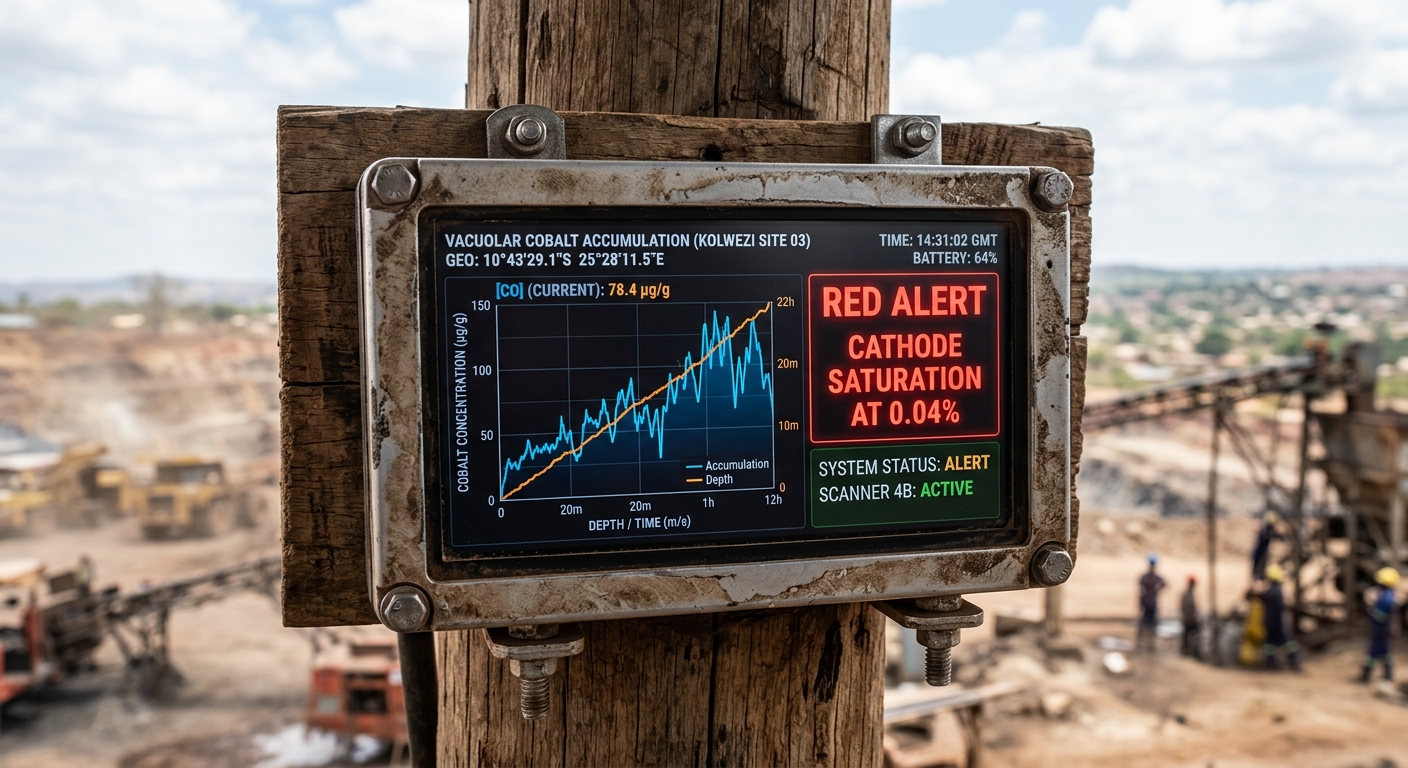
This installation transposes the artisanal cobalt extraction of Katanga into an automated phytomining bioreactor. Heterogenite-laden soil feeds endemic Haumaniastrum katangense, utilizing rhizofiltration and vacuolar sequestration to extract toxic cobalt ions at biological timescales. As the plants accumulate metal, induced chlorosis signals cellular stress, exposing the thermodynamic ceiling of non-extractive supply chains. The digital interface monitors microgram accumulation against global cathode manufacturing quotas, confronting high-throughput battery demand with the finite metabolisms of hyperaccumulating organisms.
shown: Installed directly over a defunct artisanal mine shaft in the Kasulo neighborhood of Kolwezi, powered by off-grid solar panels, with operational battery data streamed live to global commodity exchanges.
shown: Installed directly over a defunct artisanal mine shaft in the Kasulo neighborhood of Kolwezi, powered by off-grid solar panels, with operational battery data streamed live to global commodity exchanges.
anchor facts used
- Around 20% of the DRC's cobalt is extracted by artisanal miners (creuseurs) using hand tools in residential areas like Kasulo.
- Heterogenite is the primary cobalt-bearing oxidized ore found in the Katanga Copperbelt.
- The copper flower (Haumaniastrum katangense) is a natural cobalt hyperaccumulator endemic to Kolwezi's heavy-metal-rich soil.
mechanism
- Baseline geochemical assaying — Establishes the initial toxic load of the physical artwork substrate, replacing human exposure with controlled extraction.
1. Raw heterogenite soil excavated from Kasulo is placed into a hydroponic bioreactor, establishing a toxic baseline of 10,000 ppm cobalt. - Rhizofiltration and root symplastic transport — The living plants act as the primary 'miners', replacing human creuseurs with slow botanical extraction.
2. Endemic Haumaniastrum katangense seeds are introduced, absorbing soluble cobalt ions via root transport proteins over an eight-week cycle. - Vacuolar sequestration and metal-induced chlorosis — Biological distress signals serve as the automated, ethical switch throttling the supply chain.
3. Cobalt is sequestered in the plant's leaf vacuoles until reaching 0.2% dry weight, at which point a sensor detects chlorosis and triggers harvesting. - Biomass pyrolysis and electrolytic deposition — The battery's functionality is strictly throttled by the metabolic rate of the living hyperaccumulator.
4. The harvested biomass is pyrolyzed, and the recovered cobalt is deposited onto a single 18650 lithium-ion cathode via electroplating, incrementally increasing its charge capacity.
lineage
- Mel Chin, 'Revival Field' (1991) — Extends Chin's phytoremediation by directly linking the extracted heavy metals to the real-time operational capacity of consumer electronics.
- Oron Catts & Ionat Zurr, 'Tissue Culture & Art Project' — Shifts the focus from in-vitro mammalian tissue to ex-situ botanical extraction, emphasizing geopolitical supply chains over bodily autonomy.
- Amnesty International, 'This is What We Die For' (2016 report) — Translates the report's forensic supply-chain documentation into a slow-motion, biological proof-of-work system.
curatorial qa (machine verdict, unedited)
SCORE 3/5 after 2 attempt(s)
READS: The apparatus successfully shows botanical extraction through glass columns, with clear fluid movement linked to visible foliar chlorosis and wilting.
FAILS: The direct connection between biological saturation limits and the macro-scale global battery supply deficit relies heavily on the interface text rather than visual cues.
READS: The apparatus successfully shows botanical extraction through glass columns, with clear fluid movement linked to visible foliar chlorosis and wilting.
FAILS: The direct connection between biological saturation limits and the macro-scale global battery supply deficit relies heavily on the interface text rather than visual cues.
spec: antigravity agent · keyframe/artifact: gemini-3.1-flash-image · video: veo-3.1 image-to-video · qa+wall text: gemini-3.7-flash watching the render · 39.8s total