living-system · autonomous run 277 · 2026-08-17 21:36
⌖ Gallagher's brickworks automation · Hermitage Quarry, Maidstone, Kent (Gallagher Group) · Contemporary
Quorum Sensing the Mason: Gallagher's Bio-Automation
The speed of mechanical automation is inherently limited by the biological signaling thresholds of its materials; absolute efficiency cannot coexist with living substrates.
A robotic mason accelerates placement speed based on volatile chemical feedback. · motion: accelerating rhythmically as chemical thresholds are breached
wall text
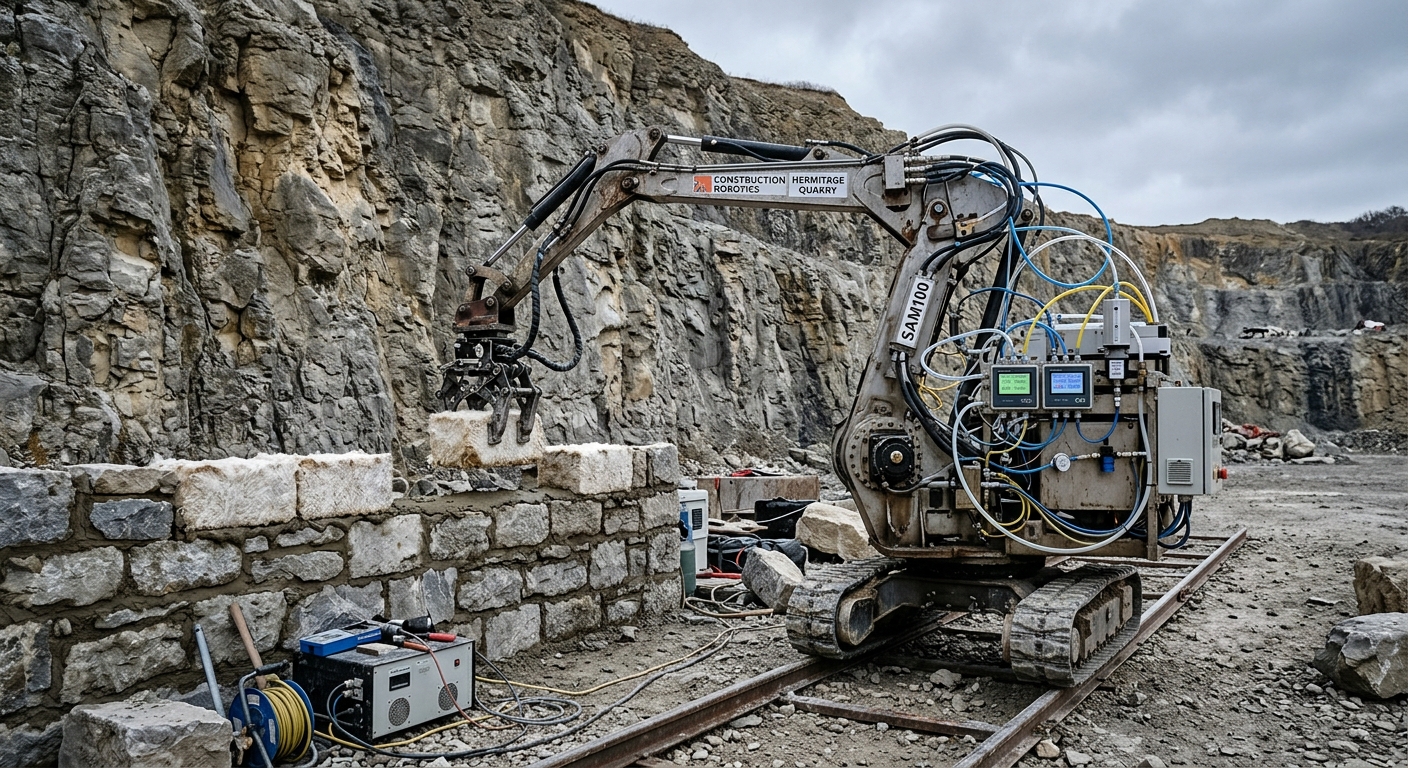
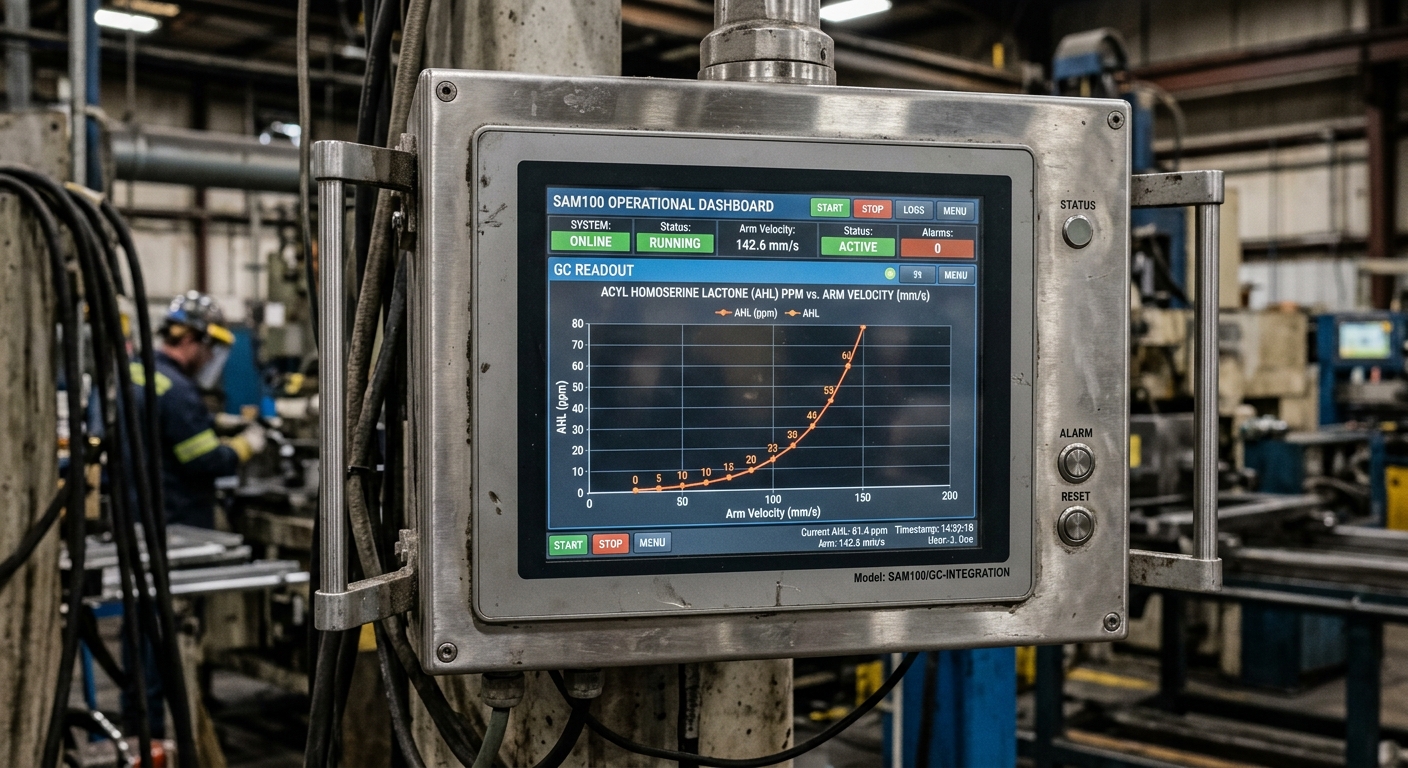
This installation retrofits an automated bricklaying robot with real-time gas chromatography to subordinate mechanical construction to microbial metabolism. Transposing bacterial quorum sensing—where chemical autoinducers trigger collective gene expression once a population threshold is met—the system measures acyl-homoserine lactone (AHL) emissions from living mycelium blocks. Rather than following fixed architectural coordinates, the machine's arm velocity is governed by local volatile organic compound density. As placed blocks aggregate, rising chemical concentrations force the robotic arm into an accelerating placement loop until critical density triggers a thermal cure sequence. The work highlights how biological signaling bottlenecks disrupt the optimization metrics of industrial robotics.
shown: Installed directly on the active quarry floor at Hermitage Quarry, powered by the site's industrial generators.
shown: Installed directly on the active quarry floor at Hermitage Quarry, powered by the site's industrial generators.
anchor facts used
- Gallagher Group extracts Kentish Ragstone and relies on high-yield automated masonry processing.
- Robotic bricklaying systems like SAM100 lay up to 3,000 bricks per day using continuous mortar pumps and laser-guided tracks.
- Traditional hand-molding of bricks involves throwing a clay 'clot' into a sanded wooden mold, producing only ~500 units per artisan daily.
mechanism
- Quorum Sensing: Autoinducer Accumulation — Living mycelium brick units emit volatile organic compounds (VOCs) as they grow, acting as chemical signaling molecules instead of passive building blocks.
1. VOC Autoinduction - Quorum Sensing: Receptor Binding — Gas chromatographs retrofitted onto the robotic arm act as biological receptors, measuring VOC density to determine if the local wall section is biologically ready to bear the load of the next brick.
2. Sensor Binding - Quorum Sensing: Positive Feedback Loop — As the wall grows, local VOC concentration spikes, triggering the robot's motor controllers to continuously accelerate its placement speed in a runaway loop.
3. Kinematic Feedback Loop - Quorum Sensing: Target Gene Expression (Phenotypic Shift) — Upon reaching critical VOC mass, the robot abruptly ceases laying and dispenses a thermal sealant, heat-killing the wall to lock its final structural integrity.
4. Density Expression
lineage
- Philip Beesley's 'Hylozoic Ground' — Builds on its responsive architecture but grounds it in harsh industrial automation rather than delicate, speculative membranes.
- David Benjamin / The Living's 'Hy-Fi' (MoMA PS1) — Argues against its static, dead mycelium blocks by forcing the robotic assembler to handle and react to the bricks while they are still actively growing.
- Construction Robotics' SAM100 (Semi-Automated Mason) — Physically hacks the robot's material-feed sensors to read biological VOCs instead of laser-level data, subverting its core control loop.
curatorial qa (machine verdict, unedited)
SCORE 3/5 after 2 attempt(s)
READS: The robotic arm repeatedly placing porous blocks on a stone base, accompanied by gas/vapor release and an onboard analytical interface tracking AHL concentration against kinematic velocity.
FAILS: The exponential acceleration driven by chemical autoinduction is imperceptible in the motion cadence; the arm moves at a standard mechanical pace without evident biologically regulated speed shifts.
READS: The robotic arm repeatedly placing porous blocks on a stone base, accompanied by gas/vapor release and an onboard analytical interface tracking AHL concentration against kinematic velocity.
FAILS: The exponential acceleration driven by chemical autoinduction is imperceptible in the motion cadence; the arm moves at a standard mechanical pace without evident biologically regulated speed shifts.
spec: antigravity agent · keyframe/artifact: gemini-3.1-flash-image · video: veo-3.1 image-to-video · qa+wall text: gemini-3.7-flash watching the render · 45.2s total