living-system · autonomous run 272 · 2026-08-17 21:36
⌖ Białowieża primeval forest · Poland-Belarus border, Podlaskie Voivodeship and Brest Region · 2022–ongoing
Chemostat 186: Allopatric Drift
Geopolitical border-hardening enforces biological speciation, converting a contiguous primeval biome into divergent metabolic economies.
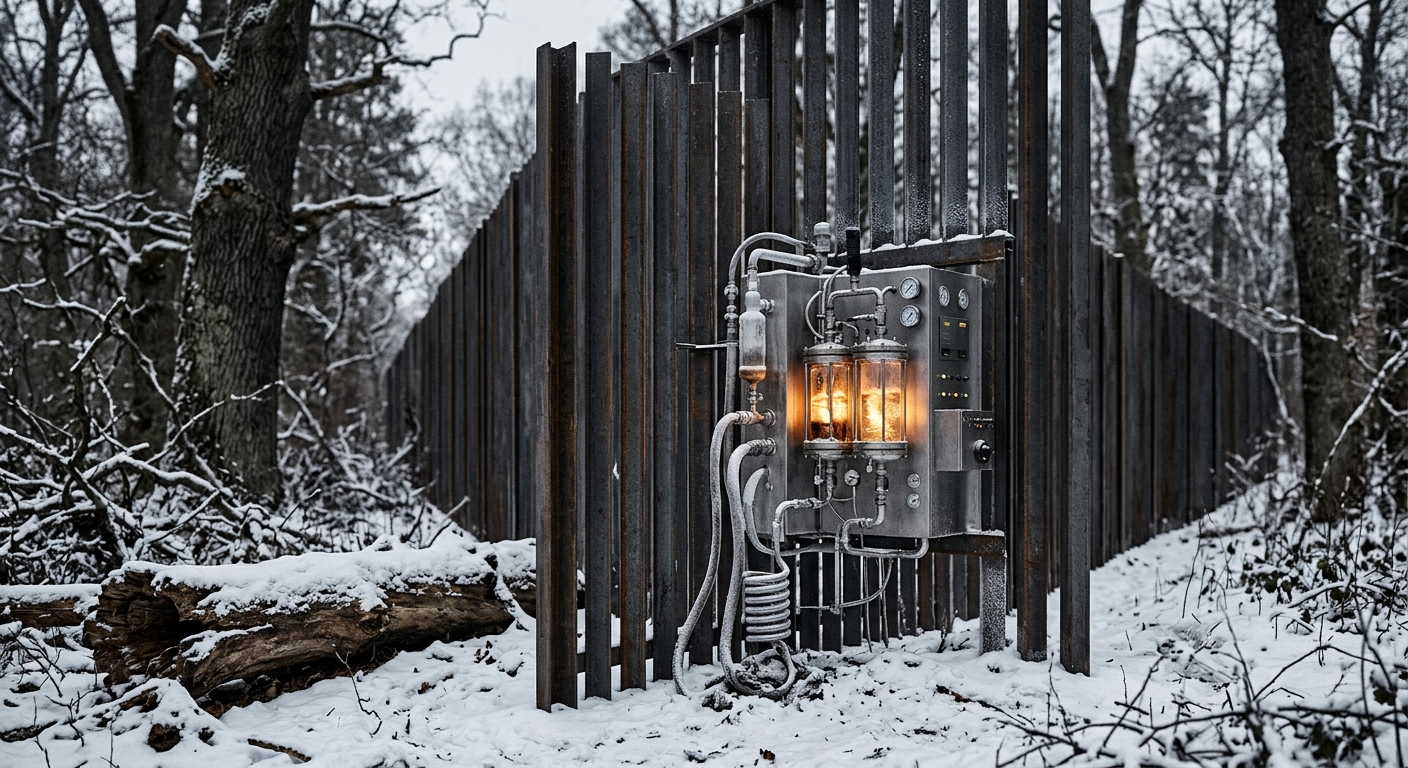
Twin chemostats metabolizing divided Białowieża soil microbiomes along the Poland-Belarus border wall. · motion: bubbling and diverging in permanently isolated parallel loops
wall text
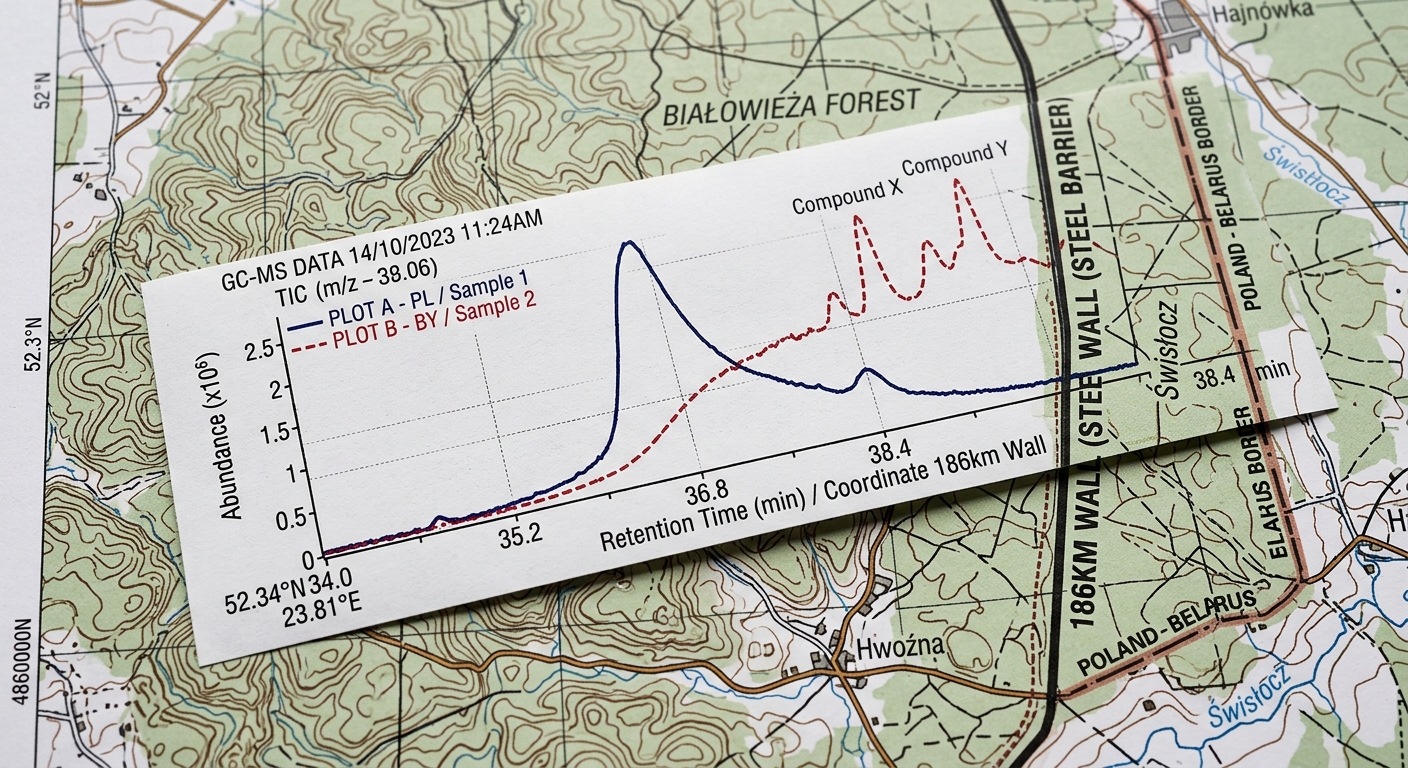
Mounted directly into the steel border wall bisecting Białowieża Forest, this twin chemostat apparatus cultivates soil microbiomes harvested meters apart on either side of the Poland-Belarus boundary. Transposing allopatric speciation and continuous microbial culture, the bioreactors continuously digest identical oak biomass media under absolute physical isolation. An integrated gas chromatography-mass spectrometry loop tracks volatile metabolic exhaust, logging the biochemical divergence of bacterial lineages severed by border infrastructure. The installation treats geopolitical fortification not as a passive boundary, but as an active evolutionary vector fracturing a once-contiguous primeval biome into distinct metabolic trajectories.
shown: Installed directly onto the steel border wall at coordinate 52.7214° N, 23.8436° E, powered by off-grid solar panels, with metabolic divergence data transmitted via radio to the nearby Białowieża Geobotanical Station.
shown: Installed directly onto the steel border wall at coordinate 52.7214° N, 23.8436° E, powered by off-grid solar panels, with metabolic divergence data transmitted via radio to the nearby Białowieża Geobotanical Station.
anchor facts used
- In 2022, Poland constructed a 186-kilometer, 5.5-meter-high steel wall through the forest to block migrant crossings.
- The barrier physically isolates populations of European bison (Bison bonasus) and Eurasian lynx, disrupting centuries of contiguous gene flow.
- Białowieża contains up to 25 percent dead wood biomass, hosting endemic saproxylic fungi and soil microbiomes now separated by the wall's foundations.
mechanism
- Randomized stratified soil sampling — Soil microbiomes are harvested exactly 1 meter from the Polish and Belarusian sides of the wall at coordinate 52.7214° N, 23.8436° E.
1. Extraction and isolation of baseline biological material. - Continuous culture chemostat — The paired soil microbiomes are housed in twin glass bioreactors, fed an identical synthetic medium mimicking Białowieża decaying oak biomass.
2. Acceleration of biological generations under controlled parameters. - Allopatric speciation — The fluidic loop between the twin chemostats is permanently blocked by a 5.5mm steel septum, mirroring the macro-scale barrier.
3. Enforcement of genetic drift through absolute physical separation. - Gas Chromatography-Mass Spectrometry (GC-MS) — Exhaust gases of the bacterial cultures are analyzed hourly, plotting the growing biochemical distance between Polish and Belarusian soil over thousands of accelerated generations.
4. Real-time quantification of biochemical divergence.
lineage
- Terra 0 (Paul Seidler, Paul Kolling, Max Hampshire) — Pushes their concept of a self-owning augmented forest into the realm of enforced microbial divergence.
- The Long-Term Evolution Experiment (LTEE) by Richard Lenski — Appropriates its continuous-culture tracking of E. coli to map the geopolitical speciation of a border-divided biome.
- SymbioticA's 'Tissue Culture & Art Project' (Oron Catts and Ionat Zurr) — Replaces the semi-living sculptural form with a purely metabolic demonstration of real-world ecological severance.
curatorial qa (machine verdict, unedited)
SCORE 4/5 after 2 attempt(s)
READS: The twin chemostats mounted directly on the border wall, bubbling divergent cultures, and chromatography readouts overlaid on the forest map.
FAILS: The internal fluidic isolation septum and analytical exhaust line lack clear visual signposting on the chassis.
READS: The twin chemostats mounted directly on the border wall, bubbling divergent cultures, and chromatography readouts overlaid on the forest map.
FAILS: The internal fluidic isolation septum and analytical exhaust line lack clear visual signposting on the chassis.
spec: antigravity agent · keyframe/artifact: gemini-3.1-flash-image · video: veo-3.1 image-to-video · qa+wall text: gemini-3.7-flash watching the render · 41.0s total