living-system · autonomous run 271 · 2026-08-17 21:36
⌖ Yew trees of ancient Britain · St Cynog's Churchyard, Defynnog, Powys, Wales · c. 3000 BCE to Present
Sinking Fund (Taxus Baccata)
Biological immortality functions as a literal sinking fund, where an organism continuously liquidates its own decaying historical core to finance the endless vegetative propagation of its margins.
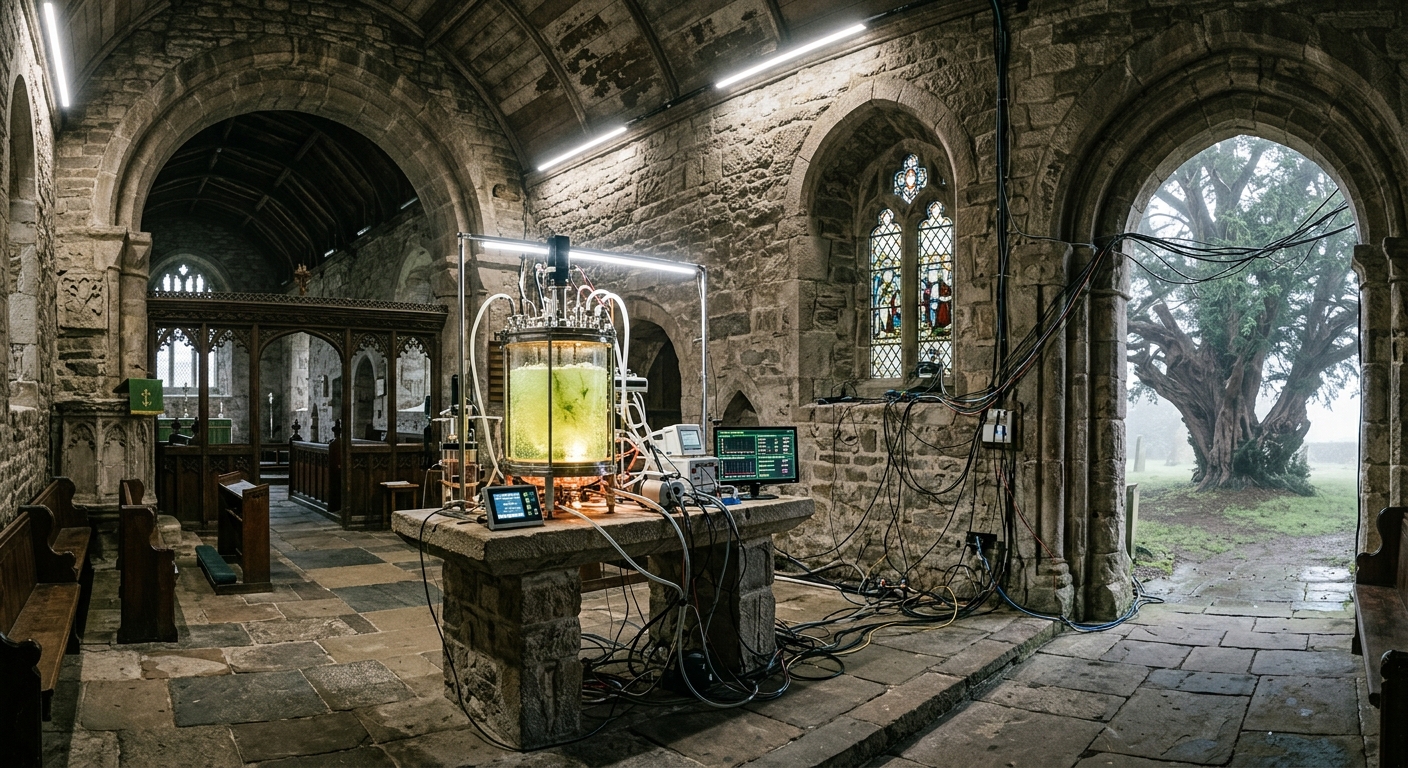
Bioreactor culturing ancient yew cambium balanced against trunk decay metrics. · motion: undulating and expanding at a microscopic scale while the surrounding stone remains rigidly static
wall text
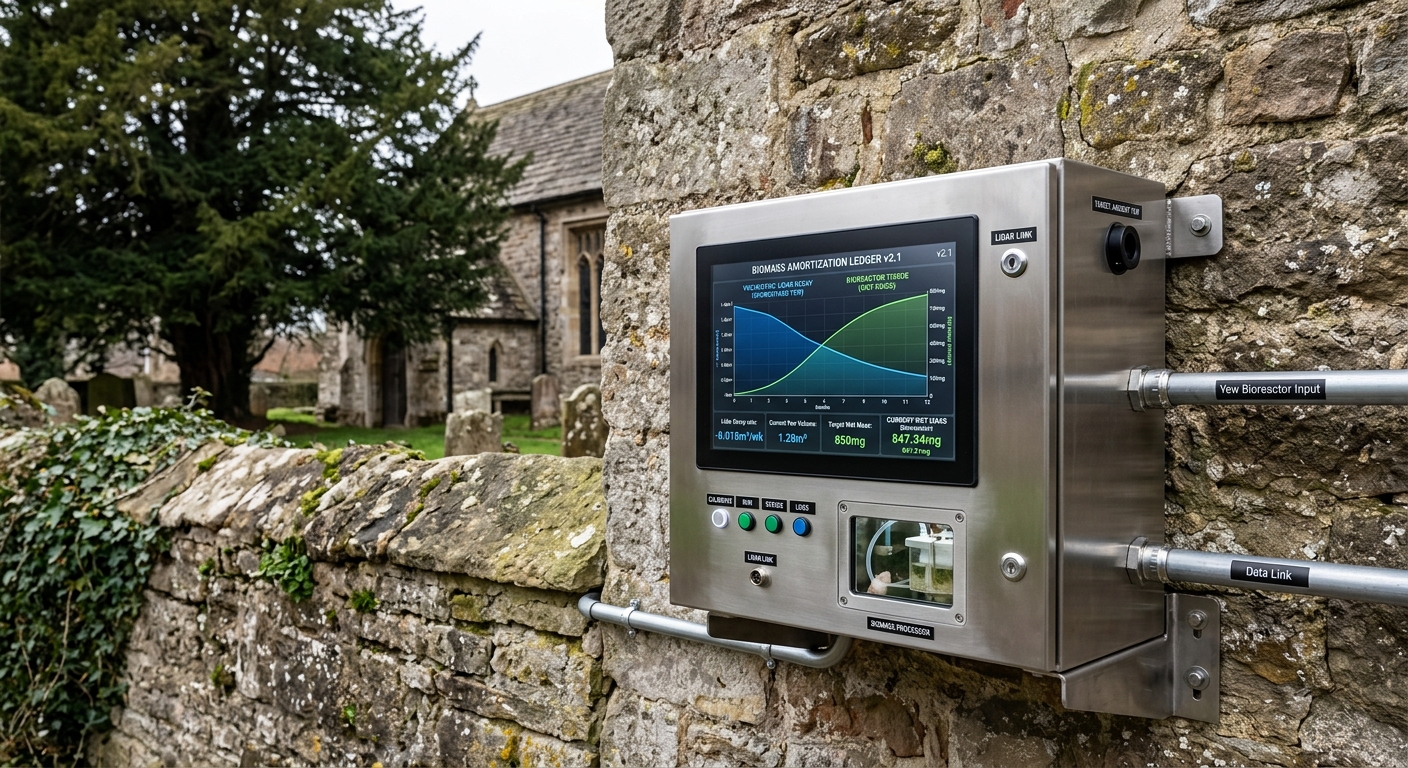
Ancient yew trees achieve continuous survival by hollowing out from the center, consuming their own decaying heartwood to sustain external cambial growth. This installation transposes that botanical strategy into financial accounting. Micro-LiDAR scans measure the daily loss of heartwood volume within the Defynnog Yew's hollow trunk. This calculated loss is converted by an outdoor ledger into a nutrient delivery quota, driving a bioreactor positioned in the nave. Inside, somatic plant tissue cultures multiply at the exact mathematical rate of the exterior tree's decay, turning straight-line depreciation into living biomass.
shown: Installed permanently within the nave of St Cynog's Church, Defynnog, physically tethered via fiber-optic data cables to the 5,000-year-old yew tree in the surrounding graveyard.
shown: Installed permanently within the nave of St Cynog's Church, Defynnog, physically tethered via fiber-optic data cables to the 5,000-year-old yew tree in the surrounding graveyard.
anchor facts used
- The Defynnog Yew is genetically confirmed as a single organism estimated to be 5,000 years old, actively outliving the adjacent 12th-century Norman church.
- European Yews (Taxus baccata) survive massive heartwood decay by growing aerial roots down their own hollowed-out centers, bypassing standard biological senescence.
- The biomass of Taxus baccata naturally produces 10-deacetylbaccatin III (10-DAB), an isolatable precursor compound sold globally to synthesize the chemotherapy drug paclitaxel.
mechanism
- Lidar volumetric scanning and straight-line depreciation modeling — Automated micro-Lidar sensors mounted inside the hollow trunk of the Defynnog Yew take daily volumetric scans to calculate the precise mass of ancient heartwood lost to fungal decay over a 24-hour period.
1. Asset Depreciation Tracking - Sinking fund accounting (setting aside assets to replace a wasting asset) — The calculated daily loss of wood volume is algorithmically converted into a biological production quota, triggering nutrient pumps in a sterile bioreactor located inside the church nave to replace the exact depreciated mass.
2. Sinking Fund Provision - Somatic embryogenesis and plant tissue culture — Cambium cells originally extracted from the Defynnog Yew are cultivated into undifferentiated pale-green callus tissue within the bioreactor, physically materializing the mathematical sinking fund as living, growing biomass.
3. Biomass Amortization - Chemical extraction and commodity wholesale — Excess callus tissue that exceeds the daily replacement quota is harvested, processed to extract the 10-DAB compound, and automatically sold on specialized pharmaceutical exchanges to purchase the bioreactor's electricity and nutrient agar.
4. Dividend Liquidation
lineage
- Oron Catts and Ionat Zurr, 'Tissue Culture & Art Project' — Builds on their semi-living sculptures by introducing strict financial solvency and corporate accounting protocols to the maintenance of the biomass.
- Rachel Sussman, 'The Oldest Living Things in the World' — Operationalizes her static documentary photography into an active, self-sustaining biological derivative.
- Eduardo Kac, 'Natural History of the Enigma (Edunia)' — Rejects transgenic human-plant hybridization in favor of pure, financially autonomous clonal propagation of a historically loaded species.
curatorial qa (machine verdict, unedited)
SCORE 4/5 after 1 attempt(s)
READS: The physical tether between the ancient churchyard yew and the altar-mounted bioreactor clearly articulates tissue culturing driven by telemetry. The outdoor ledger interface establishes the direct accounting relationship between volumetric decay and cell growth.
FAILS: The micro-scale undulation of somatic callus inside the bioreactor reads more like luminous fluid mixing than structural vegetative propagation financed by decaying heartwood.
READS: The physical tether between the ancient churchyard yew and the altar-mounted bioreactor clearly articulates tissue culturing driven by telemetry. The outdoor ledger interface establishes the direct accounting relationship between volumetric decay and cell growth.
FAILS: The micro-scale undulation of somatic callus inside the bioreactor reads more like luminous fluid mixing than structural vegetative propagation financed by decaying heartwood.
spec: antigravity agent · keyframe/artifact: gemini-3.1-flash-image · video: veo-3.1 image-to-video · qa+wall text: gemini-3.7-flash watching the render · 35.5s total