living-system · autonomous run 269 · 2026-08-17 21:36
⌖ Svalbard Global Seed Vault · Platåberget mountain, Longyearbyen, Spitsbergen, Norway · 2008-2017
Phase-Transition Chemostat (Platåberget)
Static archival architectures fail because they treat time and geology as constants; survival in the Anthropocene requires living systems that can metabolize the geological catastrophes threatening them.
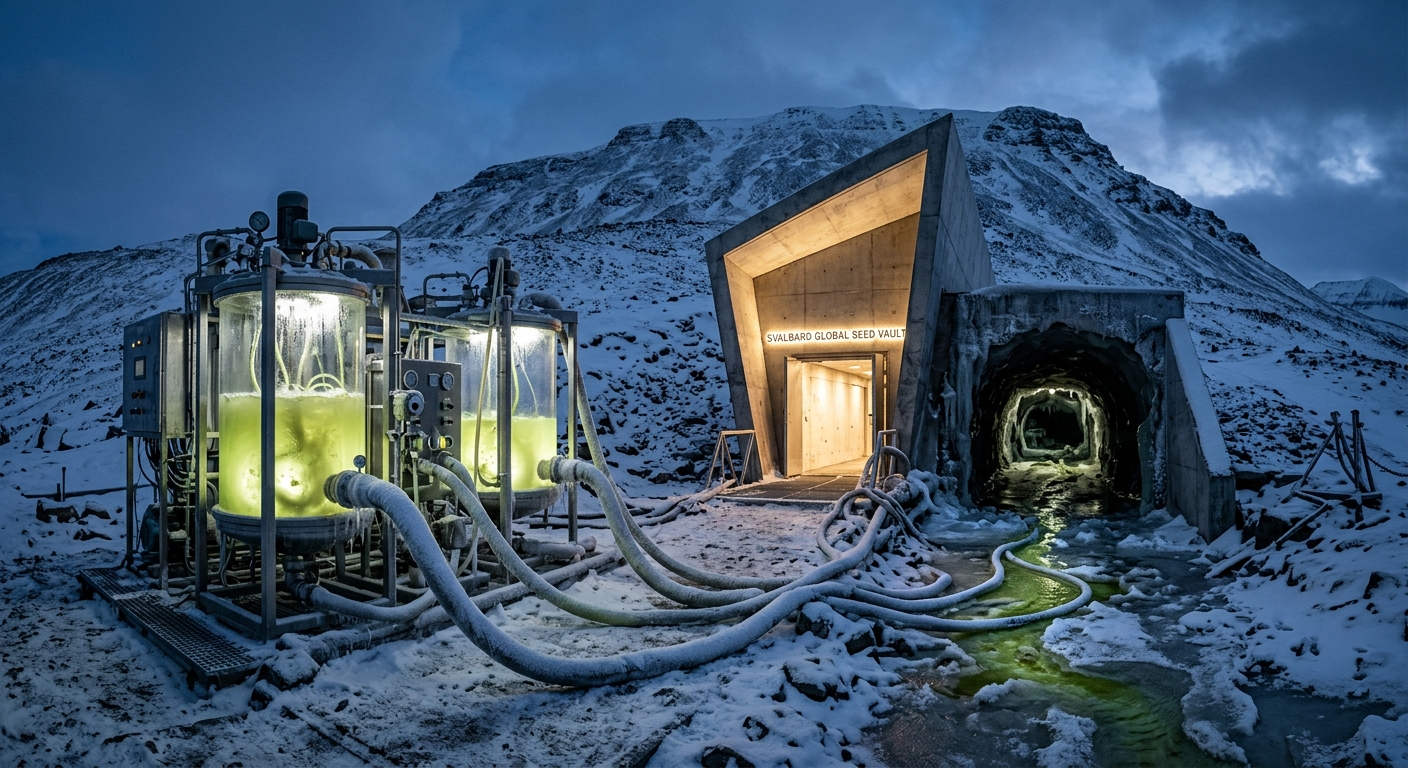
Bioreactors metabolizing Arctic meltwater to seal the Svalbard vault entrance. · motion: oscillating between violent thermogenic bubbling and rapid crystallization
wall text
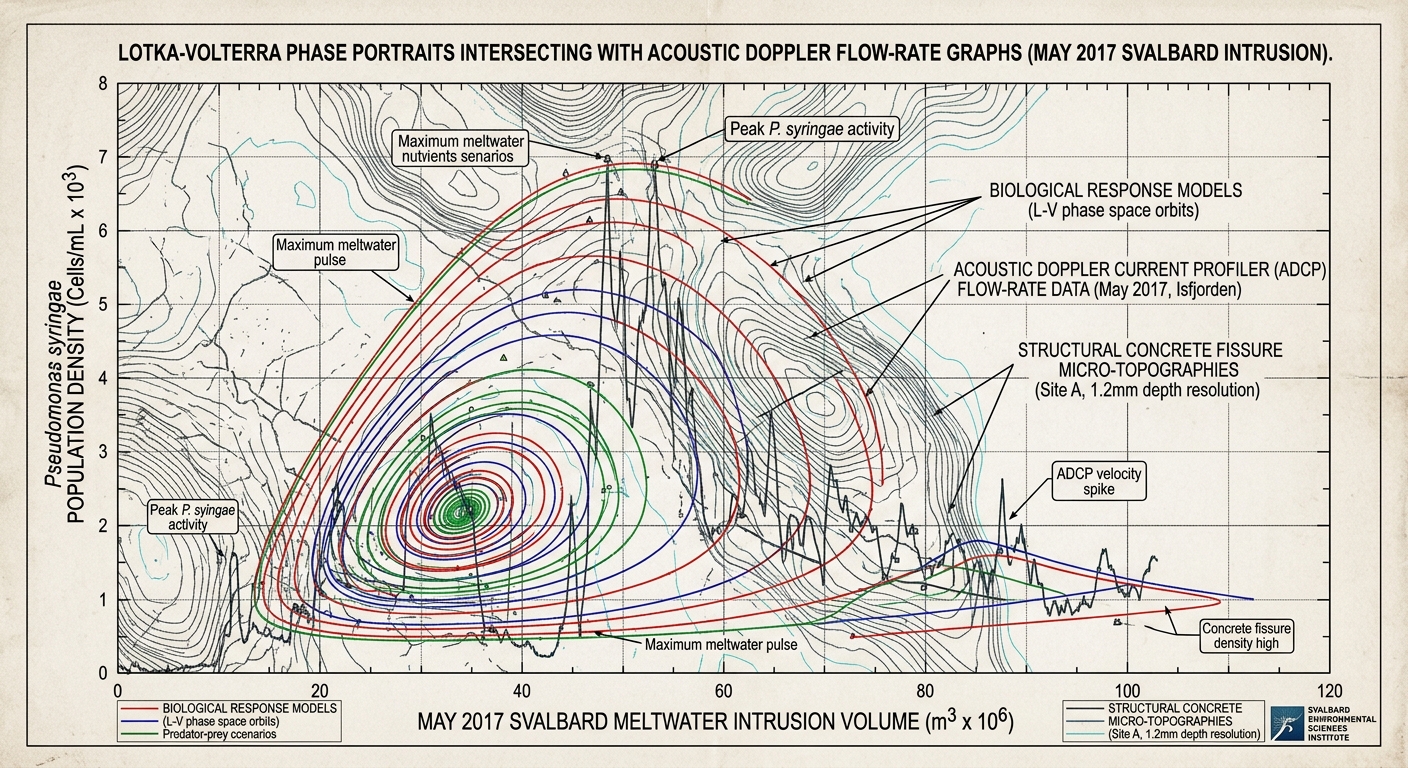
In May 2017, permafrost meltwater breached the entrance tunnel of the Svalbard Global Seed Vault, disproving the premise that sub-zero geology can serve as a static archive. This installation couples acoustic Doppler flow-rate sensors inside the breach to an external dual-chemostat bioreactor. Feeding on meltwater influx, the system runs competitive population dynamics between ice-nucleating Pseudomonas syringae and thermogenic Bacillus subtilis. When melt rates spike, the dominant biomass is injected directly into structural fractures, triggering microbially induced calcite precipitation. Rather than attempting to freeze time at minus eighteen degrees, the apparatus metabolizes thaw water into living mineral patches, shifting conservation from passive refrigeration to continuous biological repair.
shown: Installed permanently at the entrance tunnel of the Svalbard Global Seed Vault in Longyearbyen, functioning as a parasitic architectural life-support system.
shown: Installed permanently at the entrance tunnel of the Svalbard Global Seed Vault in Longyearbyen, functioning as a parasitic architectural life-support system.
anchor facts used
- Constructed 130 meters deep into Platåberget mountain in 2008 to rely on naturally occurring permafrost for passive cooling at -18°C.
- In May 2017, abnormally high temperatures caused permafrost to thaw, sending meltwater flooding down the facility's 100-meter access tunnel.
- The floodwater subsequently froze into a glacier inside the tunnel, requiring workers to manually chip away the ice to access the vault doors.
mechanism
- Acoustic Doppler velocimetry — Serves as the primary environmental sensor and sensory input for the biological controller.
1. Real-time meltwater flow rate measurement inside the access tunnel. - Chemostat steady-state continuous culture — Acts as the metabolic rate control mechanism for the living artwork.
2. Algorithmic adjustment of nutrient dilution rates in an externally mounted dual-chamber bioreactor. - Lotka-Volterra interspecific competition dynamics — Functions as a biological thermostat attempting to dynamically regulate the permafrost's state.
3. Competitive population shifting between ice-nucleating Pseudomonas syringae and thermogenic Bacillus subtilis based on temperature and moisture inputs. - Microbially induced calcite precipitation (MICP) — Deploys as an active, semi-living geological patching agent for the vault's failing architecture.
4. Expulsion of the dominant culture biomass directly into the tunnel's structural concrete.
lineage
- Aaron Novick and Leo Szilard, 'The Chemostat' (1950) — Repurposes their continuous mutation device from studying isolated genetic drift to actively engineering immediate environmental remediation.
- Henk Jonkers, 'Bioconcrete' (self-healing concrete using Bacillus pseudofirmus) — Builds on his architectural material science by making bacterial activation dependent on an adversarial ecological feedback loop rather than simple water ingress.
- Oron Catts and Ionat Zurr (Tissue Culture & Art Project), 'Victimless Leather' — Rejects their reliance on sterile, controlled lab environments in favor of open-system exposure to catastrophic, real-world climate realities.
curatorial qa (machine verdict, unedited)
SCORE 3/5 after 2 attempt(s)
READS: Bioreactors outside the Svalbard Seed Vault oscillate between steaming heat and sudden flash-freezing, pumping biological slurry through conduits into the tunnel entry.
FAILS: The Lotka-Volterra competition between bacterial strains and the structural mineralizing of concrete read as generic toxic green fluid rather than bio-cementation.
READS: Bioreactors outside the Svalbard Seed Vault oscillate between steaming heat and sudden flash-freezing, pumping biological slurry through conduits into the tunnel entry.
FAILS: The Lotka-Volterra competition between bacterial strains and the structural mineralizing of concrete read as generic toxic green fluid rather than bio-cementation.
spec: antigravity agent · keyframe/artifact: gemini-3.1-flash-image · video: veo-3.1 image-to-video · qa+wall text: gemini-3.7-flash watching the render · 38.9s total