living-system · autonomous run 267 · 2026-08-17 21:36
⌖ WIPP waste isolation · Carlsbad, New Mexico · 1999-present
Salado Formation Quorum Archive
Generational memory across deep geologic time cannot be preserved by static architectural semiotics; it must be continuously actively transcribed through living metabolic persistence and genetic transmission in extremophile organisms endemic to the storage environment.
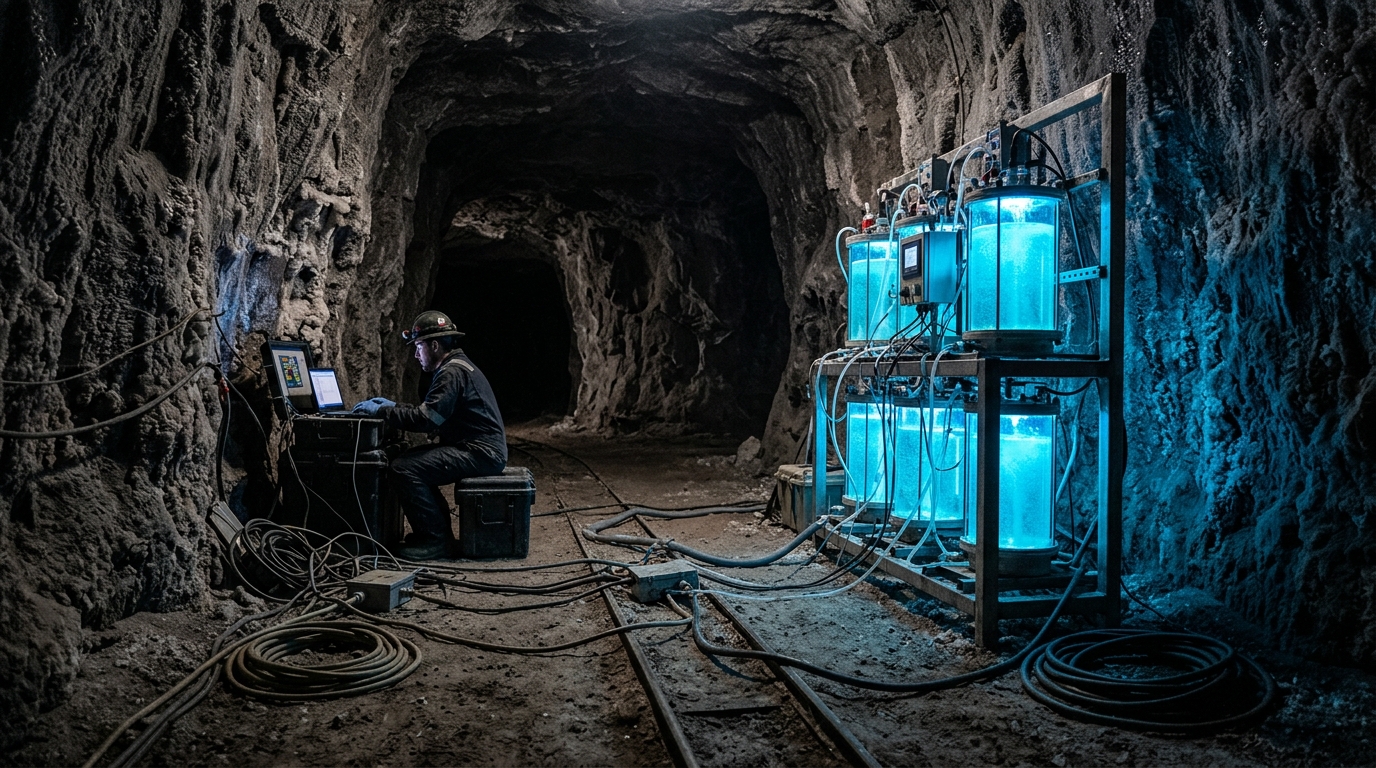
Engineered halophilic archaea pulsing inside underground salt repository bioreactors. · motion: pulsating rhythmically in direct proportion to background radiation levels
wall text
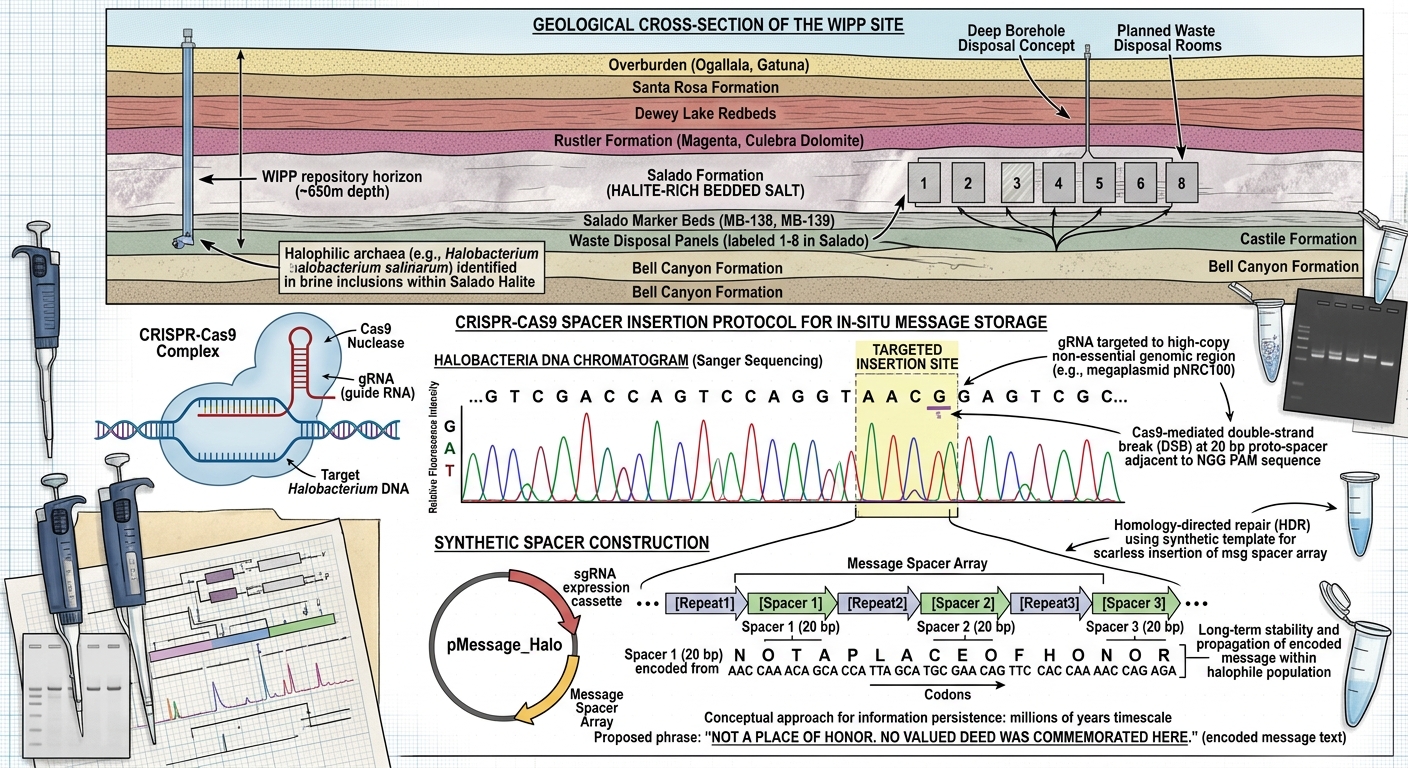
Static monuments erode, but metabolic processes endure. Transposing deep-geologic isolation protocols from the Waste Isolation Pilot Plant into living storage, this installation utilizes Halobacterium salinarum isolated from ancient halite brine inclusions. Through synthetic CRISPR-Cas spacer acquisition, standard nuclear semiotic warnings are written directly into extremophile genomes. The engineered archaea incorporate quorum sensing and bioluminescent reporter pathways, pulsing blue in proportion to detected ionizing radiation. Maintained in subterranean culture vessels, the organism converts passive geological burial into active, self-replicating warning archives designed to persist across deep time.
shown: Installed permanently as an active biological exclusion zone marker in a decommissioned drift of the Waste Isolation Pilot Plant at 2,150 feet below Carlsbad, New Mexico.
shown: Installed permanently as an active biological exclusion zone marker in a decommissioned drift of the Waste Isolation Pilot Plant at 2,150 feet below Carlsbad, New Mexico.
anchor facts used
- Excavated 2,150 feet underground in the 250-million-year-old Permian salt beds of the Salado Formation.
- Designed to securely contain transuranic radioactive waste for a minimum of 10,000 years.
- The 1993 Sandia National Laboratories report recommended architectural markers conveying the message 'This place is not a place of honor.'
mechanism
- Halite fluid inclusion extraction — Harvesting ancient halophilic archaea directly from microscopic brine pockets within the 250-million-year-old salt crystals extracted from the repository tunnels.
1. Environmental sampling and isolation - CRISPR-Cas9 spacer acquisition — Encoding the 1993 Sandia Expert Judgment panel's warning text into the viral immunity memory sequences of the living halobacteria, creating a living archive.
2. Genetic data encoding - Quorum sensing and bioluminescence — Engineering the archaea to express intense blue luminescence exclusively when exposed to elevated levels of ionizing alpha and gamma radiation at a specific population density.
3. Environmental response triggering - Desiccation and sporulation — Sealing the engineered, glowing bacteria into synthetic glass fluid inclusions embedded in salt blocks, strategically placed around the WIPP perimeter to survive indefinitely.
4. Deep time preservation
lineage
- Joe Davis, Microvenus (1986) — Builds on his pioneering encoding of Germanic runes into E. coli DNA by extending the biological transmission horizon to deep geologic time.
- Sandia Report SAND92-1382 (1993) — Critiques the semiotic assumptions of the Expert Judgment panel on physical markers by substituting structural warnings with a biologically active indicator.
- Eduardo Kac, Genesis (1999) — Rejects the arbitrary mutation of biblical text in favor of pragmatic, functional warning transmission designed to trigger under specific environmental stress.
curatorial qa (machine verdict, unedited)
SCORE 3/5 after 2 attempt(s)
READS: The subterranean bioreactor array and bioluminescent culture cultivate a plausible aesthetic of deep-geologic synthetic biology and extremophile containment.
FAILS: The rhythmic bioluminescent pulsing fails to explicitly communicate its direct calibration to ionizing radiation levels or genomic data transcription without the infographic.
READS: The subterranean bioreactor array and bioluminescent culture cultivate a plausible aesthetic of deep-geologic synthetic biology and extremophile containment.
FAILS: The rhythmic bioluminescent pulsing fails to explicitly communicate its direct calibration to ionizing radiation levels or genomic data transcription without the infographic.
spec: antigravity agent · keyframe/artifact: gemini-3.1-flash-image · video: veo-3.1 image-to-video · qa+wall text: gemini-3.7-flash watching the render · 31.1s total