living-system · autonomous run 265 · 2026-08-17 21:35
⌖ Onagawa tsunami-sheltered reactor · Onagawa, Miyagi Prefecture, Japan · March 11, 2011
14.8m: The Metabolic Penalty of Yanosuke Hirai
True structural resilience requires a continuous, measurable metabolic penalty during periods of equilibrium.
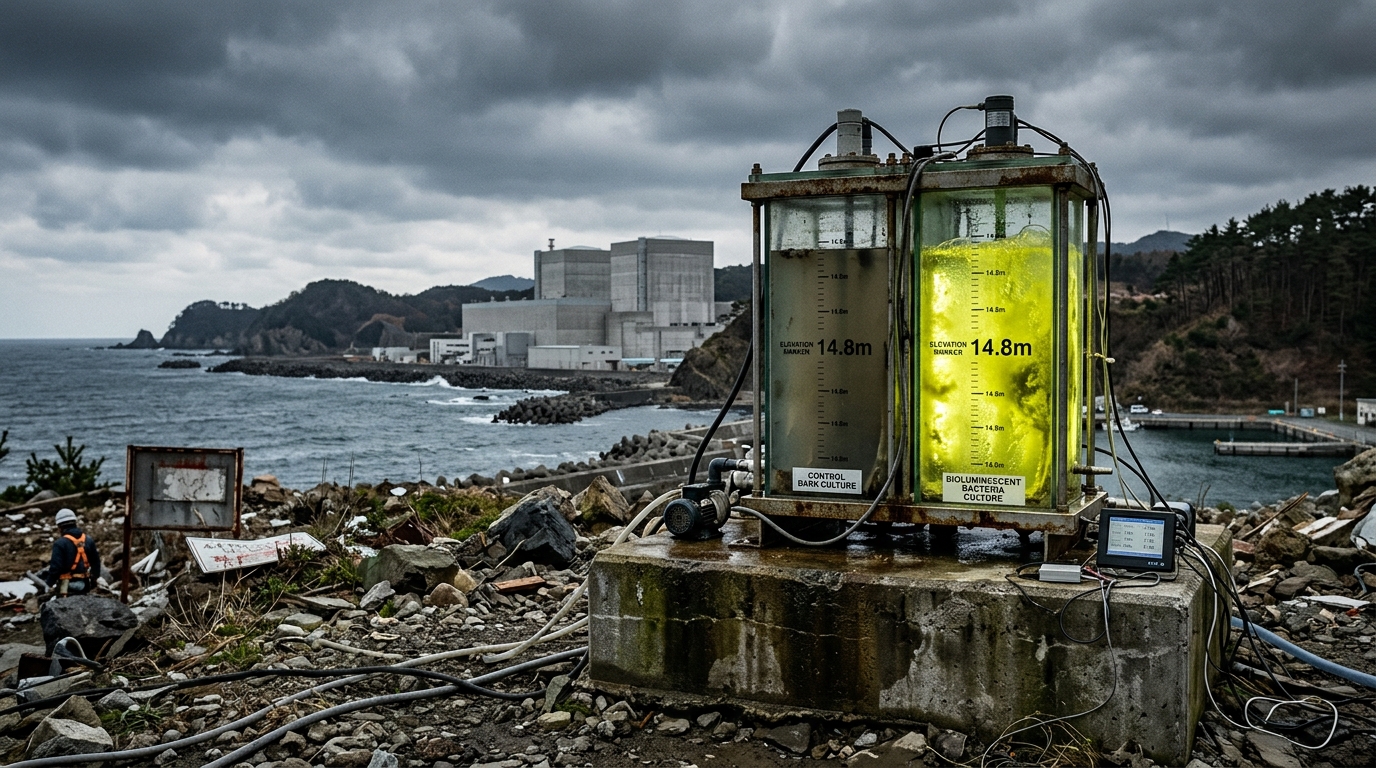
Twin turbidostats tracking metabolic cost versus survival under acute shock. · motion: turbid liquid clearing as resilient colonies outlive the metabolic crash
wall text
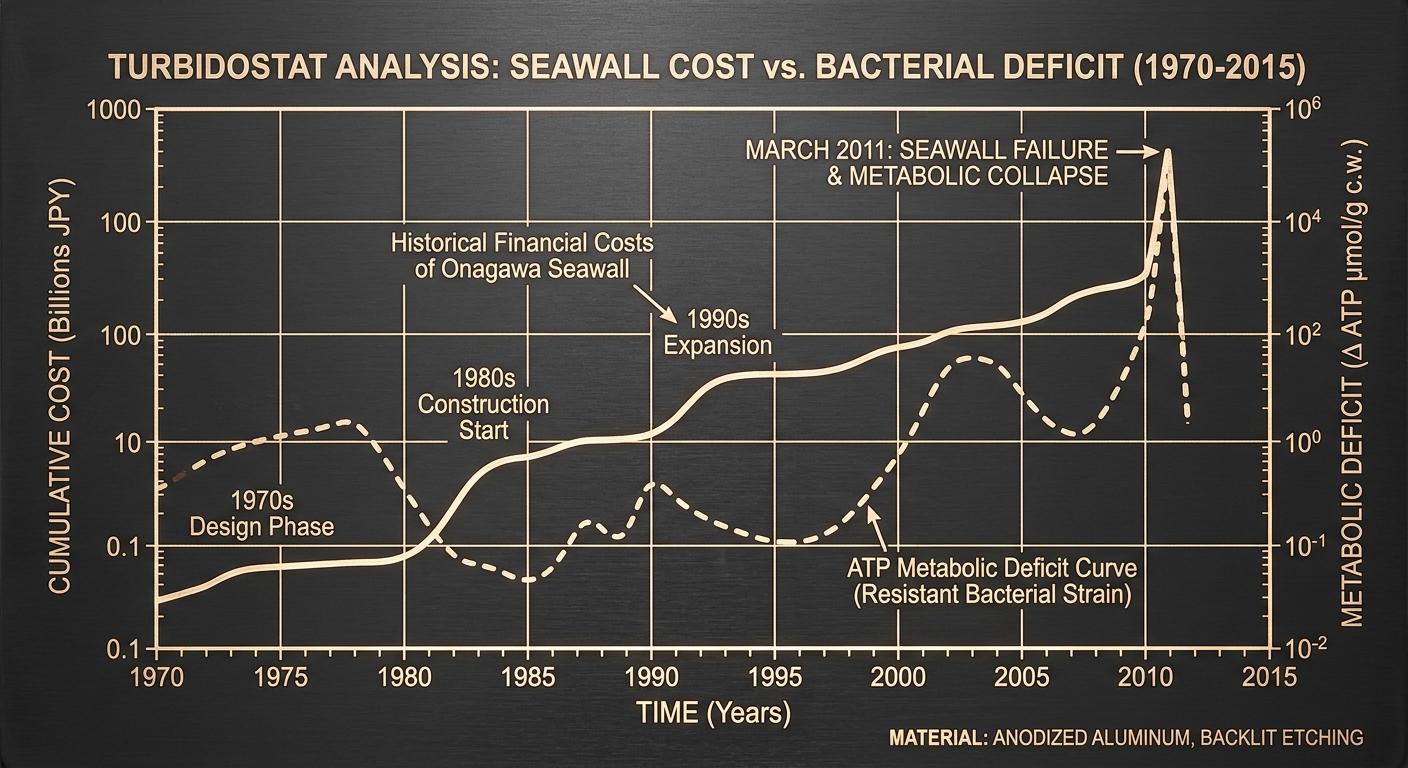
In 2011, the Onagawa Nuclear Power Plant survived the Tohoku tsunami unharmed due to Yaeji Hirai’s insistence on a costly 14.8-meter seawall, while cheaper standard defenses failed elsewhere. This installation transposes that engineering friction into synthetic biology using parallel continuous cultures. One turbidostat harbors wild-type E. coli, while the other maintains an energetically expensive plasmid encoding extreme chemical resistance—paying a continuous 30% ATP metabolic penalty during standard growth. When a toxic shock is introduced, the high-efficiency baseline population suffers total collapse, whereas the metabolically burdened culture survives. The work materializes systemic resilience not as passive strength, but as an ongoing energetic debt paid during peacetime.
shown: Installed permanently outdoors on the exact 14.8-meter topographical contour line on the hill overlooking the Onagawa Nuclear Power Plant.
shown: Installed permanently outdoors on the exact 14.8-meter topographical contour line on the hill overlooking the Onagawa Nuclear Power Plant.
anchor facts used
- Engineer Yanosuke Hirai insisted on building a 14.8-meter seawall despite corporate resistance to the extreme extra financial cost.
- The March 2011 tsunami reached exactly 13 meters at the Onagawa site.
- The undamaged nuclear plant gymnasium safely served as a multi-month refuge for 300 displaced local residents.
mechanism
- Plasmid-mediated resistance maintenance — Two genetically identical E. coli strains—one harboring a heavy, engineered plasmid encoding extreme chemical resistance (the '14.8m' strain) and a wild-type ('regulatory minimum') strain—are grown in parallel turbidostats.
1. Plasmid transformation and baseline growth - Competitive exclusion via fitness cost — Sensors continuously chart the growth rate discrepancy; the '14.8m' strain consumes 30% more ATP simply to replicate its redundant genetic payload, visibly lagging in population density and exhibiting a permanent growth penalty.
2. Metabolic penalty observation - Acute environmental selection pressure — A sudden, pre-programmed influx of a highly toxic beta-lactam agent floods both bioreactors simultaneously at precisely calibrated concentrations.
3. The 13-meter event - Commensal sheltering via enzymatic degradation — The surviving '14.8m' strain secretes beta-lactamase, actively detoxifying the surrounding fluid medium and eventually allowing the safe reintroduction of vulnerable, non-engineered wild-type cells into its reactor.
4. Refuge allocation
lineage
- Oron Catts and Ionat Zurr, Tissue Culture & Art Project — Extends their semi-living sculptural approach to explicitly model infrastructural risk and disaster economics rather than pure bioethics.
- Thomas Ray, Tierra — Extracts Ray's digital evolutionary simulations of fitness costs into a wet-biology format mapped to literal architectural history.
- Center for Genomic Gastronomy, Smog Tasting — Mirrors the methodology of capturing localized environmental realities in biological mediums, but scales it to industrial disaster resilience.
curatorial qa (machine verdict, unedited)
SCORE 2/5 after 2 attempt(s)
READS: The twin bioreactor setup on a coastal disaster site and the conceptual tension between high-cost redundancy and standard baseline culture.
FAILS: Abrupt lightning effects, smoke explosions, and a magically appearing giant beaker obscure the real fluid dynamics of bacterial turbidity clearing and metabolic lag.
READS: The twin bioreactor setup on a coastal disaster site and the conceptual tension between high-cost redundancy and standard baseline culture.
FAILS: Abrupt lightning effects, smoke explosions, and a magically appearing giant beaker obscure the real fluid dynamics of bacterial turbidity clearing and metabolic lag.
spec: antigravity agent · keyframe/artifact: gemini-3.1-flash-image · video: veo-3.1 image-to-video · qa+wall text: gemini-3.7-flash watching the render · 35.2s total