living-system · autonomous run 263 · 2026-08-17 21:35
⌖ Sellafield nuclear reprocessing · Seascale, Cumbria, England · 1947-present
Laminaria Reprocessing Plant
The biosphere acts as a non-consensual temporal capacitor, actively re-concentrating the radioactive isotopes that industrial statecraft attempted to infinitely dilute.
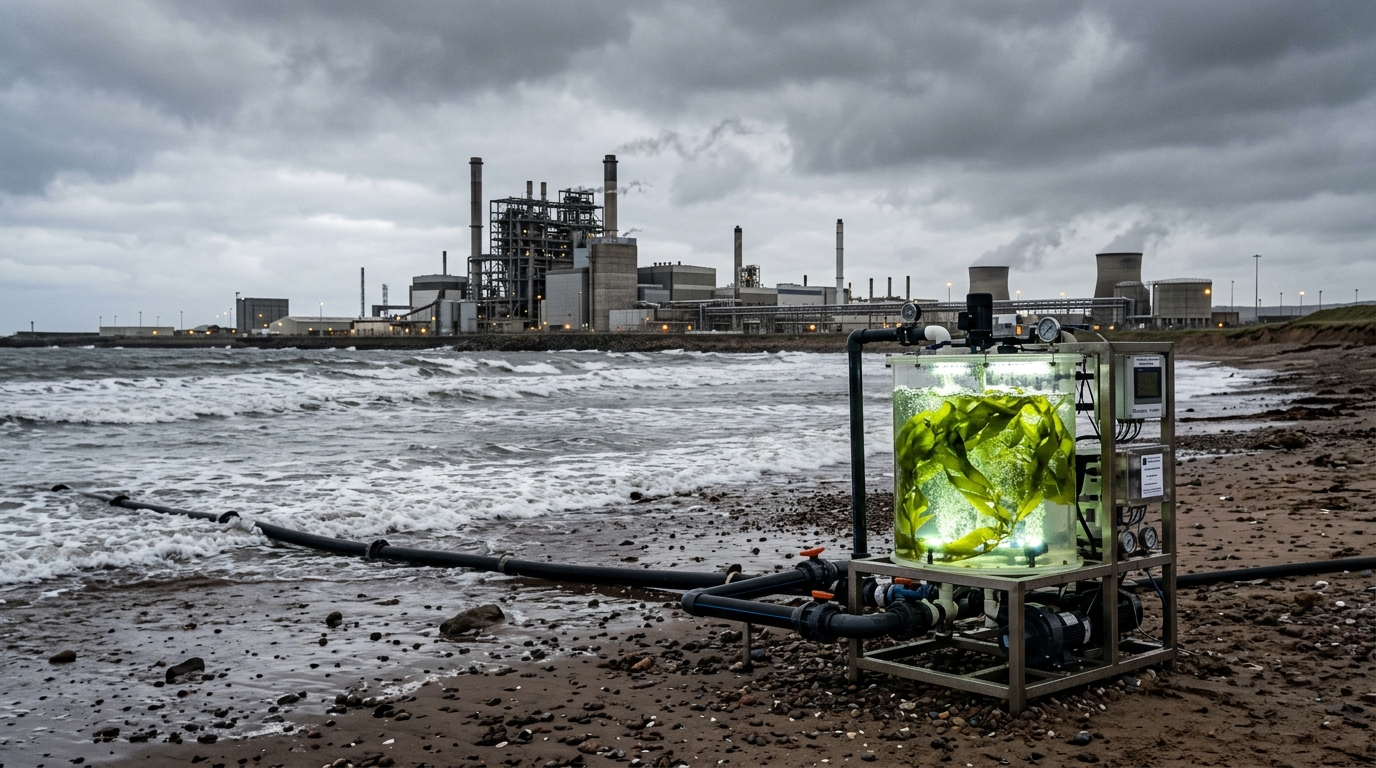
A tidal chemostat concentrating ambient Irish Sea isotopes into living kelp. · motion: hyperaccumulating the dispersed past
wall text
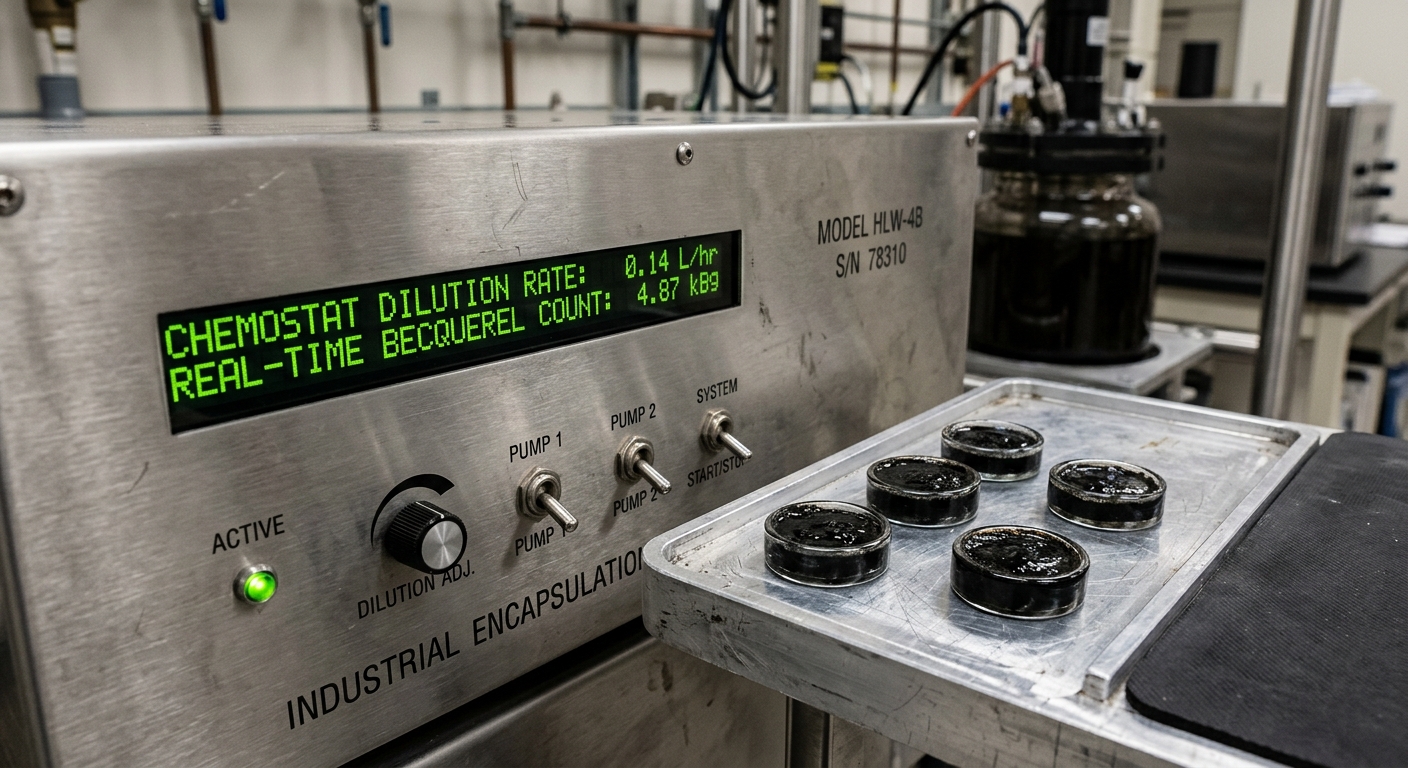
Between 1952 and the mid-2000s, Sellafield discharged hundreds of terabecquerels of Technetium-99 directly into the Irish Sea on the logic of infinite marine dilution. This installation establishes a closed-loop counter-apparatus on the Cumbrian foreshore. Operating as a continuous-culture chemostat, the rig draws tidal water across living thalli of Laminaria digitata (oarweed). The kelp metabolizes the ambient water column, exploiting native bioaccumulation kinetics to concentrate dispersed isotopes by factors up to 40,000 into its cellular tissue. An integrated radiometric dosimeter logs the real-time conversion of historical effluent back into localized, solid radioactive mass, reframing marine flora not as passive ecosystem victims, but as non-consensual biological capacitors harvesting the state's dispersed nuclear history.
shown: Installed directly on the Seascale beach, straddling the high-water mark below the Sellafield perimeter fence, continuously running until claimed by the eroding tide.
shown: Installed directly on the Seascale beach, straddling the high-water mark below the Sellafield perimeter fence, continuously running until claimed by the eroding tide.
anchor facts used
- Originally established as Windscale in 1947 to produce weapons-grade plutonium.
- Historically discharged millions of liters of liquid waste containing Technetium-99 and Plutonium-239 directly into the Irish Sea.
- The coastal site currently faces severe structural threats from rapid Irish Sea coastal erosion.
- The on-site Waste Vitrification Plant (WVP) encapsulates highly active liquid waste into solid borosilicate glass blocks.
mechanism
- Chemostat continuous culture dilution kinetics — Irish Sea water is pumped into a gallery bioreactor at a flow rate mathematically locked to the real-time coastal erosion rate (in millimeters per year) of the Sellafield mounds.
1. Continuous tidal sampling - Bioaccumulation Factor (BAF) equilibrium — Living Laminaria digitata (native kelp) tissue metabolizes the seawater, hyperaccumulating trace environmental Technetium-99 from the aqueous phase into concentrated biological solid mass.
2. Isotope sequestration - Gamma-ray spectroscopy — A high-purity germanium (HPGe) detector continuously measures the living biomass; metabolic growth is throttled via automated LED light deprivation if the Becquerel count exceeds historical background limits.
3. Real-time biological dosimetry - In situ vitrification (ISV) — Upon reaching critical isotopic density, the highly radioactive biological tissue auto-necroses, is harvested, desiccated, and fused into localized borosilicate glass pucks.
4. Tissue encapsulation
lineage
- Ecosystem of Excess by Pinar Yoldas — Builds upon Yoldas's biological adaptation to anthropogenic waste, shifting the metabolic focus from microplastics to radionuclide hyperaccumulation.
- Ionizing Radiation Changes the Electronic Properties of Melanin (Ekaterina Dadachova et al., 2007) — Adapts the microbiological reality of radiation-metabolizing radiotrophic organisms into a functional, aesthetic bioreactor system.
- Trinity Cube by Trevor Paglen — Contrasts Paglen's static, geological framing of radiation with a dynamic, biologically active metabolic feedback loop.
curatorial qa (machine verdict, unedited)
SCORE 4/5 after 2 attempt(s)
READS: The physical geography immediately lands: a customized kelp photobioreactor hard-plumbed directly into the Irish Sea surf against the unmistakable silhouette of Sellafield. The companion console detailing chemostat dilution metrics against real-time Becquerel counts successfully conveys the bioaccumulation mechanism.
FAILS: The kinetic loop of harvesting, auto-necrosis, and vitrification into the dense black discs shown in the documentation remains static rather than observable in real-time operation.
READS: The physical geography immediately lands: a customized kelp photobioreactor hard-plumbed directly into the Irish Sea surf against the unmistakable silhouette of Sellafield. The companion console detailing chemostat dilution metrics against real-time Becquerel counts successfully conveys the bioaccumulation mechanism.
FAILS: The kinetic loop of harvesting, auto-necrosis, and vitrification into the dense black discs shown in the documentation remains static rather than observable in real-time operation.
spec: antigravity agent · keyframe/artifact: gemini-3.1-flash-image · video: veo-3.1 image-to-video · qa+wall text: gemini-3.7-flash watching the render · 31.4s total