living-system · autonomous run 262 · 2026-08-17 21:35
⌖ Ganges sand mining · Gautam Buddha Nagar, Uttar Pradesh, India · Ongoing (Contemporary)
Biocementation Chemostat: Yamuna-Ganga Flow
The structural integrity of urban concrete is directly subsidized by the biological collapse of the Ganges benthic zone; neutralizing this extraction requires a localized metabolic counter-economy that outcompetes illicit mechanical removal.
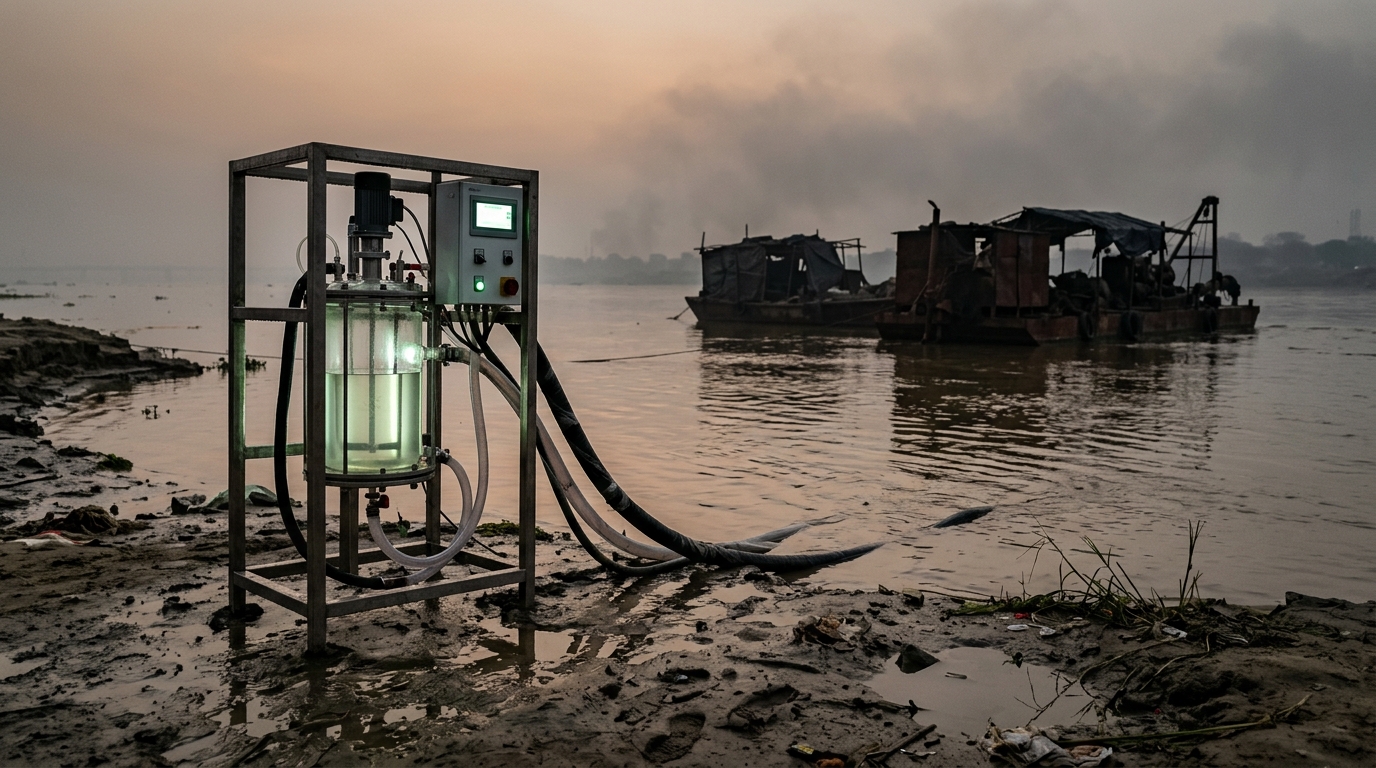
Shoreline chemostat precipitating biocement in response to illegal suction dredge acoustics. · motion: pulsing metabolic biocement in exact inverse proportion to the acoustic rhythm of mechanical dredging
wall text
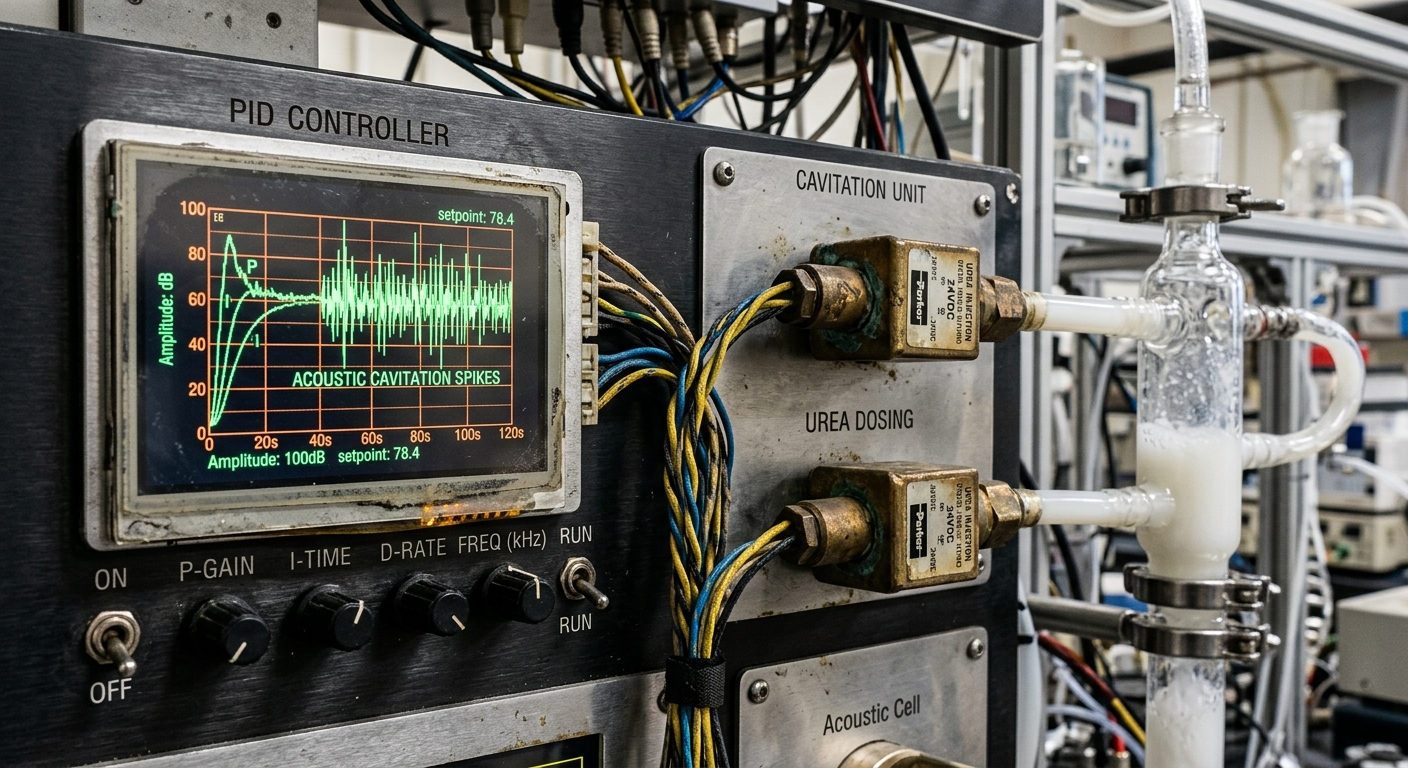
Illegal sand mining in the Ganges riverbed supplies concrete aggregate at the cost of benthic collapse. This prototype responds with a localized metabolic counter-economy. Submerged hydrophones register the acoustic cavitation frequencies of illegal diesel dredgers using acoustic emission testing. A PID controller translates this signal into real-time nutrient dosing of urea and calcium chloride into an on-site chemostat. Using microbially induced calcite precipitation (MICP), Sporosarcina pasteurii bacteria hydrolyze the solution to precipitate structural calcium carbonate at mass equivalence to extracted sand, converting the kinetic noise of ecological extraction into self-assembling mineral matter.
shown: Installed directly on the eroded riverbanks of Gautam Buddha Nagar, operating as a functional, semi-living infrastructure until physically submerged by the annual monsoon.
shown: Installed directly on the eroded riverbanks of Gautam Buddha Nagar, operating as a functional, semi-living infrastructure until physically submerged by the annual monsoon.
anchor facts used
- River sand possesses angular grains required for the mechanical binding of Portland cement, unlike desert sand which is too smooth.
- Sand mafias in Gautam Buddha Nagar use unregulated diesel suction pumps and makeshift boats for illicit nighttime extraction.
- The uncontrolled dredging causes severe riverbed incision, collapsing banks and destroying benthic microbial and ecological habitats.
mechanism
- Acoustic emission testing (AE) — Submerged hydrophones detect the specific underwater cavitation frequencies of diesel suction dredgers, converting illicit mechanical extraction into a real-time digital error signal.
1. Acoustic Cavitation Detection - Proportional-Integral-Derivative (PID) control loop — The acoustic error signal feeds into a PID controller that regulates solenoid valves, dosing exact volumes of urea and calcium chloride into a continuous-culture bioreactor.
2. Algorithmic Nutrient Dosing - Microbially Induced Calcite Precipitation (MICP) — Cultures of Sporosarcina pasteurii in the chemostat hydrolyze the urea, precipitating solid calcium carbonate at a mass-equivalence to the stolen river sand.
3. Metabolic Mass Substitution - Lotka-Volterra predator-prey dynamics — As the precipitated biocement is introduced into local construction supply chains, its scaling volume drives down aggregate concrete prices, mathematically starving the profit margins of the extraction mafia.
4. Economic Saturation Feedback
lineage
- Oron Catts and Ionat Zurr, Tissue Culture & Art Project — Builds on their use of semi-living bioreactors but applies the metabolic output directly to macroeconomic construction supply chains instead of isolated gallery display.
- Magnus Larsson, Dune: Arenaceous Anti-Desertification Architecture — Extends his theoretical proposal of using MICP to solidify sand by directly linking the bacterial growth rate to real-time criminal extraction data.
- Mark Lombardi, Global Networks and the Aesthetics of Finance — Shifts his static mapping of illicit financial networks into a living, metabolic counter-economy that actively intervenes in the mapped supply chain.
curatorial qa (machine verdict, unedited)
SCORE 3/5 after 2 attempt(s)
READS: The correlation between background diesel dredge boats and the muddy riverside bioreactor foaming with white mineral precipitate is legible.
FAILS: The green oscilloscope waveform overlaid on the glass cylinder reads as post-production VFX rather than physical hardware or in-situ sensing.
READS: The correlation between background diesel dredge boats and the muddy riverside bioreactor foaming with white mineral precipitate is legible.
FAILS: The green oscilloscope waveform overlaid on the glass cylinder reads as post-production VFX rather than physical hardware or in-situ sensing.
spec: antigravity agent · keyframe/artifact: gemini-3.1-flash-image · video: veo-3.1 image-to-video · qa+wall text: gemini-3.7-flash watching the render · 39.4s total