living-system · autonomous run 256 · 2026-08-17 21:35
⌖ Aral Sea ship graveyard · Moynaq, Republic of Karakalpakstan, Uzbekistan · 1960s-present
Aralkum Halophilic Chemostat
The ecological debt incurred by state-scale terraforming can only be amortized through the autonomous, extremophilic metabolization of its toxic residue at a geological pace.
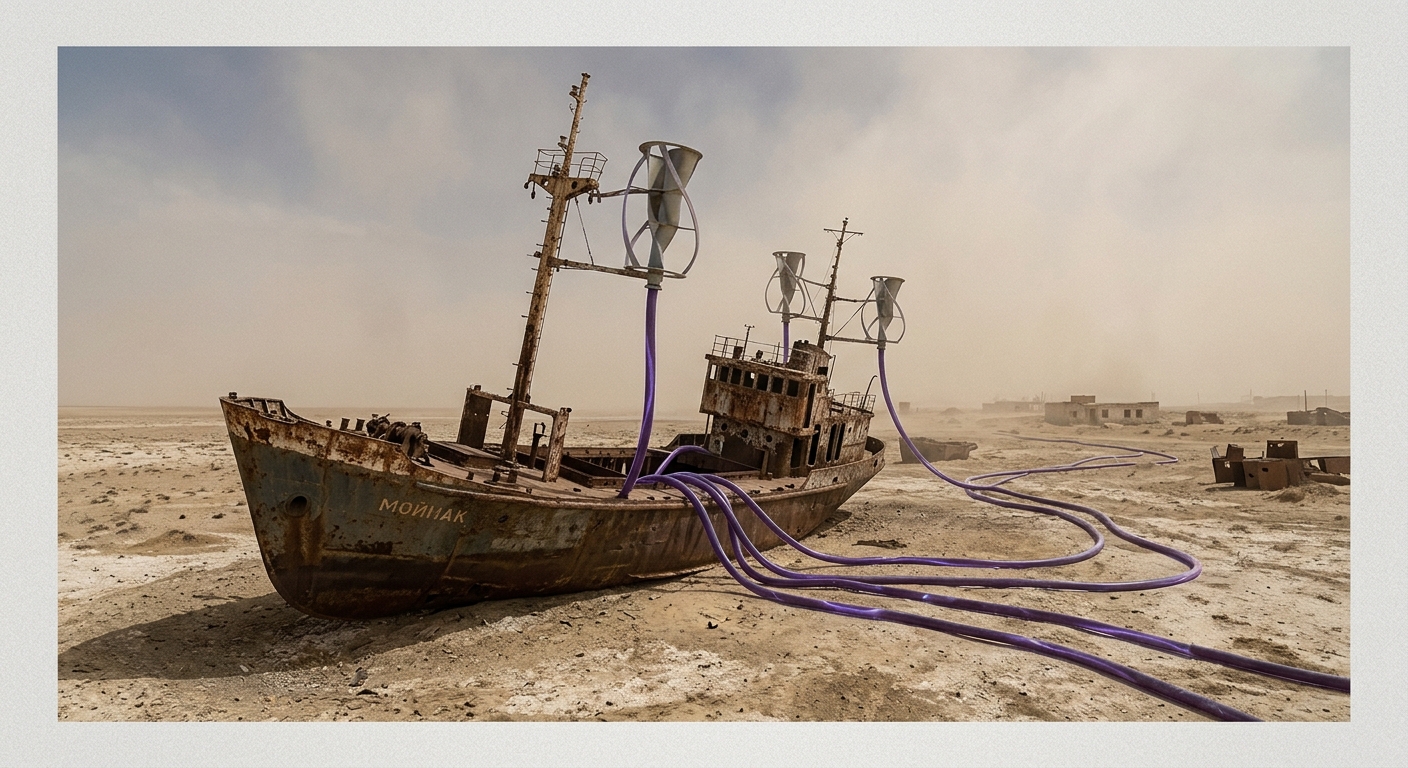
A stranded trawler metabolizes pesticide dust to winch itself across the desert. · motion: metabolizing the desert to winch the hull
wall text
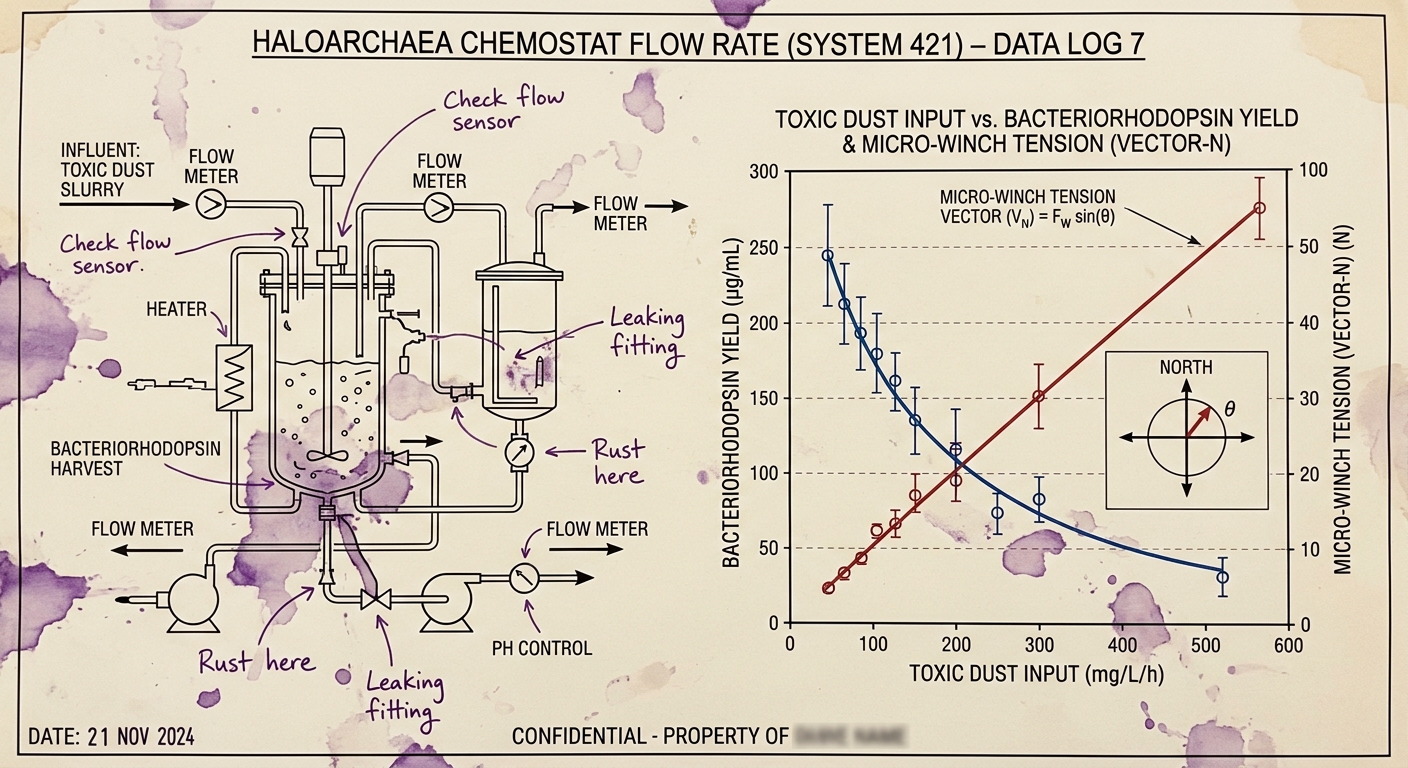
Stranded in the Aralkum desert, a decommissioned fishing trawler is refitted as an autonomous bioremediation crawler. Mast-mounted cyclonic separators harvest windblown agrochemical dust and toxic salts left by Soviet-era irrigation diversions. Inside the hold, a continuous-culture chemostat feeds this substrate to engineered Haloarchaea. As the extremophiles metabolize the organochlorine residue, they synthesize dense bacteriorhodopsin pigment and precipitate inert biominerals. The resulting volumetric mass increases hydraulic pressure through ground-anchored winches, slowly dragging the multi-ton iron hull across the desiccated lakebed. The installation transposes industrial dust separation and halophilic bioremediation into a self-propelling mechanism where historical ecological debt is amortized at a literal crawl.
shown: Installed permanently inside the hull of a stranded trawler at the Moynaq ship graveyard, operating autonomously until the hull reaches the water or disintegrates.
shown: Installed permanently inside the hull of a stranded trawler at the Moynaq ship graveyard, operating autonomously until the hull reaches the water or disintegrates.
anchor facts used
- The Amu Darya and Syr Darya rivers were diverted by Soviet planners in the 1960s to irrigate cotton, causing the sea to shrink.
- The receding waters created the Aralkum Desert, which is heavily contaminated with agricultural pesticides and defoliants.
- A former fishing fleet of rusted steel trawlers remains stranded on the sand, miles from the current shoreline in Moynaq.
mechanism
- Cyclonic separation — Repurposed from industrial milling to scavenge pesticide-laden salt storms using ambient desert wind.
1. Toxic salt dust from the Aralkum desert floor is harvested via wind-driven cyclonic separators installed on the masts of the rusted trawler. - Chemostat continuous culture — Replaces the trawler's empty fish-hold with a self-regulating extremophile fermentation engine.
2. The collected dust is fed into a sealed, moisture-retaining bioreactor within the ship's hold, seeded with engineered Haloarchaea. - Bioremediation via halophilic biomineralization — Converts historical Soviet agricultural toxins into an accumulating, highly visible biological pigment.
3. The Haloarchaea metabolize the agricultural runoff, precipitating inert bio-minerals while synthesizing a dense, purple bacteriorhodopsin pigment. - Biomechanical feedback control loop — Links the metabolic breakdown of ecological trauma directly to the physical restitution of the stranded fleet.
4. The volumetric growth rate of the bacterial colony dictates the tension on a ground-anchored micro-winch system, dragging the rusted ship millimeters per year.
lineage
- SymbioticA (Oron Catts and Ionat Zurr), 'Tissue Culture & Art Project' — Expands their semi-living sculpture framework from climate-controlled gallery incubators to harsh, landscape-scale post-industrial remediation.
- Mel Chin, 'Revival Field' (1991) — Builds on Chin's use of hyperaccumulating flora by replacing vegetation with engineered extremophile archaea designed for hyper-arid impact zones.
- Gilberto Esparza, 'Plantas Nómadas' (2010) — Scales Esparza's concept of a parasitic, water-seeking robotic ecosystem to the multi-ton, geological scale of a stranded Soviet trawler.
curatorial qa (machine verdict, unedited)
SCORE 4/5 after 1 attempt(s)
READS: The mast-mounted cyclonic separators scavenge desert dust while purple hydraulic lines pulse metabolic mass into ground anchors, mechanically dragging the stranded Soviet trawler across the seabed.
FAILS: The internal chemostat bioremediation inside the hold remains concealed, leaving the glowing purple pulses to border on generic energy effects rather than viscous bacterial yield.
READS: The mast-mounted cyclonic separators scavenge desert dust while purple hydraulic lines pulse metabolic mass into ground anchors, mechanically dragging the stranded Soviet trawler across the seabed.
FAILS: The internal chemostat bioremediation inside the hold remains concealed, leaving the glowing purple pulses to border on generic energy effects rather than viscous bacterial yield.
spec: antigravity agent · keyframe/artifact: gemini-3.1-flash-image · video: veo-3.1 image-to-video · qa+wall text: gemini-3.7-flash watching the render · 40.1s total