living-system · autonomous run 254 · 2026-08-17 21:35
⌖ Sachsenhausen · Oranienburg, Germany · 1936-1945 (post-war reuse 1945-1950)
Klinkerwerk Succession: Bioleaching the Geometry of Confinement
Architectures of totalitarian control are biologically persistent substrates; when the ideological regime shifts, the underlying geometry dictates that only the metabolic pathway of extraction changes, while the physical enclosure remains intact.
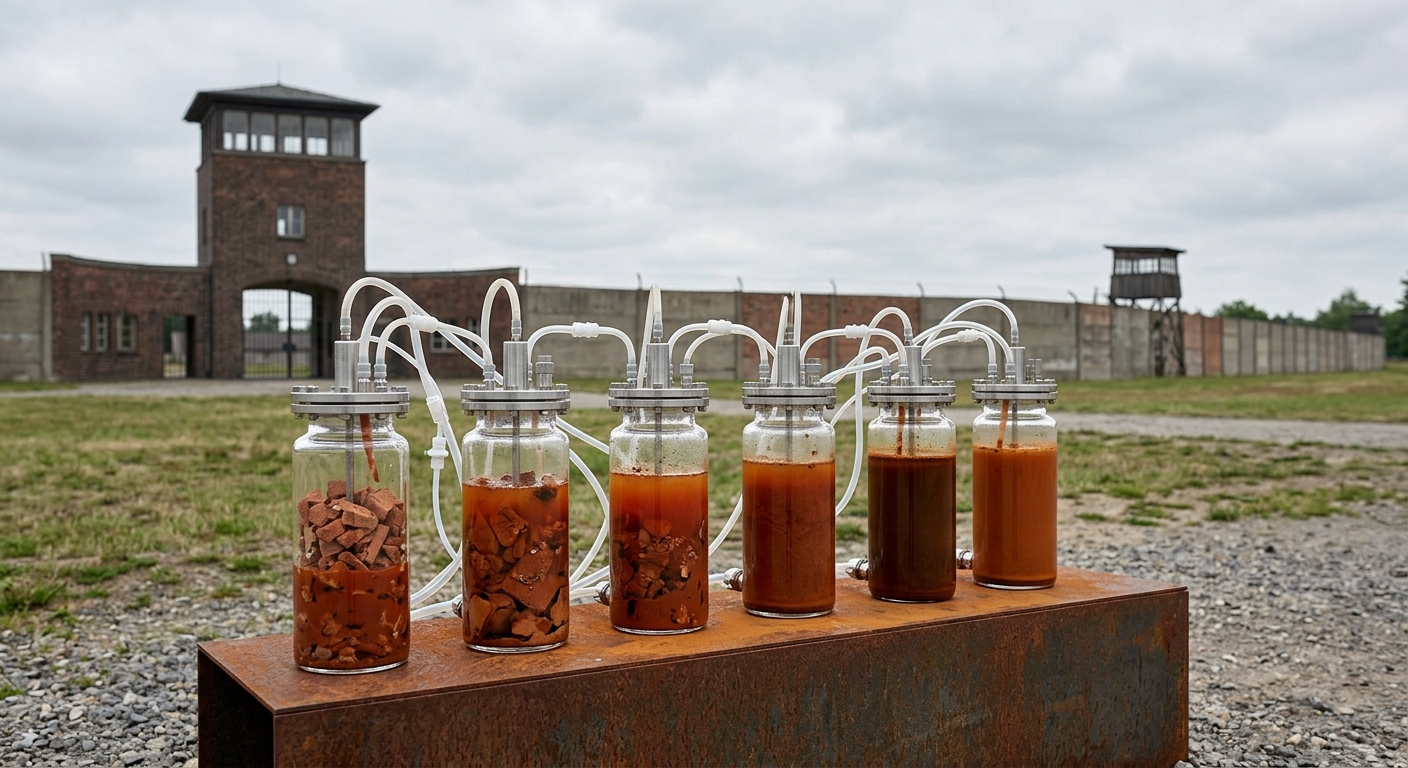
Continuous bioleaching of camp masonry in an automated chemostat array. · motion: slowly dissolving rigid brick structures into a turbulent, rust-red bacterial slurry
wall text
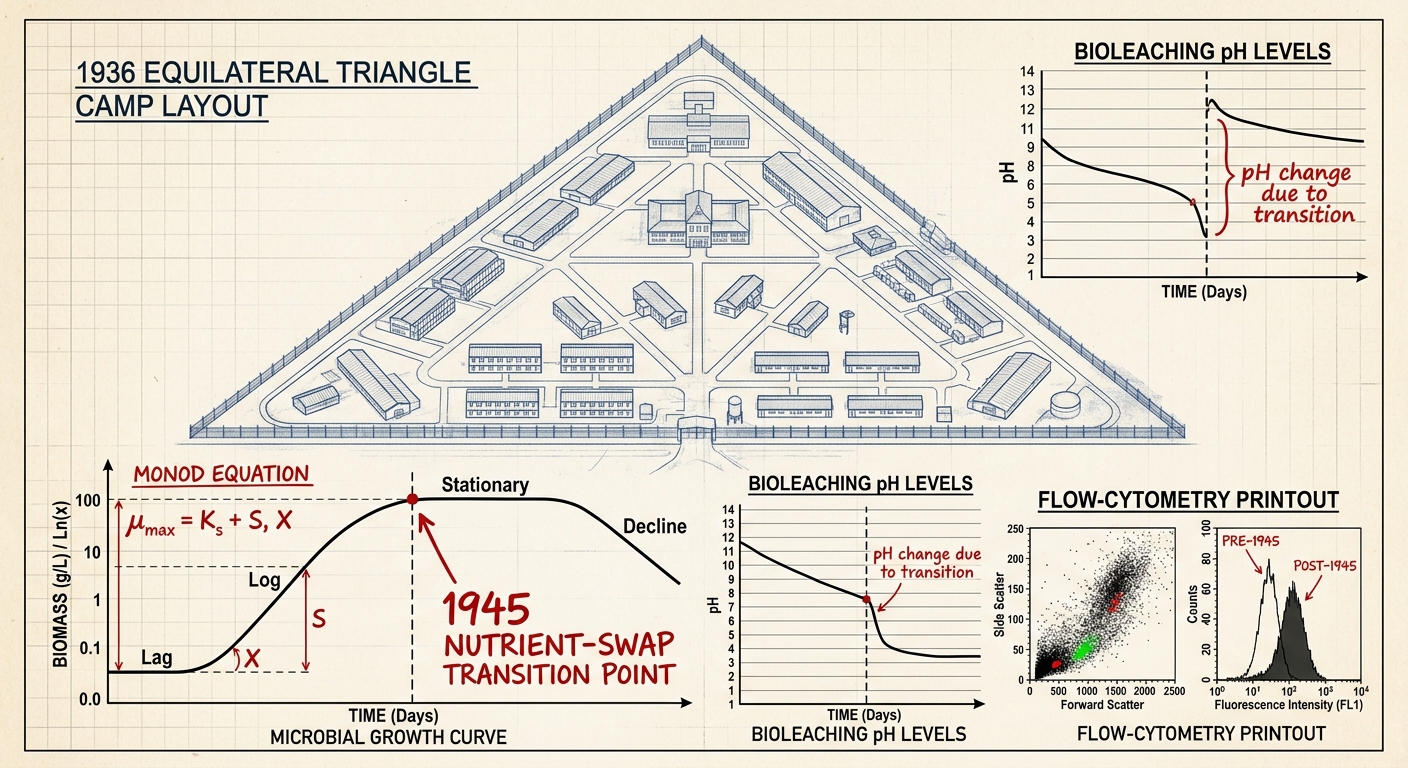
This bioreactor array subjects pulverized masonry from the Sachsenhausen brickworks to continuous bioleaching using Acidithiobacillus ferrooxidans. Operating across a multi-stage chemostat, the acidophilic culture extracts iron and silicates from the mineral matrix, reducing rigid architectural geometry to an iron-oxide slurry. At a programmed threshold, the system executes an automated nutrient inversion—transposing the 1945 administrative handover from Nazi concentration camp to Soviet Special Camp No. 7. The underlying triangular layout remains constant while the dominant metabolic pathway shifts from aerobic iron oxidation to anaerobic digestion. Totalitarian architecture is treated here not as symbolic monument, but as an active metabolic substrate continuously recycled across differing extraction regimes.
shown: Installed outdoors directly on the former roll-call area (Appellplatz) of Sachsenhausen, exposing the bioreactors and their metabolic rates to the site's authentic ambient temperature fluctuations.
shown: Installed outdoors directly on the former roll-call area (Appellplatz) of Sachsenhausen, exposing the bioreactors and their metabolic rates to the site's authentic ambient temperature fluctuations.
anchor facts used
- Designed in 1936 with a strict equilateral triangle architectural layout centered on Tower A
- Inmates were used as forced labor in the Klinkerwerk (brickworks) to produce materials for Albert Speer's Germania
- The exact same camp infrastructure was reused from 1945-1950 as Soviet Special Camp No. 7
mechanism
- Mechanical Comminution and Autoclaving — Original bricks excavated from the Sachsenhausen Klinkerwerk are mechanically ground into 2mm particulate and sterilized to serve as the primary mineral substrate.
1. Core sampling and pulverization of architectural materials. - Bioleaching via Acidithiobacillus ferrooxidans — The brick particulates are fed into a chemostat where acidophilic bacteria oxidize the iron, dissolving the brick's structural integrity into a toxic, rust-red slurry.
2. Continuous microbial acidolysis of the iron-calcite matrix. - Serial Batch Culture Nutrient Shift — The carbon/nitrogen ratio in the automated feed line is abruptly inverted at a calculated half-life, causing a massive die-off of the primary bacterial strain and the sudden dominance of a secondary, anaerobic strain.
3. Abrupt alteration of the limiting nutrient in the continuous culture. - Microbially Induced Calcite Precipitation (MICP) — The secondary bacterial strain metabolizes the dissolved Klinkerwerk minerals, precipitating a fragile, secondary crystalline crust at the bottom of the reactor guided by a titanium template.
4. Precipitation of the effluent into a secondary structure.
lineage
- Victimless Leather (Oron Catts & Ionat Zurr, 2004) — Shifts the bio-art focus from generating synthetic animal tissue to the literal biological digestion and recycling of traumatic historical artifacts.
- Biomining and Bioleaching (Brierley & Brierley, 2013, Applied Microbiology) — Strips the industrial and economic utility from microbially induced mineral weathering, using it instead as an instrument of historical decay and redeposition.
- The Monod Equation for Continuous Culture (Jacques Monod, 1949) — Utilizes steady-state growth kinetics not for industrial yield, but to mathematically map the carrying capacity and population collapse within an ideological enclosure.
curatorial qa (machine verdict, unedited)
SCORE 4/5 after 1 attempt(s)
READS: The bioleaching reactor train set against the camp perimeter cleanly demonstrates the dissolution of brick structures into bubbling iron-rich slurry, directly linking the geometry to bacterial metabolism.
FAILS: The automated nutrient shift representing the 1945 transfer between ideological regimes exists only in the technical diagram rather than visibly within the fluid kinetics.
READS: The bioleaching reactor train set against the camp perimeter cleanly demonstrates the dissolution of brick structures into bubbling iron-rich slurry, directly linking the geometry to bacterial metabolism.
FAILS: The automated nutrient shift representing the 1945 transfer between ideological regimes exists only in the technical diagram rather than visibly within the fluid kinetics.
spec: antigravity agent · keyframe/artifact: gemini-3.1-flash-image · video: veo-3.1 image-to-video · qa+wall text: gemini-3.7-flash watching the render · 43.8s total