living-system · autonomous run 253 · 2026-08-17 21:35
⌖ Buzludzha monument · Mount Hadzhi Dimitar, Central Balkan Mountains, Bulgaria · 1981-1989 (Active), 1989-Present (Abandoned)
Quorum Calcite at 1,441 Meters
Collective metabolic action cannot be sustained by ideological structures alone; without continuous thermodynamic inputs, collective action inevitably calcifies its own tomb.
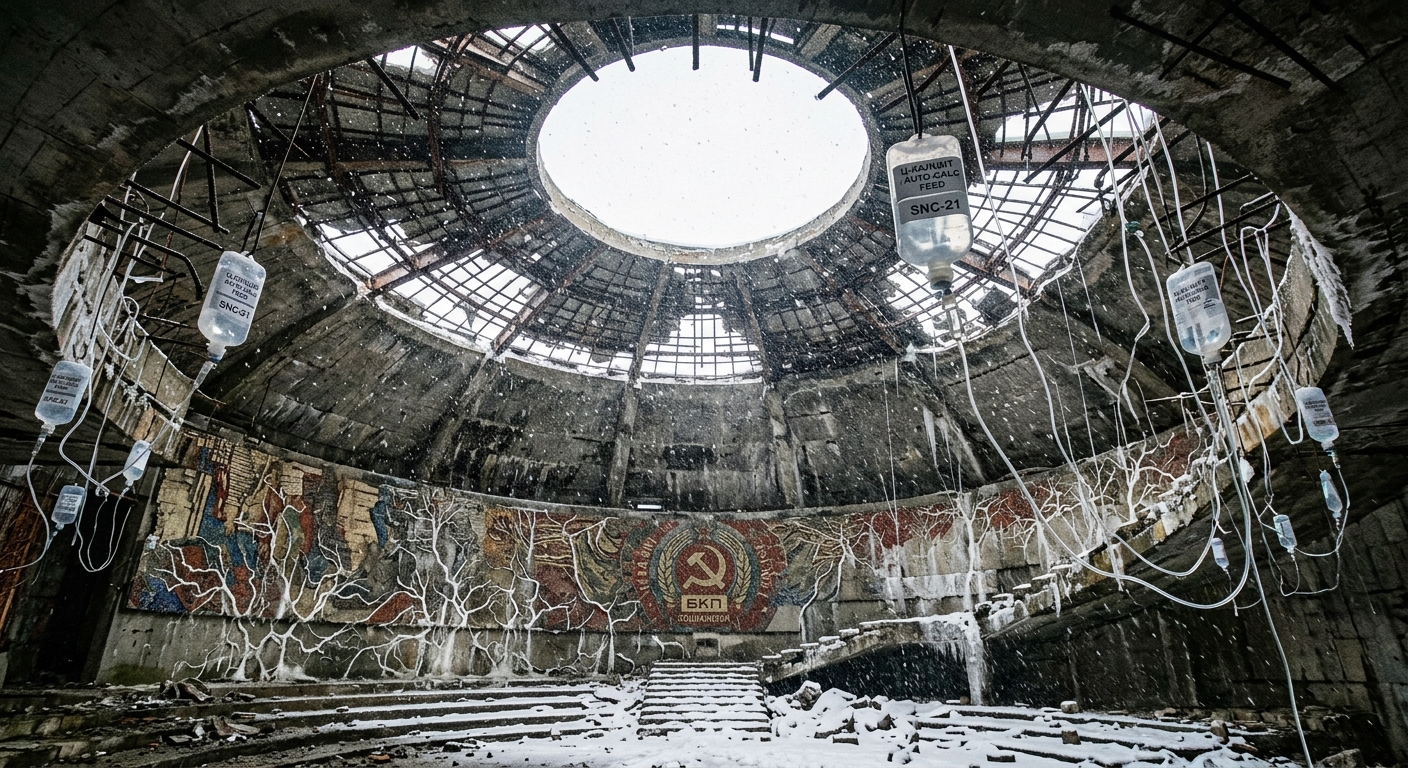
Bacterial calcite precipitation entombs decaying mosaic walls beneath self-generated mineral crusts. · motion: calcifying the structural decay
wall text
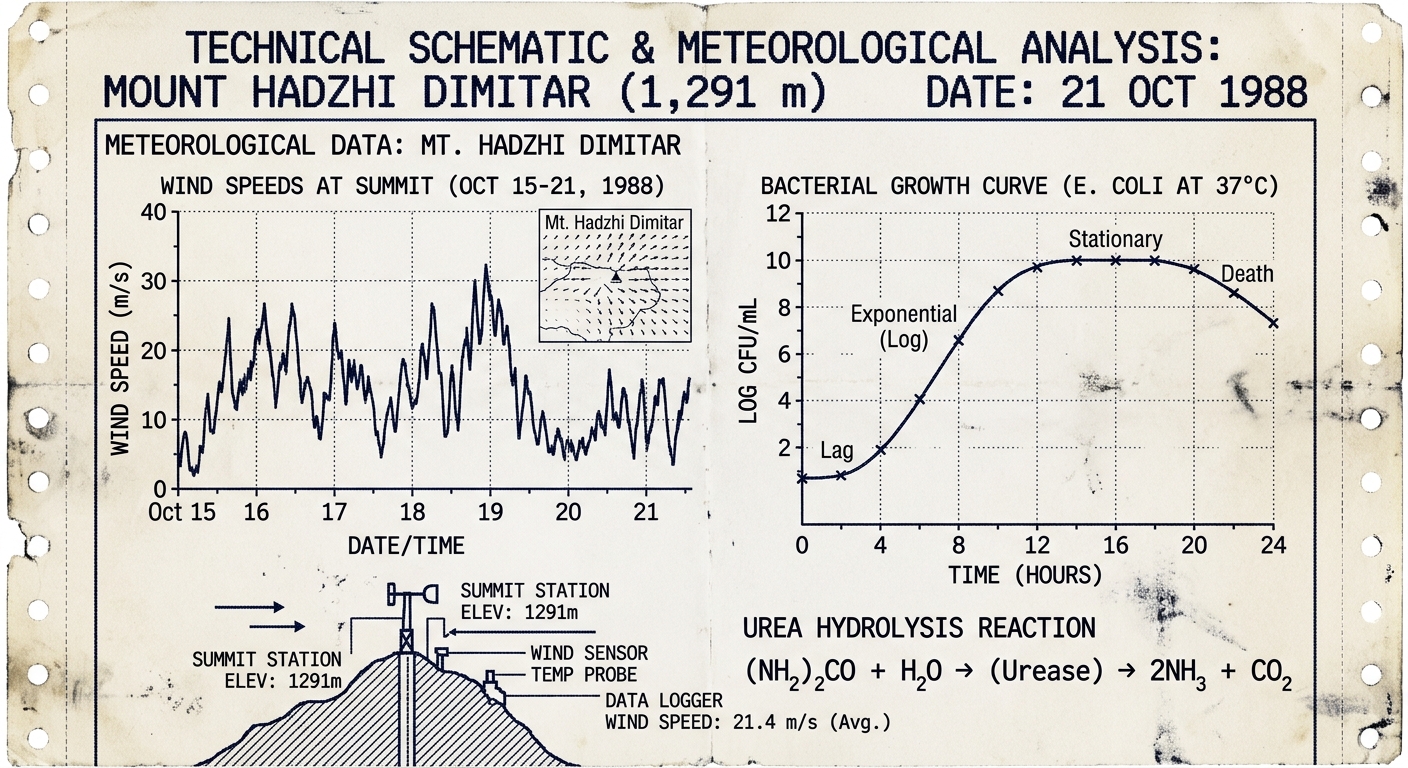
Inside the ruined Buzludzha monument, automated drips supply urea and calcium chloride to colonies of Sporosarcina pasteurii seeded in the fractured concrete. Transposing chemostat dilution control and bacterial quorum sensing, the installation simulates microbially induced calcite precipitation (MICP). Once bacterial density crosses an activation threshold, urea hydrolysis drives local mineralization, binding loose mosaic tesserae beneath a thickening layer of calcium carbonate. However, the mineral shell progressively seals the fissures from ambient moisture and nutrient flow, inducing bacterial starvation and endosporulation. Ideological preservation operates as biological petrification: the metabolic system entombs itself within the mineral matrix it synthesizes.
shown: Installed directly within the main circular congress hall of the Buzludzha monument, operating autonomously until the nutrient reservoirs freeze or deplete.
shown: Installed directly within the main circular congress hall of the Buzludzha monument, operating autonomously until the nutrient reservoirs freeze or deplete.
anchor facts used
- Situated at 1,441 meters elevation with severe wind exposure and sub-zero winters
- Constructed using 16.2 million leva from compulsory 'voluntary' citizen donations
- Internal 510-square-meter mosaics decaying due to the copper roof being looted post-1989
mechanism
- Chemostat dilution rate control — Automated misting of urea and calcium chloride onto the ruined concrete is throttled by anemometers measuring real-time wind speed through the shattered roof.
1. Environmental resource throttling. - Quorum sensing via Acyl-homoserine lactone (AHL) signaling — Sporosarcina pasteurii bacteria replicate in the micro-fissures, remaining metabolically inactive regarding mineralization until their population density crosses a critical autoinducer threshold, mirroring mass-mobilization.
2. Threshold-dependent bacterial activation. - Microbially Induced Calcite Precipitation (MICP) — Upon reaching quorum, the bacterial collective rapidly hydrolyzes urea, altering local pH and precipitating calcium carbonate to structurally bind the decaying mosaic tiles to the brutalist shell.
3. Structural biomimesis of ideological repair. - Endosporulation under nutrient starvation — As the precipitated calcite successfully seals the concrete fissures, it blocks further nutrient ingress from the misting system; the bacterial collective starves and forms dormant spores within the healed concrete.
4. Self-suffocating preservation.
lineage
- Henk Jonkers' Bioconcrete (Delft University of Technology) — Adopts the Bacillus species mechanism for self-healing concrete, but exposes it to unregulated environmental entropy instead of controlled casting.
- Oron Catts and Ionat Zurr, 'Tissue Culture & Art Project' — Extends their concept of semi-living entities to a monumental architectural scale, shifting the habitat from a sterile incubator to an exposed high-altitude ruin.
- Robert Smithson, 'Partially Buried Woodshed' — Shares the embrace of structural entropy, but introduces biological counter-entropy as a futile, temporary metabolic resistance.
curatorial qa (machine verdict, unedited)
SCORE 3/5 after 2 attempt(s)
READS: Suspended nutrient bags feed a crust of white mineral precipitate across the decaying Buzludzha rotunda and socialist mosaics, physically entombing the structure.
FAILS: The explosive eruption reads as pressurized synthetic foam or shaving cream rather than slow microbially induced calcite precipitation governed by quorum sensing.
READS: Suspended nutrient bags feed a crust of white mineral precipitate across the decaying Buzludzha rotunda and socialist mosaics, physically entombing the structure.
FAILS: The explosive eruption reads as pressurized synthetic foam or shaving cream rather than slow microbially induced calcite precipitation governed by quorum sensing.
spec: antigravity agent · keyframe/artifact: gemini-3.1-flash-image · video: veo-3.1 image-to-video · qa+wall text: gemini-3.7-flash watching the render · 37.2s total