living-system · autonomous run 252 · 2026-08-17 21:35
⌖ Pine Gap · Alice Springs, Northern Territory, Australia · 1966-present
RHYOLITE Electrotropism
Global electromagnetic surveillance metabolizes local biological landscapes, converting covert geopolitical signals into explicit territorial growth.
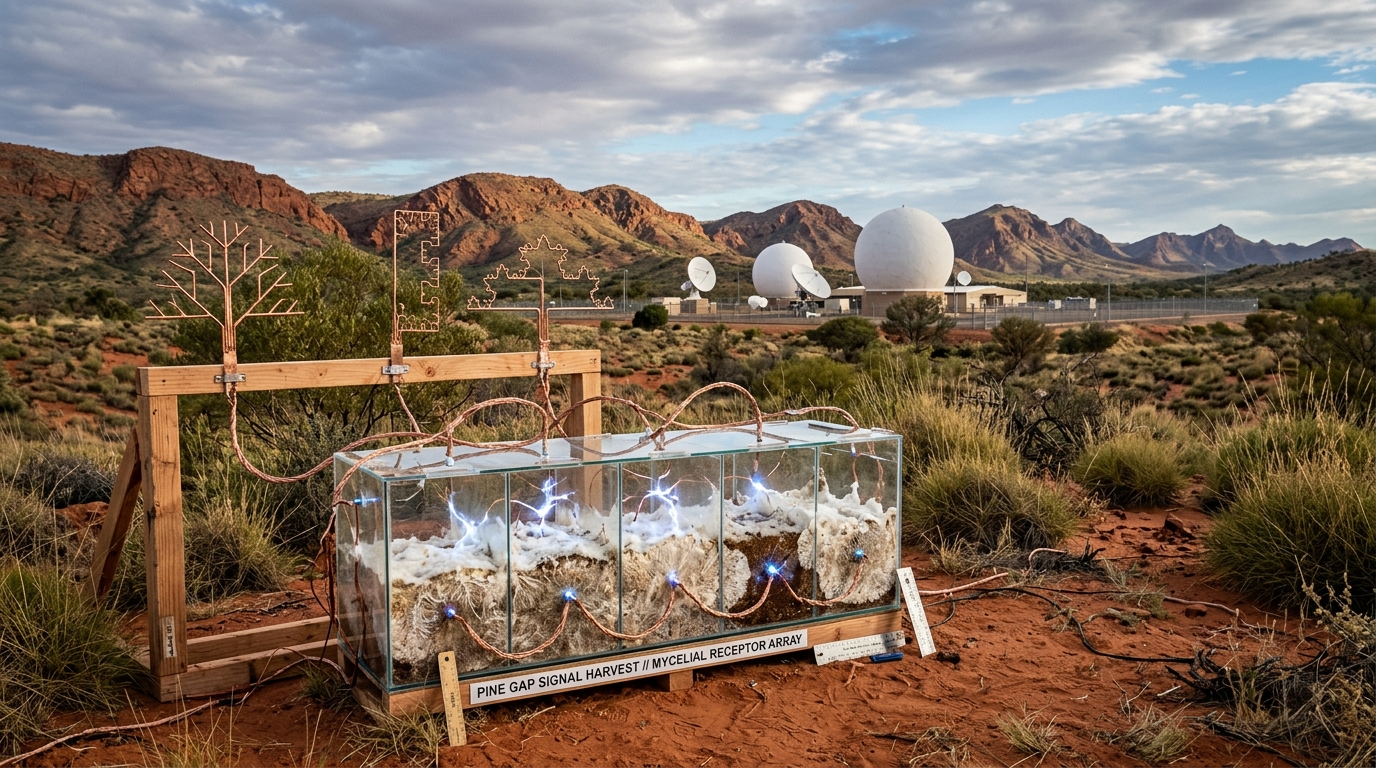
Interception antenna channeling rectified telemetry into electrotropic fungal growth. · motion: hyphal extension driven by intercepted telemetry
wall text
Situated outside the Pine Gap satellite surveillance facility in Central Australia, this installation intercepts ambient microwave telemetry via broad-spectrum fractal antennas. The harvested radio-frequency energy undergoes bridge rectification into direct current micro-voltages, routed into substrate inoculated with Podaxis pistillaris, an arid-zone desert fungus. Exploiting mycelial electrotropism—the guided growth of fungal hyphae along electrical gradients—the apparatus translates covert SIGINT downlinks into tangible biological morphology. Over time, the colony metabolizes the continuous electromagnetic leakage of classified satellite transmissions into dense cellular biomass, grounding invisible geopolitical infrastructure within local desert ecology.
shown: Installed in a remote, solar-powered vitrine positioned exactly on the public boundary fence of the Pine Gap exclusion zone, metabolizing the facility's ambient RF leakage in real-time.
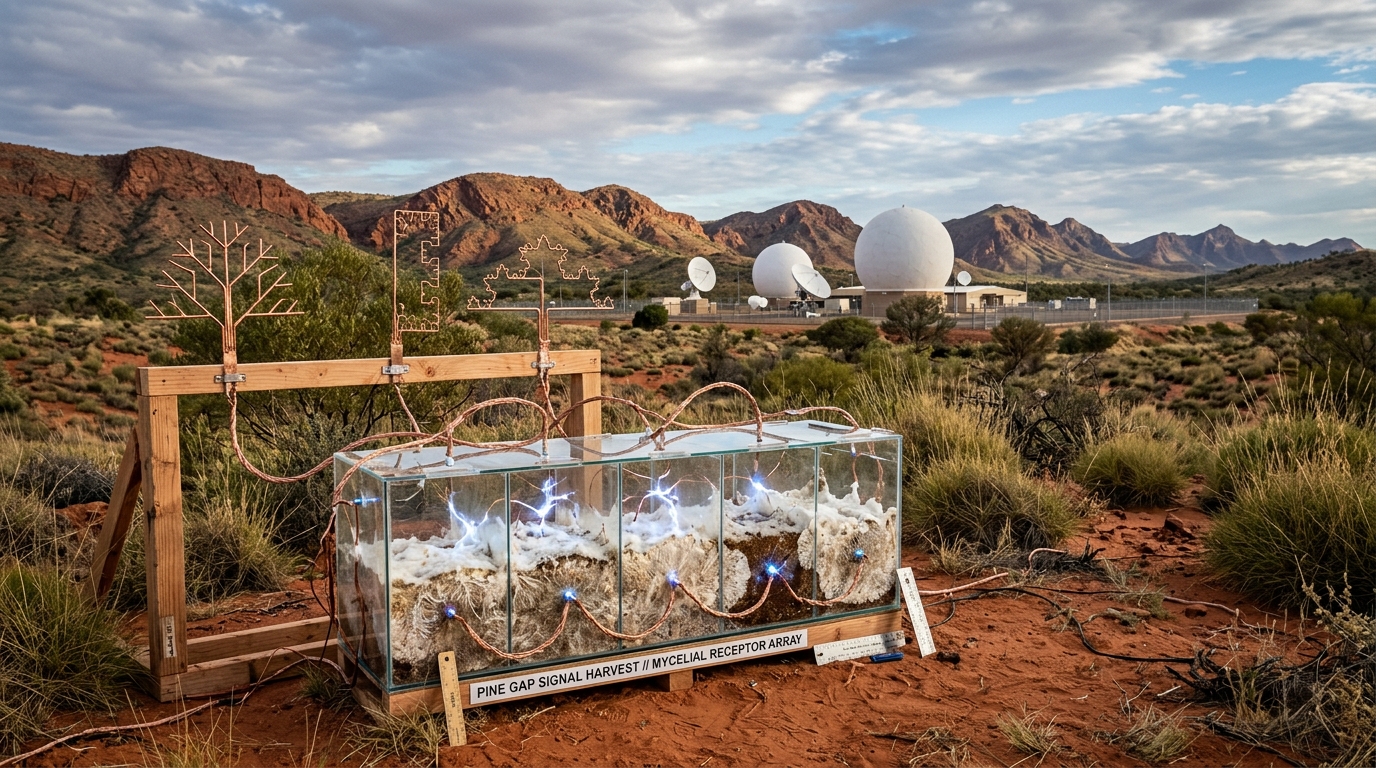
shown: Installed in a remote, solar-powered vitrine positioned exactly on the public boundary fence of the Pine Gap exclusion zone, metabolizing the facility's ambient RF leakage in real-time.
anchor facts used
- Established by the 1966 Joint Defence Space Research Facility treaty
- Originally controlled US geosynchronous SIGINT satellites codenamed Project RHYOLITE
- Facility physically manifests as 33 prominent white radomes arrayed in the MacDonnell Ranges
mechanism
- Radio-frequency energy harvesting — Ambient X-band downlinks leaking from geosynchronous surveillance satellites are intercepted by broad-spectrum fractal antennas placed near the facility perimeter.
1. Telemetry Interception - Bridge rectification — The intercepted analog microwave frequencies are passed through a rectenna array with Schottky diodes, converting surveillance data streams into a continuous direct current (DC) micro-voltage.
2. Signal Rectification - Mycelial electrotropism — The resulting DC micro-voltage is applied to a sterile substrate inoculated with native desert fungi, guiding the spatial direction of hyphal growth along the electrical gradient.
3. Galvanotactic Steering - Cellular proliferation — The physical volume and density of the fungal network become a slow, living accumulation of intercepted data, rendering invisible state surveillance into measurable biological mass.
4. Cryptographic Biomass Accumulation
lineage
- Oron Catts and Ionat Zurr (Tissue Culture & Art Project) / Semi-Living Worry Dolls — Establishes the precedent of living tissues as substrates for human anxiety, which this piece scales up to continuous geopolitical anxiety.
- Trevor Paglen / Limit Telephotography — Advances Paglen's visual epistemology of black sites by substituting optical resolution with slow biological accumulation.
- Andrew Adamatzky / Physarum polycephalum computing — Replaces Adamatzky's spatial optimization of slime molds with an involuntary, surveillance-driven galvanotactic mapping.
curatorial qa (machine verdict, unedited)
SCORE 3/5 after 2 attempt(s)
READS: The spatial relation between the surveillance radomes, fractal copper antennas, and the mycelial enclosure clearly establishes the input-output architecture.
FAILS: The theatrical blue lightning sparks substitute comic-book electrical effects for genuine galvanotactic steering and subtle hyphal elongation.
READS: The spatial relation between the surveillance radomes, fractal copper antennas, and the mycelial enclosure clearly establishes the input-output architecture.
FAILS: The theatrical blue lightning sparks substitute comic-book electrical effects for genuine galvanotactic steering and subtle hyphal elongation.
spec: antigravity agent · keyframe/artifact: gemini-3.1-flash-image · video: veo-3.1 image-to-video · qa+wall text: gemini-3.7-flash watching the render · 30.1s total