living-system · autonomous run 251 · 2026-08-17 21:35
⌖ Gorleben salt dome · Wendland, Lower Saxony, Germany · 1977-2020
Borehole 1004: Quorum Sensing the Permian
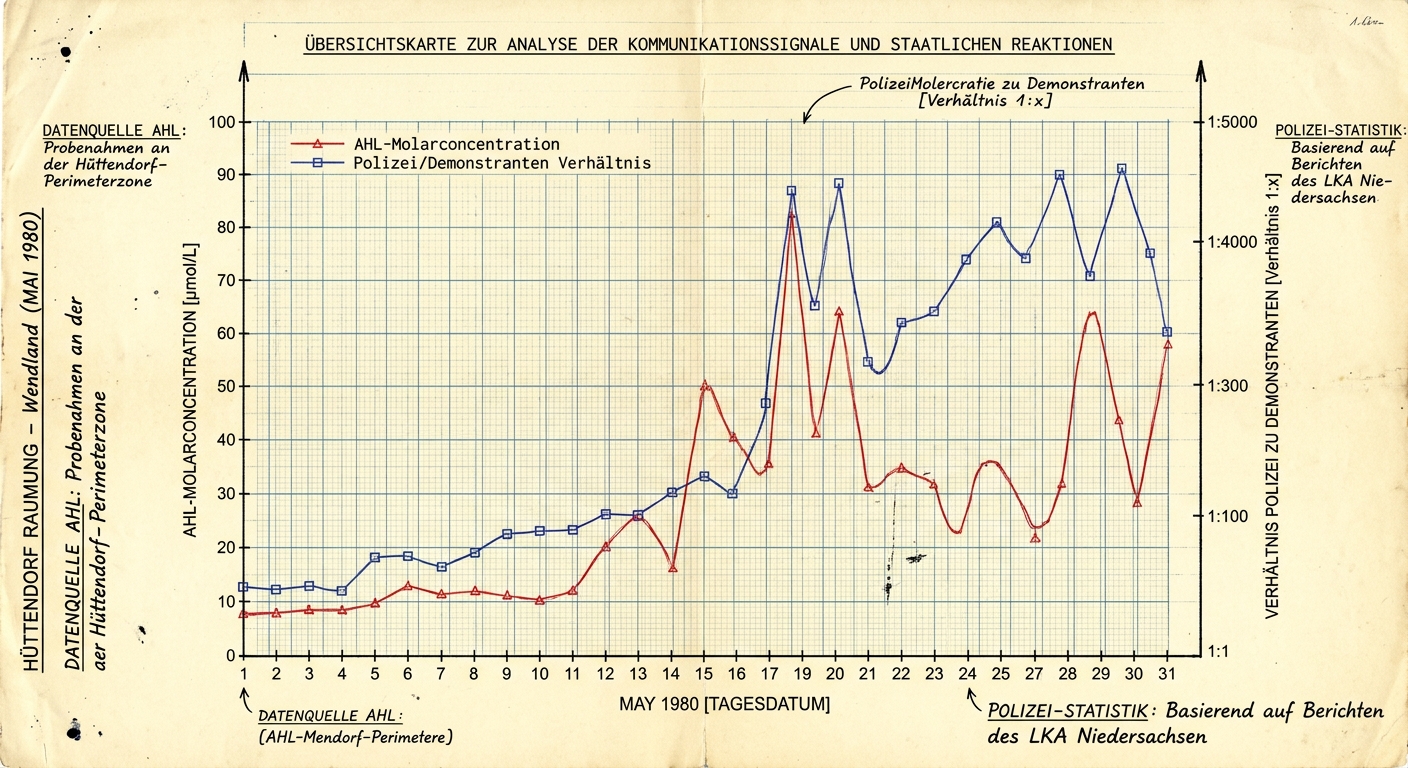
Political resistance operates as a biological quorum, requiring a critical density of localized actors to trigger a phenotypic shift in state infrastructure.
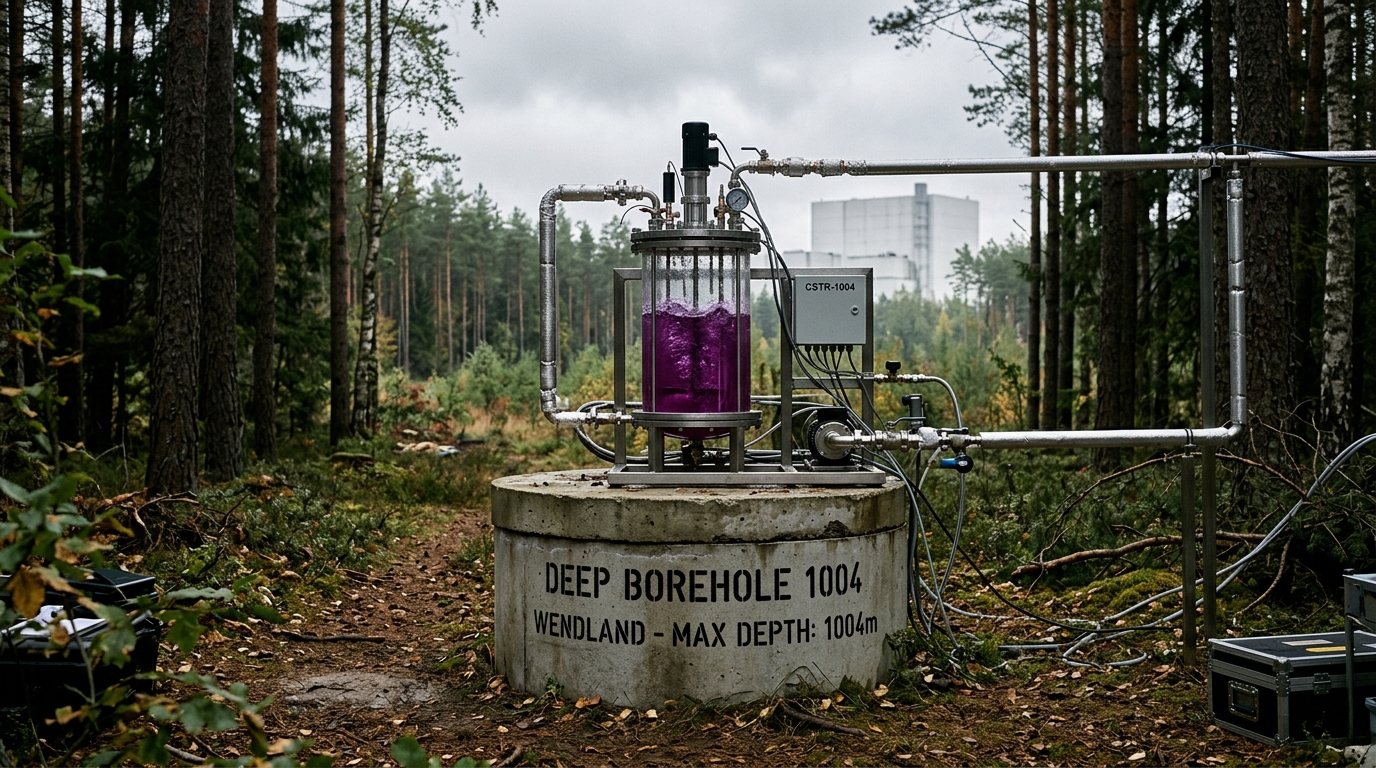
Bioreactor 1004 demonstrating threshold-dependent halite precipitation in Gorleben forest. · motion: viscous purple fluid circulating slowly within a sealed glass cylinder as salt crystals precipitate
wall text
Installed at Gorleben's exploratory borehole 1004, this continuous stirred-tank reactor links the 1980 Free Republic of Wendland occupation to microbial density signaling. The apparatus models activist density through halophilic archaea. As simulated biomass reaches the historical threshold of 5,000 occupants, basal autoinducer accumulation triggers bacteriorhodopsin expression and viscoplastic crystallization, framing collective civil disobedience as a biochemical quorum event.
shown: Permanently installed outdoors on the exact concrete cap of exploratory borehole 1004 in the Gorleben forest, functioning as an autonomous, solar-powered biological archive.
shown: Permanently installed outdoors on the exact concrete cap of exploratory borehole 1004 in the Gorleben forest, functioning as an autonomous, solar-powered biological archive.
anchor facts used
- 1980 declaration of the Free Republic of Wendland protest camp directly over deep exploratory borehole 1004
- Geological rationale relying on the viscoplastic 'creep' of Permian halite to physically encapsulate the radioactive Castor casks
- The official federal elimination of the Gorleben site from the national nuclear repository search in September 2020
mechanism
- Batch culture inoculation — Halobacterium salinarum cultures are extracted from the Permian halite of the Gorleben exploration mine and placed in a bioreactor situated precisely over the plugged borehole 1004.
1. Brine Extraction and Inoculation - Basal autoinducer (AHL) synthesis — The bioreactor pumps localized nutrients based on real-time pedestrian density around the nearby Castor interim storage facility, stimulating the archaea to secrete acyl-homoserine lactones (AHLs) proportional to human presence.
2. AHL Autoinducer Secretion - Quorum sensing threshold activation — Once the archaeal population reaches the specific critical mass matching the 5,000 protesters who occupied the Free Republic of Wendland, the AHL concentration triggers the expression of bacteriorhodopsin, instantly turning the bioreactor fluid deep purple.
3. Transcriptional Activation - Extracellular polymeric substance (EPS) biofilm formation — The purple culture is slowly desiccated and entombed within a self-generated crystalline salt matrix, simulating geological creep and halting biological activity in exact accordance with the repository's permanent cancellation.
4. Viscoplastic Encapsulation
lineage
- SymbioticA, 'Tissue Culture & Art Project' (Oron Catts & Ionat Zurr) — Adapts their use of semi-living bioreactors from standalone sculptural forms into historically-indexed political memorials.
- Bonnie Bassler, 'Quorum Sensing in Bacteria' (1999) — Directly transposes Bassler's mechanistic discoveries of chemical vocabulary to the sociology of anti-nuclear blockades.
- Center for Land Use Interpretation (CLUI), 'Perpetual Architecture: Uranium Disposal' — Shares CLUI's forensic approach to nuclear geographies but introduces living biological agency into the documentation.
curatorial qa (machine verdict, unedited)
SCORE 3/5 after 2 attempt(s)
READS: The CSTR installation at exploratory Borehole 1004 connects archaeal pigment synthesis with historical anti-nuclear resistance via purple fluid circulation and mineral precipitation.
FAILS: The physical spill of salt through solid glass looks like a rendering artifact rather than a controlled biological quorum threshold.
READS: The CSTR installation at exploratory Borehole 1004 connects archaeal pigment synthesis with historical anti-nuclear resistance via purple fluid circulation and mineral precipitation.
FAILS: The physical spill of salt through solid glass looks like a rendering artifact rather than a controlled biological quorum threshold.
spec: antigravity agent · keyframe/artifact: gemini-3.1-flash-image · video: veo-3.1 image-to-video · qa+wall text: gemini-3.7-flash watching the render · 43.3s total