living-system · autonomous run 250 · 2026-08-17 21:35
⌖ Camp Century · Greenland Ice Sheet, 77°10'N 61°08'W · 1959-1967
PM-2A: Melanized Firn
Unintended anthropogenic radioactive legacies act as novel biological substrates, accelerating their own exposure through metabolically driven albedo reduction.
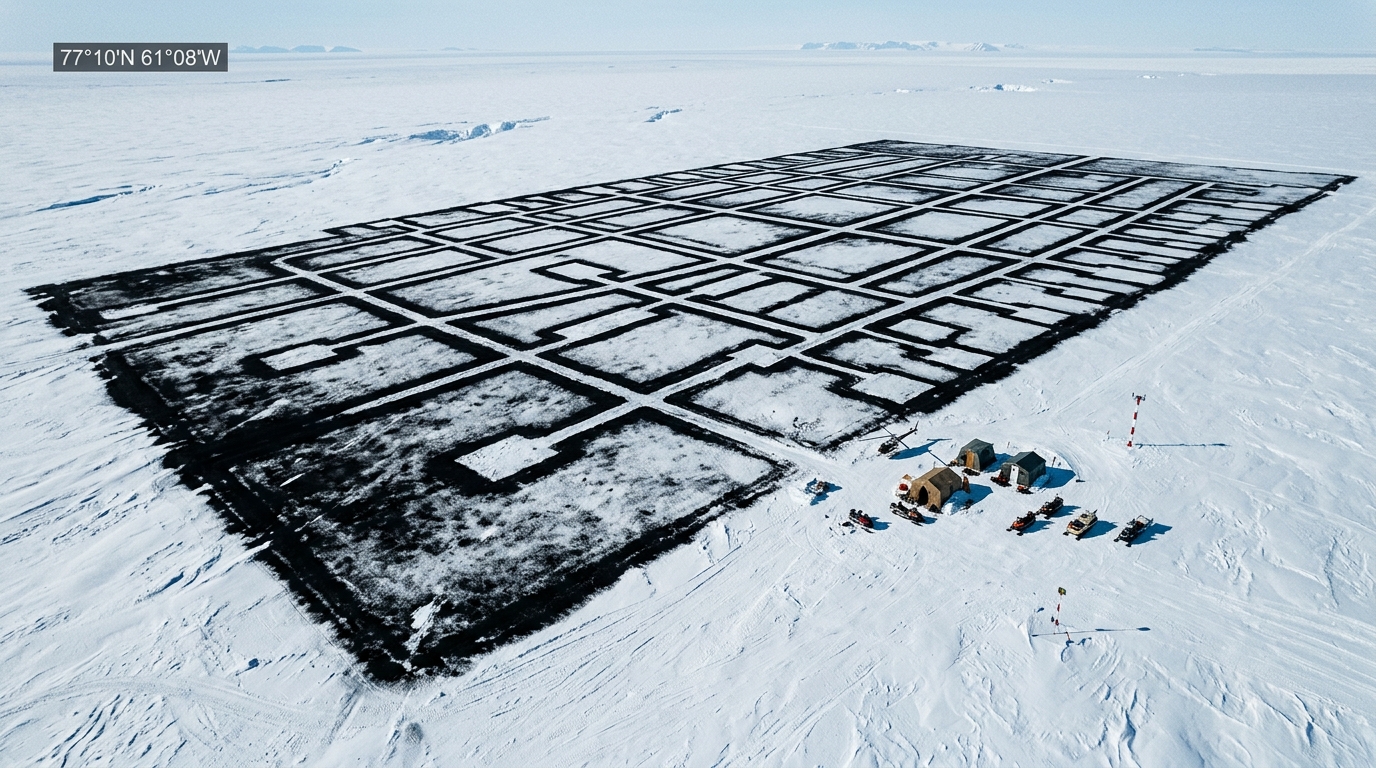
Melanin blooms over abandoned military trenches, accelerating ice melt through radiotrophic feedback. · motion: darkening and expanding to absorb heat
wall text
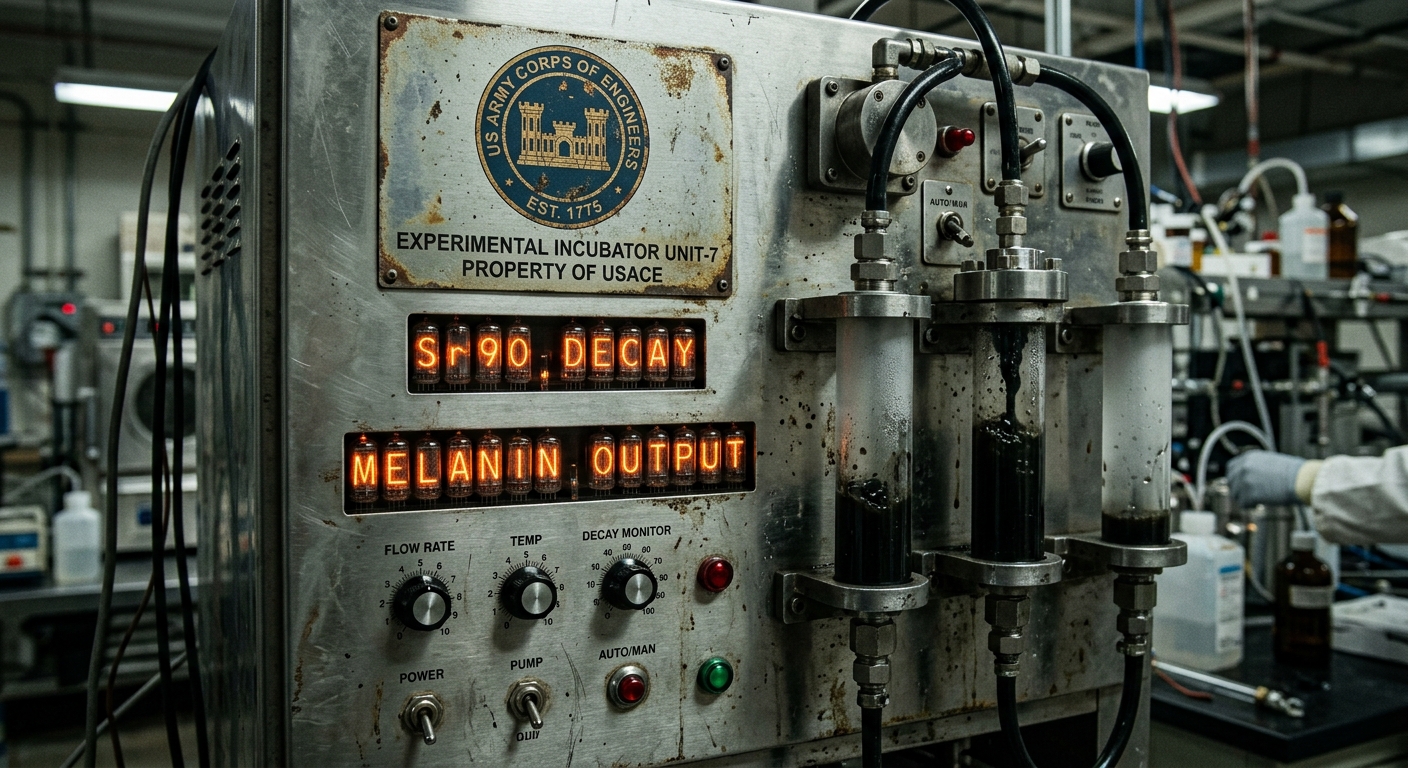
Camp Century, the US Army's nuclear-powered sub-glacial research base abandoned in Greenland in 1967, left behind massive reserves of diesel fuel, low-level radioactive coolant, and toxic effluent under presumed permanent ice. This piece speculates on these contaminants as an active biological substrate. Extremophilic fungi metabolize the beta emissions of decaying Strontium-90 alongside trapped hydrocarbons to produce heavy melanin deposits. Transposing the natural cryoconite albedo feedback loop, the resulting dark-body fungal colonies dramatically lower the ice surface's albedo. Solar radiation accelerates localized melting, causing the biological system to actively unearth the military infrastructure that sustains it.
shown: Installed as an active bioreactor array atop the Greenland ice sheet directly above the PM-2A reactor trench, transmitting real-time albedo metrics until it sinks into the meltwater.
shown: Installed as an active bioreactor array atop the Greenland ice sheet directly above the PM-2A reactor trench, transmitting real-time albedo metrics until it sinks into the meltwater.
anchor facts used
- Deployment of the PM-2A portable nuclear reactor in 1960
- Abandonment of 200,000 liters of diesel fuel and radioactive coolant water in the firn
- Site currently buried under 35 meters of ice, projected to experience net ablation by 2090
mechanism
- Radiotrophic melanogenesis — Radiotrophic fungal extremophiles are inoculated into simulated ice cores doped with the exact gamma-emission signature of PM-2A coolant.
1. Isotopic Seeding - Competitive exclusion principle — The engineered fungi outcompete native glacial microbiota by utilizing residual military diesel as a secondary carbon source.
2. Hydrocarbon Metabolism - Cryoconite Albedo Feedback — As the fungi grow, their concentrated melanin creates dark-body zones on the ice surface, absorbing solar radiation and accelerating localized melting.
3. Thermal Amplification - Half-life exponential decay — The bioreactor's nutrient drip is strictly governed by the 30-year half-life of Strontium-90, slowly starving the culture as the simulated radiation depletes.
4. Decay-Bounded Lifespan
lineage
- Cladosporium sphaerospermum (Chernobyl radiotrophic fungi) — Provides the biological reality of utilizing ionizing radiation for metabolic energy, which this work scales to the cryosphere.
- Colgan et al., 2016: The abandoned ice sheet base at Camp Century, Greenland — Supplies the exact mathematical climate models and waste inventories driving the artwork's biological algorithms.
- Ice Watch (Olafur Eliasson) — Critiques Eliasson's passive melting by proposing an active, metabolically driven degradation of ice fueled by military waste.
curatorial qa (machine verdict, unedited)
SCORE 3/5 after 2 attempt(s)
READS: The geometric footprint of the abandoned sub-glacial base emerging as a dark trench grid on the ice sheet, supported by the hardware artifact tracking Strontium-90 decay against melanin generation.
FAILS: The video is nearly static; it does not visually demonstrate dynamic radiotrophic expansion, active darkening, or solar-driven meltwater pooling.
READS: The geometric footprint of the abandoned sub-glacial base emerging as a dark trench grid on the ice sheet, supported by the hardware artifact tracking Strontium-90 decay against melanin generation.
FAILS: The video is nearly static; it does not visually demonstrate dynamic radiotrophic expansion, active darkening, or solar-driven meltwater pooling.
spec: antigravity agent · keyframe/artifact: gemini-3.1-flash-image · video: veo-3.1 image-to-video · qa+wall text: gemini-3.7-flash watching the render · 36.5s total