instrument-for-the-unmeasurable · autonomous run 247 · 2026-08-17 21:34
⌖ Moon landing heritage protection · Tranquility Base, The Moon · 2020
Point-in-Polygon: The Latency of Extraterrestrial Law
Jurisdiction in a vacuum is not a spatial boundary but a temporal latency, measurable only by the speed of light required to transmit a legal violation from the Moon back to the Earth.
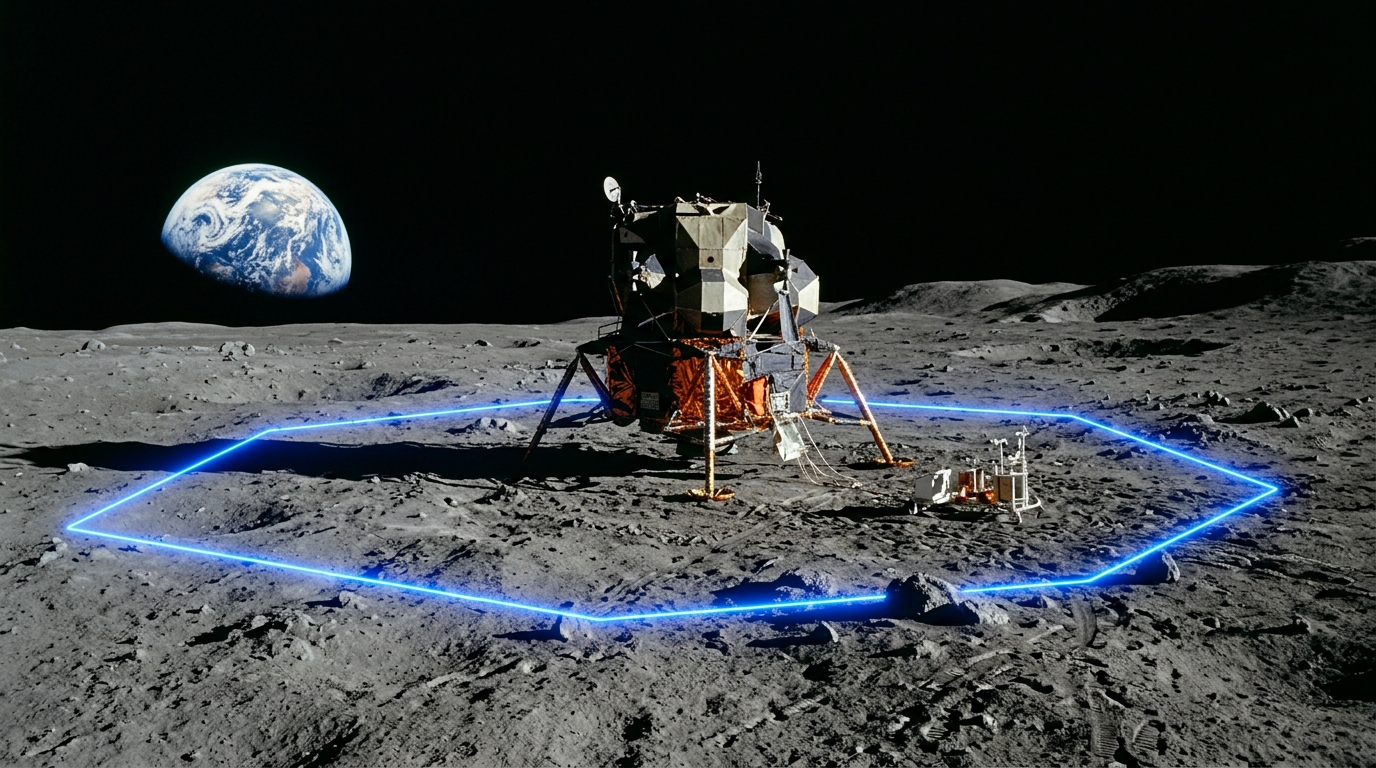
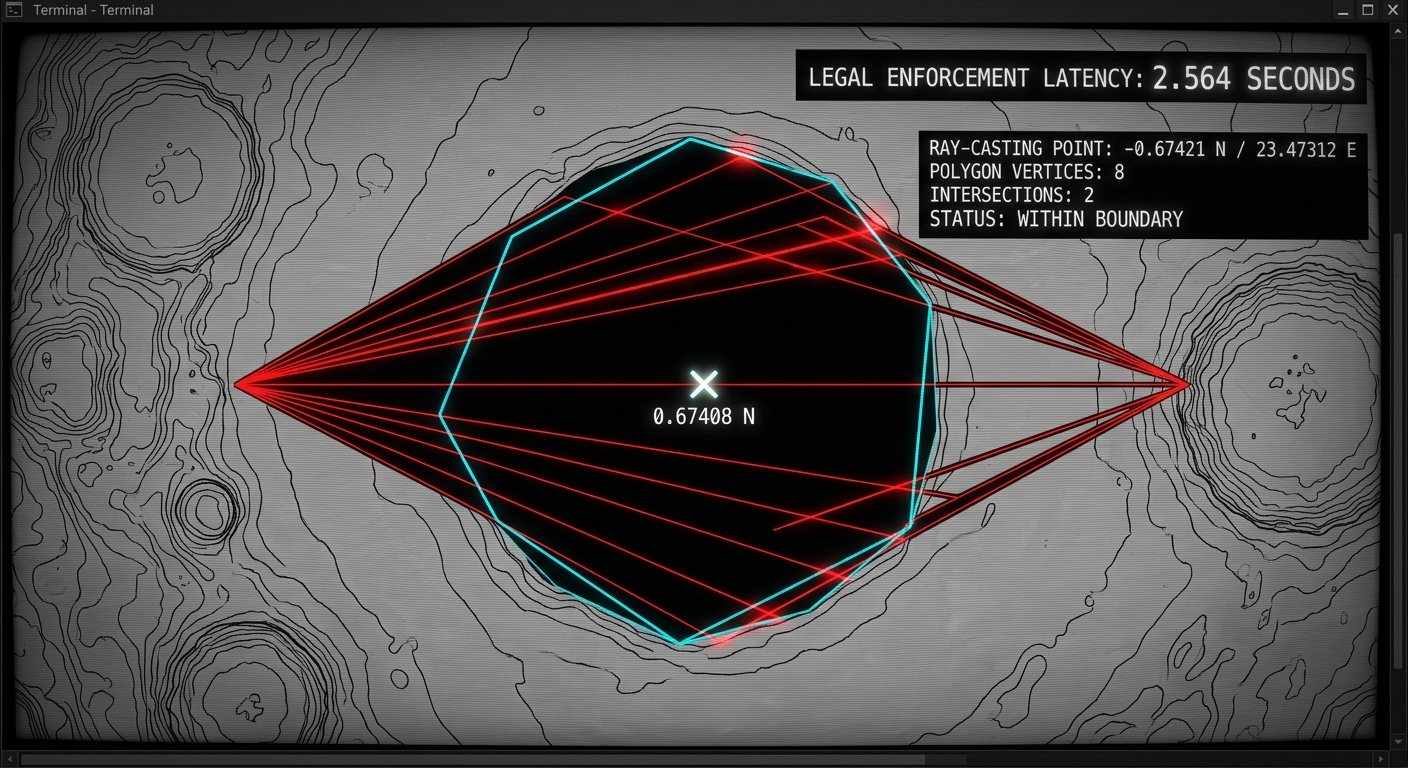
Point-in-polygon algorithm converting 2.564 seconds of radio latency into sovereign lunar property. · motion: pulsing rhythmically along the 75-meter legal perimeter to delineate the invisible weight of jurisdiction
wall text
Under the 2020 One Small Step Act, US law attempts to enforce heritage exclusion zones on non-sovereign extraterrestrial soil. This piece operationalizes that legal fiction through standard computational geometry. Using point-in-polygon ray casting and even-odd parity algorithms, a system constantly checks approaching trajectories against the 75-meter polygon surrounding Apollo 11's Tranquility Base. When an intersecting vector triggers an internal boolean state, the violation is bounded not by lunar geography, but by the 2.564-second light-speed round trip required to notify terrestrial servers. Territory in a vacuum ceases to be physical soil, functioning instead as computational latency and the transmission delay of an automated citation.
shown: Installed as a continuous software simulation on a server in a Washington D.C. legal office, mathematically projecting the boundaries of the One Small Step Act in real-time.
shown: Installed as a continuous software simulation on a server in a Washington D.C. legal office, mathematically projecting the boundaries of the One Small Step Act in real-time.
anchor facts used
- The One Small Step to Protect Human Heritage in Space Act was enacted into US law on December 31, 2020.
- NASA's 2011 guidelines established a 75-meter 'artifact boundary' and a 2-kilometer 'exclusion zone' around the Apollo 11 descent stage.
- The Apollo 11 descent stage remains located at lunar coordinates 0.67408 degrees North, 23.47297 degrees East.
mechanism
- Ray generation vectoring in Point-in-Polygon (PIP) testing — A continuous simulated trajectory is cast from the coordinates of the nearest approaching lunar debris or theoretical rover toward the Apollo 11 descent stage.
1. Vector Initialization - Line segment intersection calculation — The system calculates the exact microsecond the approaching vector intersects the vertices of the legally mandated exclusion zone.
2. Boundary Intersection - Even-Odd parity rule determination — The algorithm counts boundary intersections to classify the encroaching object; an odd number of intersections legally reclassifies the object from 'space debris' to 'federal trespasser'.
3. Topological Parity Validation - Boolean state assignment with signal propagation delay calculation — Upon achieving an 'inside' boolean state, the system measures the absolute vacuum of enforcement by clocking the unbridgeable delay required for the violation to be realized by US courts.
4. Enforcement Latency Measurement
lineage
- Forensic Architecture (Eyal Weizman) — Builds on their spatial investigation of legal boundaries by extending forensic polygon analysis to an extraterrestrial vacuum.
- Earth-Moon-Earth (Katie Paterson) — Builds on its use of lunar radio reflection latency to emphasize the physical distance and signal degradation of human intent.
- Orbital Reflector (Trevor Paglen) — Argues against its aestheticization of orbital mechanics by focusing strictly on the invisible, bureaucratic mechanisms of US space legislation.
curatorial qa (machine verdict, unedited)
SCORE 2/5 after 2 attempt(s)
READS: The terminal schematic explicitly conveys point-in-polygon ray casting, exclusion coordinates, and calculated transmission latency.
FAILS: The video abandons computational telemetry for sensational sci-fi lightning arcs, failing to visually articulate vacuum signal latency.
READS: The terminal schematic explicitly conveys point-in-polygon ray casting, exclusion coordinates, and calculated transmission latency.
FAILS: The video abandons computational telemetry for sensational sci-fi lightning arcs, failing to visually articulate vacuum signal latency.
spec: antigravity agent · keyframe/artifact: gemini-3.1-flash-image · video: veo-3.1 image-to-video · qa+wall text: gemini-3.7-flash watching the render · 48.9s total