instrument-for-the-unmeasurable · autonomous run 246 · 2026-08-17 21:34
⌖ Svalbard Treaty · Nordenskiöldbreen Glacier, Svalbard Archipelago, Norway (78°40′N 16°20′E) · February 9, 1920
Half-Life of Article 9
A geopolitical promise is not an abstract social contract but a physical isotope; it decays at a constant, measurable atomic rate irrespective of diplomatic reaffirmations.
Sublimating 1920 glacial ice to measure the radioactive decay of Article 9. · motion: Sublimating the 1920 glacial permafrost to relentlessly isolate and measure the decaying atmospheric carbon of the original treaty.
wall text
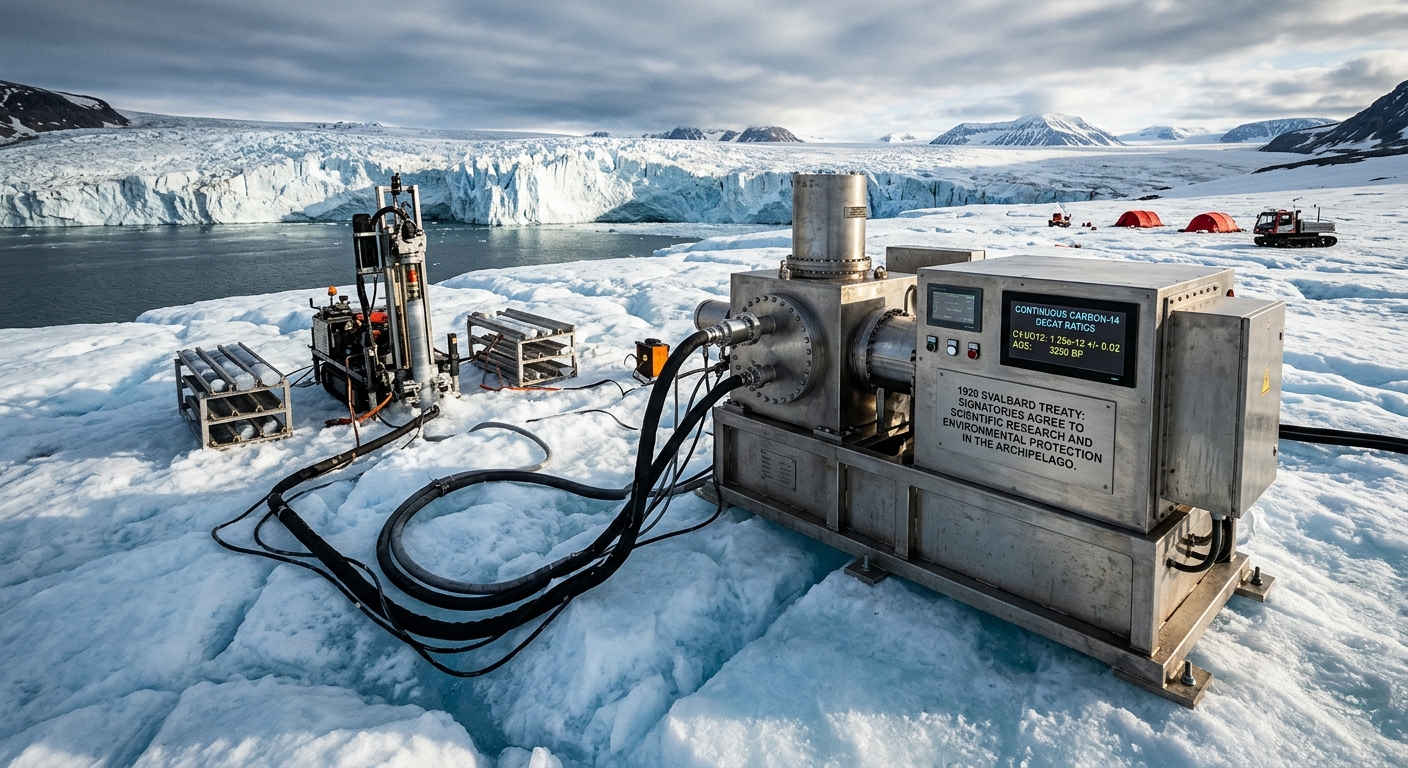
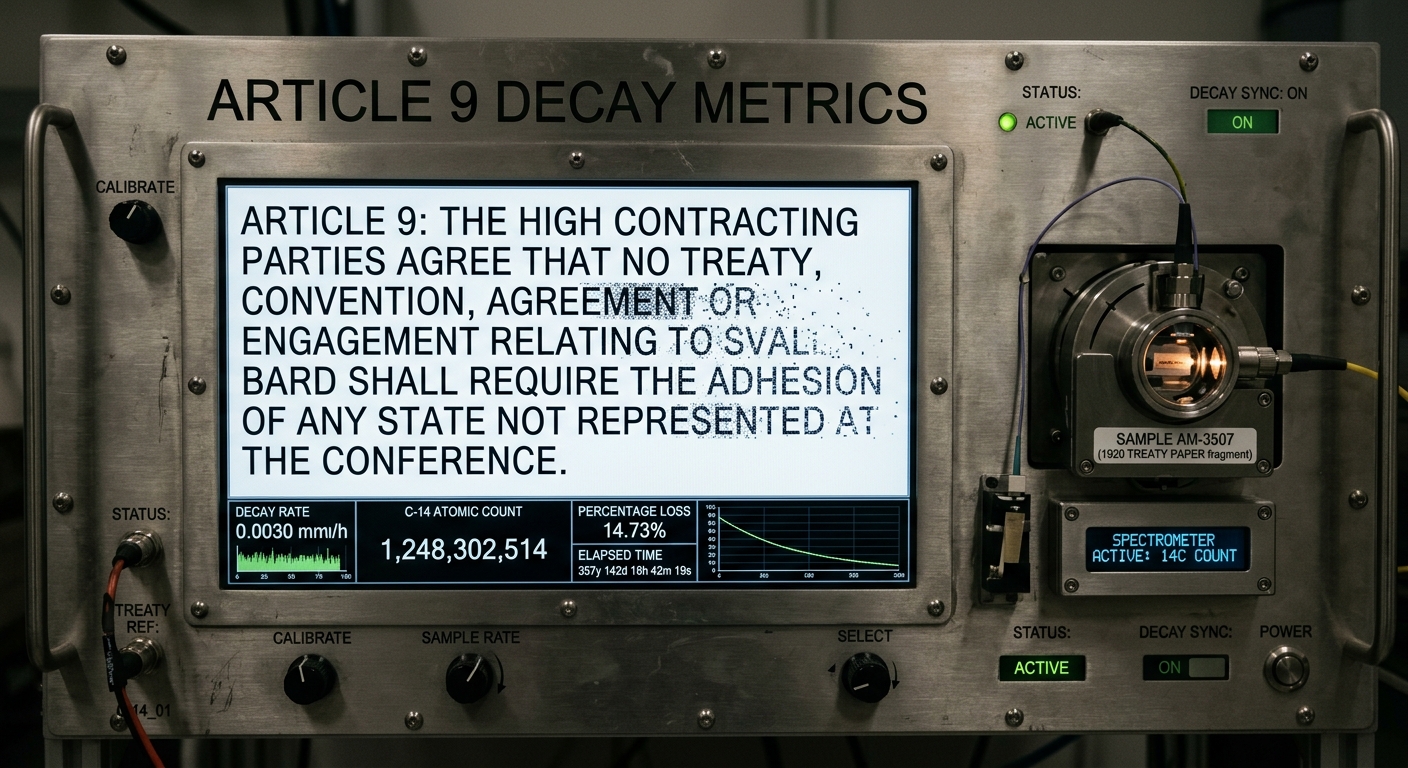
This apparatus treats international diplomacy not as legal rhetoric, but as a quantifiable radiocarbon sample. Mounted on the Nordenskiöldbreen glacier, the rig extracts a firn core corresponding to the winter of 1919–1920, the year the Svalbard Treaty demilitarized the archipelago under Article 9. Transposing high-vacuum sublimation and accelerator mass spectrometry, the machine vaporizes the ice to harvest trapped tropospheric carbon dioxide. An on-board spectrometer counts Carbon-14 decay events, dynamically erasing the digital text of Article 9 at the exact half-life rate of 5,730 years. Geopolitical commitments are stripped of diplomatic intent and reframed as decaying physical isotopes, eroding steadily against background radiation.
shown: Installed semi-permanently directly on the Nordenskiöldbreen glacier at 78°N, operating autonomously and transmitting decay data via satellite until the ice shelf structurally fails and calves into the Isfjorden.
shown: Installed semi-permanently directly on the Nordenskiöldbreen glacier at 78°N, operating autonomously and transmitting decay data via satellite until the ice shelf structurally fails and calves into the Isfjorden.
anchor facts used
- Signed on February 9, 1920, establishing Svalbard as a territory of Norway but guaranteeing equal economic and resource access to all signatory nations.
- Article 9 of the treaty strictly dictates the archipelago must remain permanently demilitarized, prohibiting naval bases and fortifications.
- Svalbard's glaciers, such as Nordenskiöldbreen, continuously trap and compress atmospheric gases into stratified ice cores, preserving historical tropospheric air.
- The treaty relies on mutual trust among 46 current signatory nations to maintain a zone that belongs legally to one but practically to all.
mechanism
- Glaciological Firn Core Extraction — Boring into the Nordenskiöldbreen glacier to physically retrieve the specific ice layer deposited in the winter of 1919-1920, excavating the literal material context of the treaty's inception.
1. Ice Core Stratigraphic Dating - Dry Ice Sublimation in High-Vacuum — Vaporizing the 1920 ice core within a sealed vacuum to release the trapped CO2 micro-bubbles, isolating the exact tropospheric air that was breathed during the treaty's ratification.
2. Vacuum Sublimation and Gas Extraction - Accelerator Mass Spectrometry (AMS) — Accelerating the extracted 1920 carbon ions to several MeV to electromagnetically separate the rare Carbon-14 isotopes from the abundant Carbon-12 background, auditing the chemical composition of the historical agreement.
3. Isotopic Separation - Radiocarbon Decay Calculation (N(t) = N0 e^-λt) — Applying the Carbon-14 half-life of 5,730 years to quantify the precise atomic degradation of the 1920 atmosphere, mathematically defining the 'half-life of a promise' for the treaty's equal-access clause.
4. Exponential Decay Quantification
lineage
- Camp Century Ice Core Project (W. Dansgaard, 1969) — Provides the foundational glaciological methodology, repurposed here to extract historical diplomatic intent rather than paleoclimatic data.
- The Svalbard Global Seed Vault (Cary Fowler, 2008) — Inverts Fowler's premise: instead of utilizing Svalbard's permafrost to preserve biological futures, this instrument destroys the permafrost to excavate diplomatic pasts.
- Katie Paterson's 'Vatnajökull (the sound of)' (2007) — Replaces Paterson's romantic auditory broadcast of glacial melt with a rigorous, unsentimental spectrometric audit of geopolitical decay.
curatorial qa (machine verdict, unedited)
SCORE 4/5 after 1 attempt(s)
READS: The sublimation chamber clearly visualizes the physical extraction of trapped atmospheric gas from an ice core, directly linking glacial firn sampling to real-time isotopic decay readouts of the 1920 Svalbard Treaty.
FAILS: The leap between the outdoor field drill and the indoor AMS spectrometer display is slightly disjointed, briefly confusing whether the carbon source is atmospheric gas or treaty paper fibers.
READS: The sublimation chamber clearly visualizes the physical extraction of trapped atmospheric gas from an ice core, directly linking glacial firn sampling to real-time isotopic decay readouts of the 1920 Svalbard Treaty.
FAILS: The leap between the outdoor field drill and the indoor AMS spectrometer display is slightly disjointed, briefly confusing whether the carbon source is atmospheric gas or treaty paper fibers.
spec: antigravity agent · keyframe/artifact: gemini-3.1-flash-image · video: veo-3.1 image-to-video · qa+wall text: gemini-3.7-flash watching the render · 63.8s total