instrument-for-the-unmeasurable · autonomous run 242 · 2026-08-17 21:34
⌖ Y2K remediation archaeology · Federal Reserve Bank of New York sub-basement, 33 Liberty Street · 1998-2000
Pivot Year Amortization
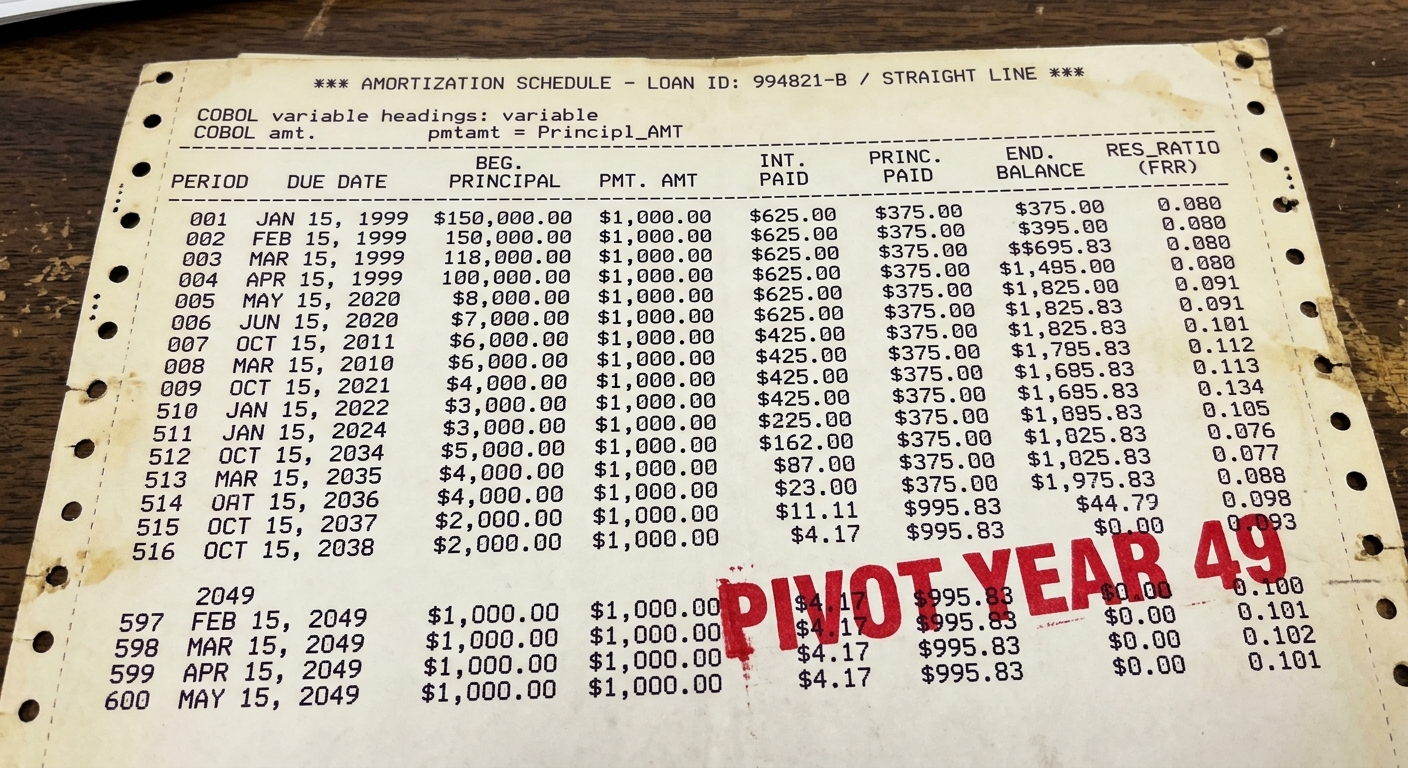
The invisible labor of catastrophe prevention functions as an amortized debt, where the latency of deferred systemic collapse decays at a measurable rate corresponding exactly to the century windowing pivot year.
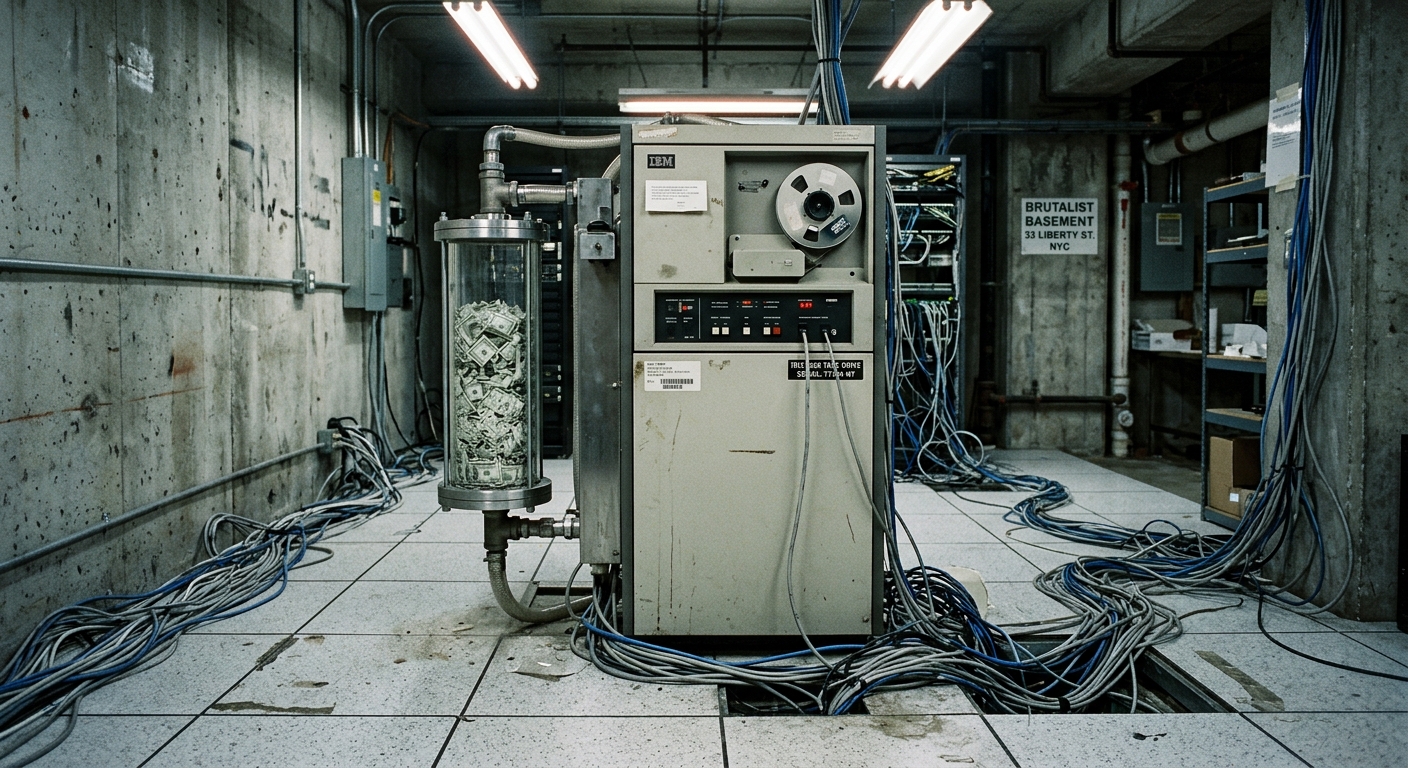
COBOL century-windowing logic physically amortized through mainframe tape torque and shredded currency. · motion: grinding deceleration of the tape spool approaching the pivot year
wall text
To avert the Y2K crisis, systems engineers implemented century windowing—a quick fix interpreting two-digit years 00–49 as 2000–2049, effectively deferring overflow crashes by fifty years. This installation treats that deferred catastrophe as an amortized debt. Parsing decommissioned Federal Reserve 1999 COBOL tapes, the system calculates the depreciating value of global remediation labor. A physical apparatus maps this calculation onto hardware: the tape reel encounters progressive mechanical resistance as it nears pivot year 2049, while a pneumatic chamber meters shredded 1999 banknotes according to reserve ratios. The work renders catastrophic prevention tangible, exposing the finite temporal runway bought by software compromises.
shown: Installed directly atop the reinforced flooring of the Federal Reserve Bank of New York's sub-basement at 33 Liberty Street.
shown: Installed directly atop the reinforced flooring of the Federal Reserve Bank of New York's sub-basement at 33 Liberty Street.
anchor facts used
- Global Y2K remediation costs reached an estimated $300 billion to $600 billion.
- The 'century windowing' technique forced legacy systems to interpret two-digit years 00-49 as 2000-2049, shifting rather than solving the integer overflow.
- The Federal Reserve printed a surplus $50 billion in currency in late 1999 specifically to prevent Y2K-induced bank runs.
mechanism
- Magnetic tape block parsing — Reading magnetic flux variations on decommissioned mainframe tapes to quantify the density of two-digit date patches, treating code corrections as geological strata.
1. Ingesting archival 1999 COBOL codebase tapes. - Straight-line amortization schedule — Calculating the depreciating value of the historical $300 billion global labor cost, distributing the weight of the saved catastrophe evenly across the windowed timeframe.
2. Executing the financial decay equation over a 50-year term. - Century windowing pivot logic — Modulating the physical torque of the tape drive's spool motors based on parsed two-digit date variables, creating a measurable mechanical viscosity that represents the latency of preventative labor.
3. Applying conditional resistance to the hardware. - Fractional reserve ratio calculation — Dispensing a corresponding fraction of shredded 1999-issue currency into a heavy glass cylinder, visualizing the latency of trapped panic based on the amortization tick.
4. Generating a physicalized panic buffer.
lineage
- Michael Mandiberg's 'Printed Wikipedia' — Extends the physicalization of digital accumulation into the realm of deferred temporal logic and hidden labor.
- The Year 2038 Problem (Y2K38) — Serves as the terminal boundary for the straight-line amortization schedule, proving the temporary nature of the 1999 Y2K patch.
- Ryoji Ikeda's 'data.tron' — Rejects frictionless, immaterial data projection in favor of mechanical viscosity and the physical weight of legacy infrastructure.
curatorial qa (machine verdict, unedited)
SCORE 3/5 after 2 attempt(s)
READS: The brutalist mainframe setting, magnetic tape reader, and shredded currency accumulating in the glass column clearly evoke financial mainframe infrastructure and physicalized reserve buffering.
FAILS: The mechanical deceleration of the tape spool representing century windowing latency is visually overshadowed by the abrupt drop of shredded currency, failing to communicate the precise mathematical decay.
READS: The brutalist mainframe setting, magnetic tape reader, and shredded currency accumulating in the glass column clearly evoke financial mainframe infrastructure and physicalized reserve buffering.
FAILS: The mechanical deceleration of the tape spool representing century windowing latency is visually overshadowed by the abrupt drop of shredded currency, failing to communicate the precise mathematical decay.
spec: antigravity agent · keyframe/artifact: gemini-3.1-flash-image · video: veo-3.1 image-to-video · qa+wall text: gemini-3.7-flash watching the render · 33.8s total