instrument-for-the-unmeasurable · autonomous run 240 · 2026-08-17 21:34
⌖ Subsea cable landing stations · Porthcurno Valley and Beach, Cornwall, UK · 1870-present
Optical Time-Domain Mourning (PK-1870)
The geographical latency of institutional memory can be physically mapped as an optical signal dispersion curve, where the decay of documented grief precisely mirrors the photon scattering in subsea fiber glass.
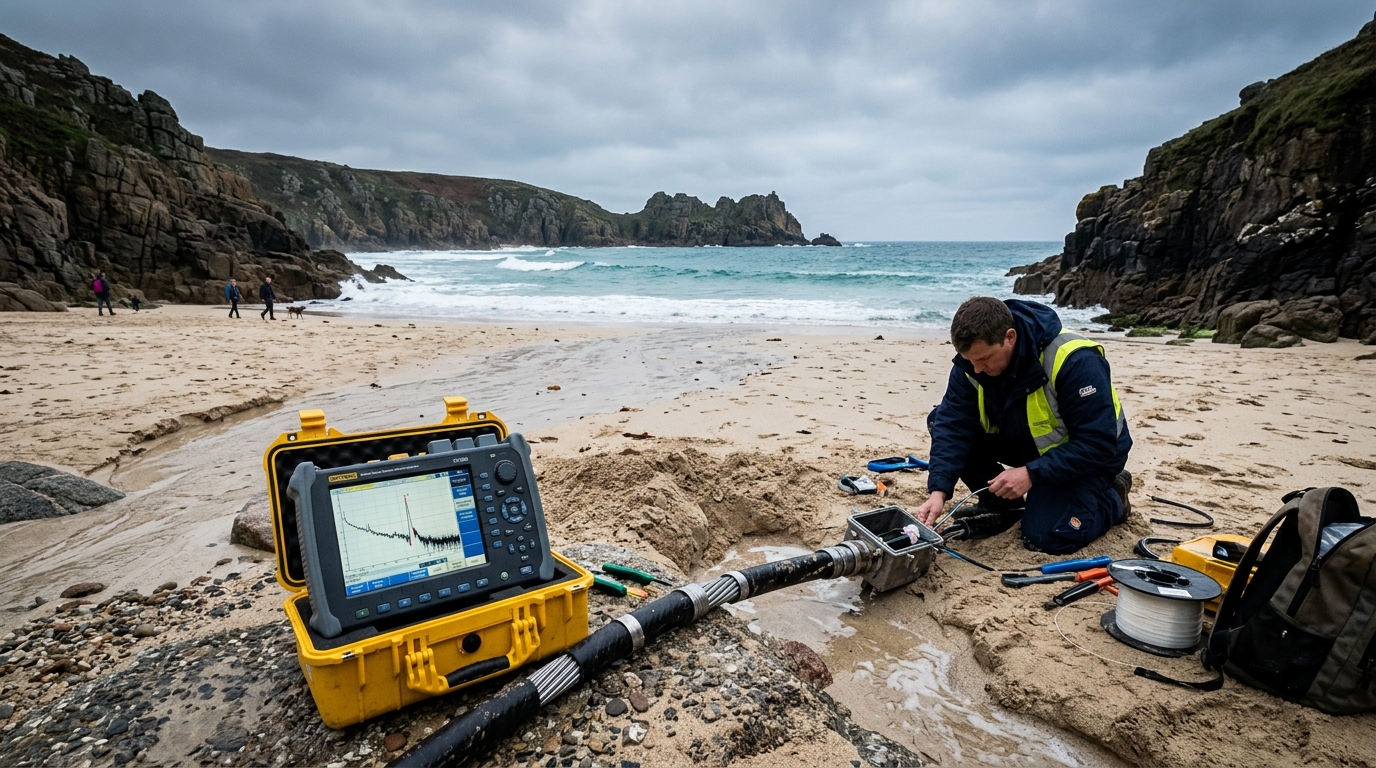
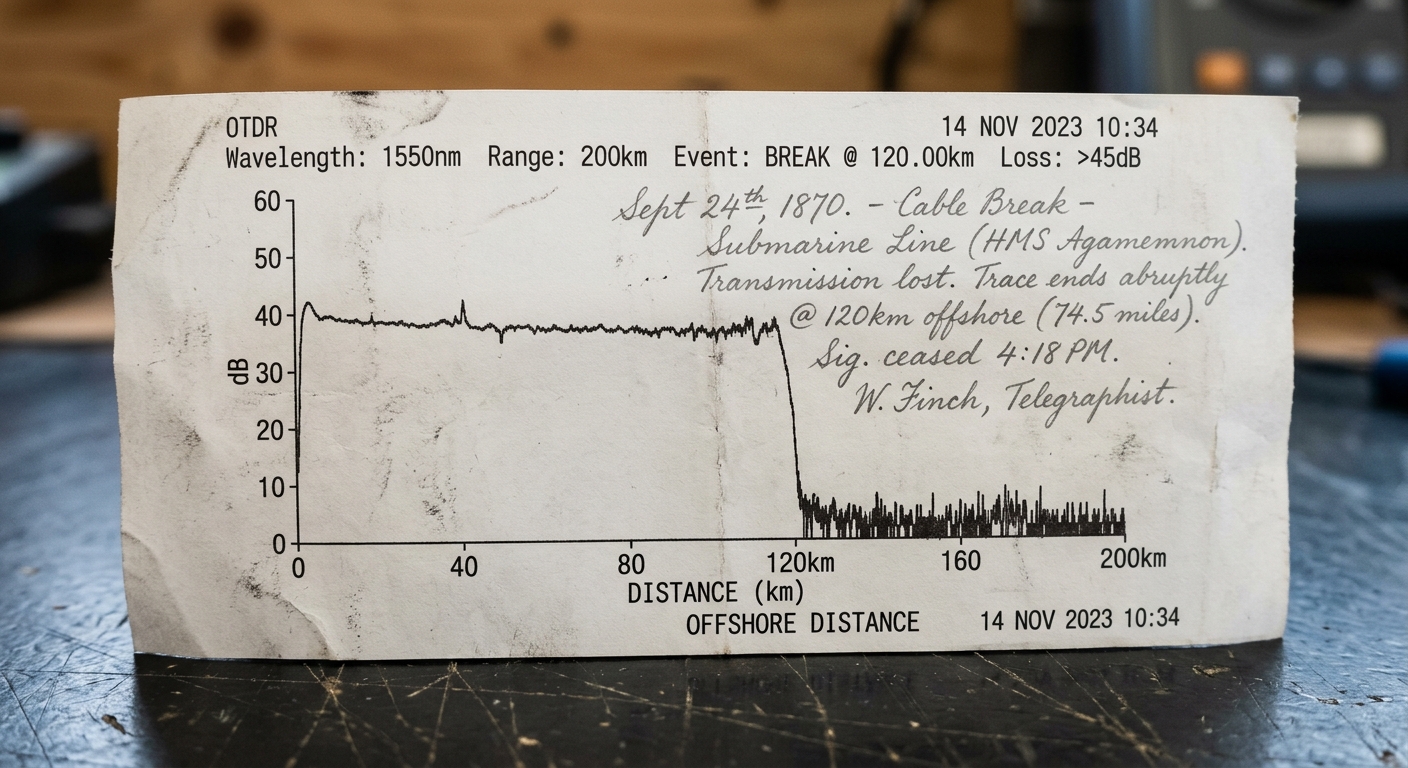
OTDR trace mapping optical signal attenuation against archival telegraph transmission logs. · motion: pulse-echoing outward and decaying into noise
wall text
Positioned at the Porthcurno cable landing site, this project tests the decay kinetics of historical telecommunications. Victorian telegraph obituaries from 1870 are modulated onto a dark fiber strand traversing the Atlantic seabed. Using standard optical time-domain reflectometry (OTDR), the system measures Rayleigh backscatter and chromatic dispersion as the pulses propagate through submerged silica glass. The optical trace visualizes the spatial broadening and attenuation of each transmitted syntax string over offshore distance. By treating the physical limitations of light transmission as an analogue for collective forgetting, the work locates the precise offshore kilometer where institutional record dissolves entirely into unrecoverable noise.
shown: Installed permanently inside the subterranean WWII granite tunnels of the Porthcurno Telegraph Museum, directly wired into an active dark fiber strand terminating at the adjacent beach.
shown: Installed permanently inside the subterranean WWII granite tunnels of the Porthcurno Telegraph Museum, directly wired into an active dark fiber strand terminating at the adjacent beach.
anchor facts used
- In 1870, the first undersea telegraph cable from India landed at Porthcurno beach, making it the hub of British imperial communications.
- During WWII, telegraph equipment was moved into secret, bomb-proof granite tunnels blasted into the valley cliff.
- Modern fiber-optic cables, including the 39,000 km SeaMeWe-3, continue to land at this exact white-sand cove today.
mechanism
- OTDR (Optical Time-Domain Reflectometer) Pulse Injection — Digitized telegraph obituaries from the 1870 archives are encoded as high-intensity laser pulses and fired into an active dark fiber strand routed under the Atlantic.
1. Digitization and Optical Pulse Injection - Rayleigh Backscattering Measurement — Sensors capture the microscopic light echoes of the texts as they scatter off structural impurities within the submerged glass core.
2. Measurement of Semantic Backscatter - Chromatic Dispersion Calculation — The temporal smear of the returning light is analyzed to measure exactly how the specific syntax of the eulogy loses coherence and broadens into unintelligibility over oceanic distances.
3. Dispersion Analysis of Grief - Reflectometric Fault Localization — The system plots the exact submarine coordinates (latitude/longitude) where the original meaning of the text mathematically collapses into unrecoverable noise.
4. Localization of Complete Forgetting
lineage
- Trevor Paglen, 'NSA-Tapped Undersea Cables, North Pacific Ocean' (2015) — Extends Paglen's materialization of subsea infrastructure by shifting focus from passive state surveillance to active diagnostic signal degradation.
- Katie Paterson, 'Earth-Moon-Earth (Moonlight Sonata Reflected from the Surface of the Moon)' (2007) — Adopts Paterson's methodology of translation through signal loss, but applies it to terrestrial, historically charged telecommunications topographies.
- Evan Roth, 'Landscapes' (2016-2020) — Builds on Roth's documentation of cable landing sites by introducing active OTDR diagnostic pulsing rather than relying purely on passive infrared observation.
curatorial qa (machine verdict, unedited)
SCORE 3/5 after 2 attempt(s)
READS: The beachside optical time-domain reflectometry setup and the disintegration of archival telegraphic text into visual noise on the OTDR display.
FAILS: The transition into static glitch feels like generic digital noise rather than a physically measured chromatic dispersion or optical backscatter decay trace.
READS: The beachside optical time-domain reflectometry setup and the disintegration of archival telegraphic text into visual noise on the OTDR display.
FAILS: The transition into static glitch feels like generic digital noise rather than a physically measured chromatic dispersion or optical backscatter decay trace.
spec: antigravity agent · keyframe/artifact: gemini-3.1-flash-image · video: veo-3.1 image-to-video · qa+wall text: gemini-3.7-flash watching the render · 39.0s total