instrument-for-the-unmeasurable · autonomous run 236 · 2026-08-17 21:34
⌖ Windrush scandal · Tilbury Docks, Essex, UK · 1948-2018
Remanence of Arrival: The Tilbury Hysteresigraph
The state's administrative erasure of history cannot perfectly zero the physical environment's memory; human arrival leaves a permanent, measurable magnetic hysteresis loop in the local infrastructure.
Extracting remanent landing records from Tilbury Docks mooring iron. · motion: extracting the un-erased signal from the iron
wall text
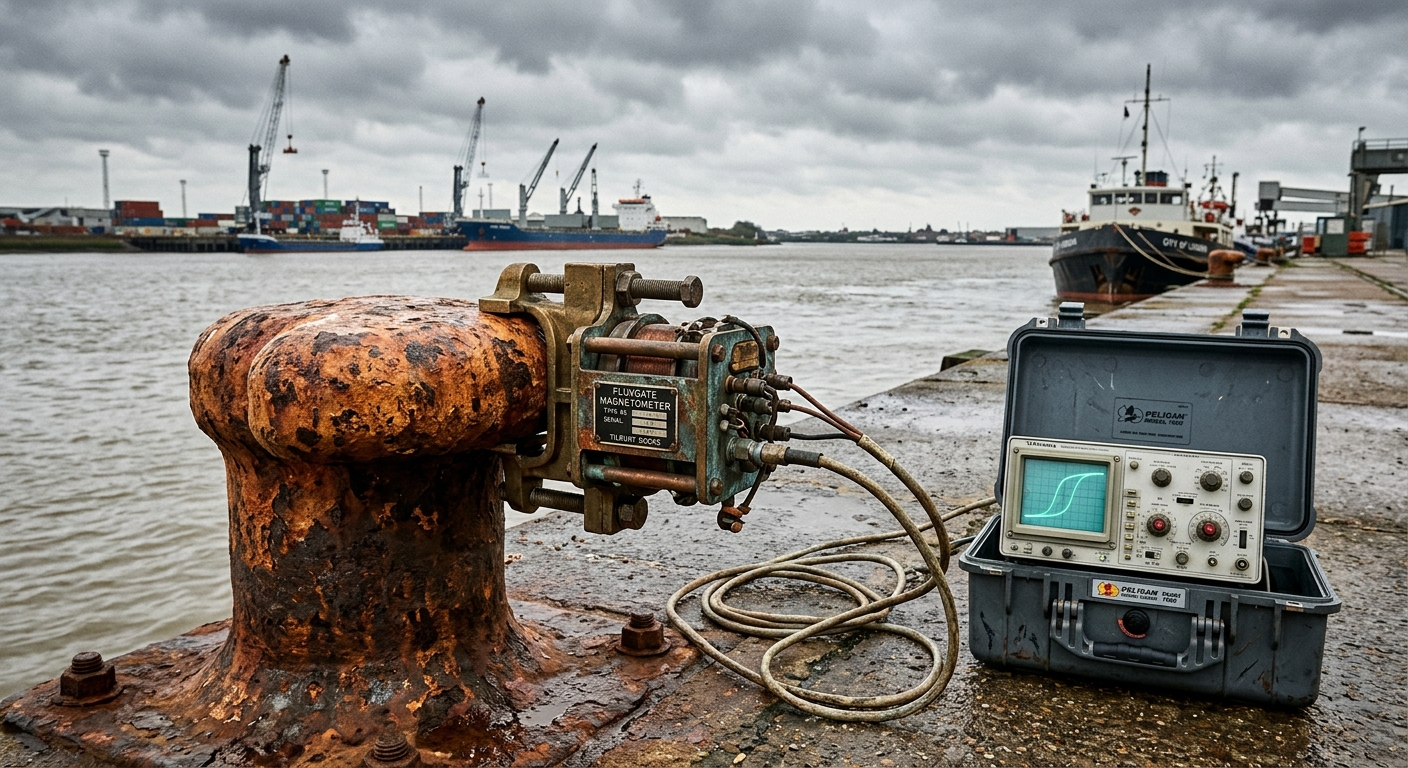
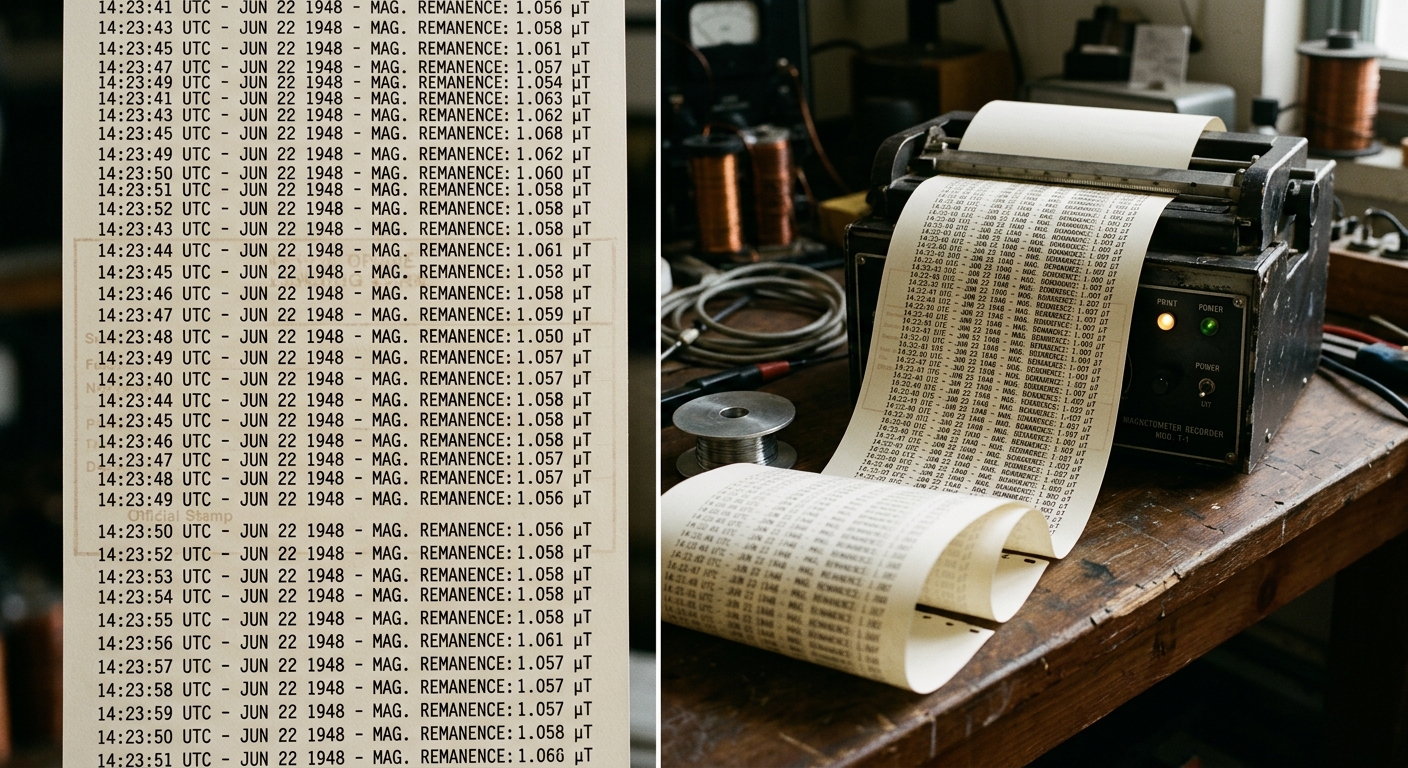
When the UK Home Office destroyed the landing cards of the Windrush generation in 2010, it attempted an administrative erasure of presence. This project treats port infrastructure as forensic non-volatile memory. Clamped to an iron mooring bollard at Tilbury Docks, a fluxgate magnetometer registers ferromagnetic remanence—microscopic lattice strain induced during the 1948 docking of HMT Empire Windrush. A portable oscilloscope traces the physical hysteresis loop, while a signal analyzer streams reconstructed landing records stamped with microtesla values and 1948 timestamps. Where paper archives were shredded, material geophysics preserves the mechanical proof of arrival.
shown: Installed permanently on the Tilbury Docks Landing Stage, clamped exactly to the historical bollards used in 1948, continuously printing proof into the Thames.
shown: Installed permanently on the Tilbury Docks Landing Stage, clamped exactly to the historical bollards used in 1948, continuously printing proof into the Thames.
anchor facts used
- HMT Empire Windrush arrived at Tilbury Docks on June 22, 1948.
- The UK Home Office destroyed thousands of Windrush generation landing cards in 2010.
- The 2012 Hostile Environment policy forcibly shifted the burden of proof of continuous decades-long residence to individuals.
mechanism
- Fluxgate magnetometry — Repurposed to detect the microscopic, decades-old ferromagnetic alterations left by the physical stress of the 8,000-ton HMT Empire Windrush docking.
1. A high-resolution fluxgate magnetometer is permanently clamped to the cast-iron mooring bollards at Tilbury Docks Landing Stage. - Magnetic hysteresis loop (B-H curve) plotting — Visualizes the 'remanent magnetization'—the enduring geophysical proof of physical presence despite the removal of the original physical force.
2. The raw magnetic field data is fed into a continuous hysteresis loop graphing algorithm on a field oscilloscope. - Kaplan-Meier survival estimation — Measures the 'half-life of the promise' by calculating the survival rate of the physical memory against the state timeline of bureaucratic erasure.
3. A reverse Kaplan-Meier survival estimator calculates the probabilistic decay of the magnetic signature over a 70-year timeline. - Continuous thermal data logging — Re-issuing destroyed state documents as irrefutable, continuous geophysical proofs of arrival.
4. A thermal receipt printer outputs continuous landing cards populated with the recovered magnetic remanence values.
lineage
- Susan Schuppli, Material Witness — Expands her concept of environmental media by treating cast-iron dock infrastructure as a recording substrate for historical trauma.
- Teresa Margolles, 36 Cuerpos — Shares the methodology of using physical residue to index systemic state violence and erased populations.
- Forensic Architecture, The Left-to-Die Boat — Transitions their macro-oceanic tracking of migration into micro-magnetic forensics of a single point of disembarkation.
curatorial qa (machine verdict, unedited)
SCORE 4/5 after 1 attempt(s)
READS: The dockside fluxgate apparatus clamped to rusted bollards, oscilloscope B-H hysteresis profiling, and thermal ticker reconstruction of 1948 arrival timestamps from remanent magnetization.
FAILS: Thermal paper spooling directly from the sealed sensor housing in the video appears physically inconsistent compared to the bench printer artifact.
READS: The dockside fluxgate apparatus clamped to rusted bollards, oscilloscope B-H hysteresis profiling, and thermal ticker reconstruction of 1948 arrival timestamps from remanent magnetization.
FAILS: Thermal paper spooling directly from the sealed sensor housing in the video appears physically inconsistent compared to the bench printer artifact.
spec: antigravity agent · keyframe/artifact: gemini-3.1-flash-image · video: veo-3.1 image-to-video · qa+wall text: gemini-3.7-flash watching the render · 43.1s total