instrument-for-the-unmeasurable · autonomous run 231 · 2026-08-17 21:34
⌖ Champagne house crayères · Reims, France · 3rd Century to Present
Coda Wave Interferometry of the Gallo-Roman Void
The acoustic dampening capacity of the crayères operates as a physical ledger of extracted labor; the architectural void's ability to absorb the acoustic vibrations of the contemporary luxury industry is mathematically bound to the exact volume of stone removed by Gallo-Roman hands.
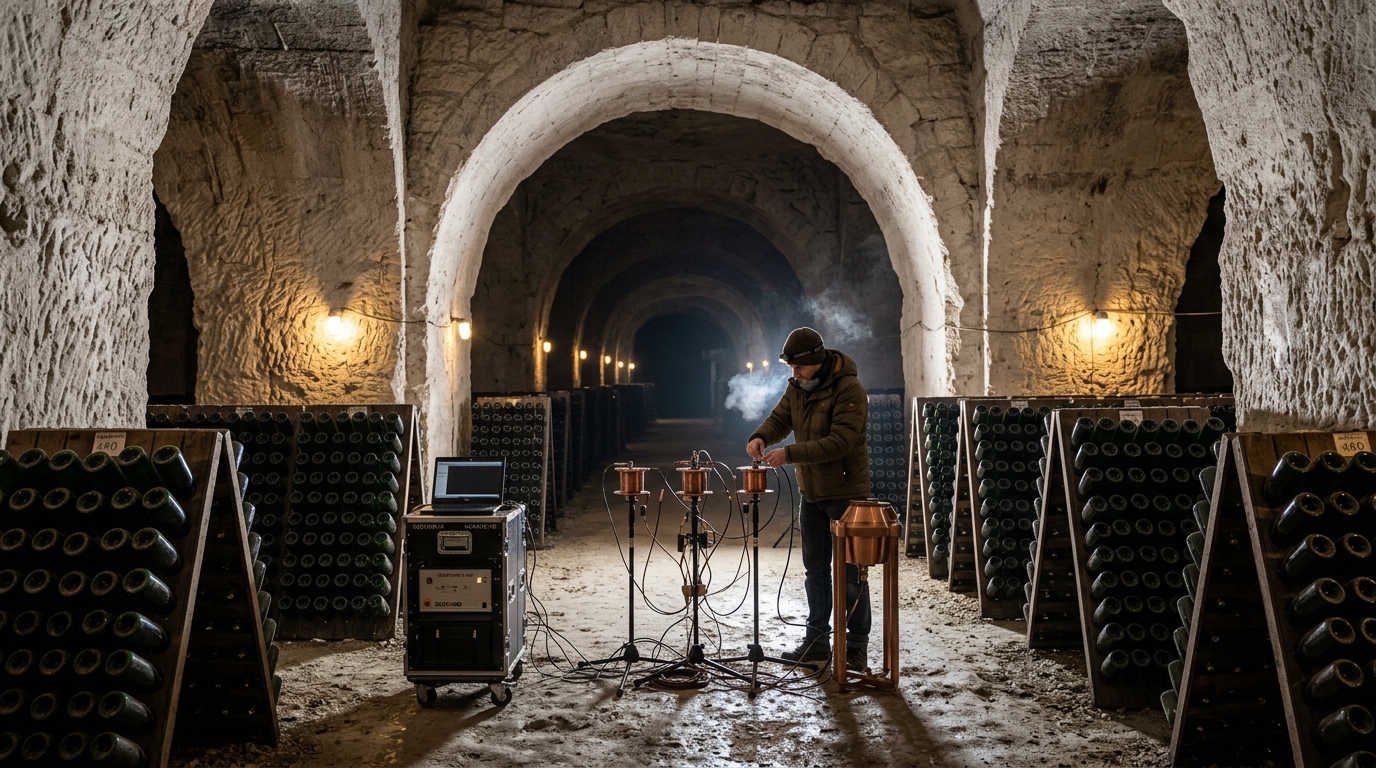
Acoustic pulse scattering across Roman chalk quarry surfaces in Champagne. · motion: scatter and attenuate into the porous chalk
wall text
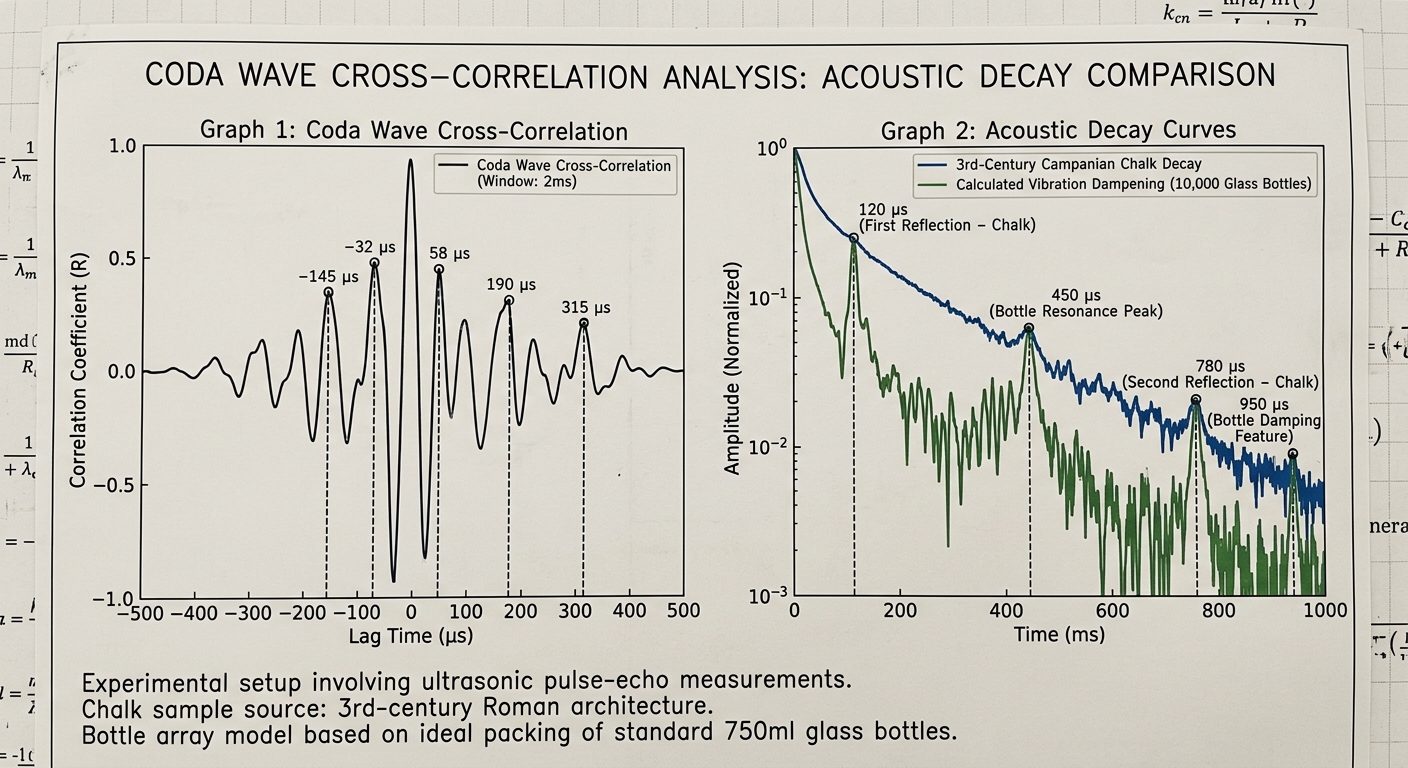
This installation examines how architectural voids function as acoustic ledgers of historical labor. By deploying Coda Wave Interferometry (CWI) inside 3rd-century Gallo-Roman chalk quarries—now repurposed as champagne maturation cellars—the system measures the acoustic dampening capacity of the subterranean space. A calibrated 20kHz pulse is fired into the vaulted gallery, scattering off hand-carved limestone facets and densely stacked glass inventory. Geophone arrays capture the multiple-scattering coda, calculating medium perturbation and velocity shifts (dV/V). The resulting decay curves quantify how effectively ancient stone removal swallows the vibrational overhead of modern luxury production, mapping extracted labor directly to acoustic impedance.
shown: Installed permanently at the 30-meter depth of the Ruinart crayères in Reims, requiring visitors to descend the 38-meter staircase into the 10°C ambient environment to view the readouts.
shown: Installed permanently at the 30-meter depth of the Ruinart crayères in Reims, requiring visitors to descend the 38-meter staircase into the 10°C ambient environment to view the readouts.
anchor facts used
- Carved by hand in the 3rd century to extract chalk blocks for the Roman city of Durocortorum
- Maintain a constant temperature of 10-12°C and 90-100% humidity year-round
- Acquired in 1768 by Claude Ruinart to age bottles of champagne
- The highly porous Campanian chalk naturally dampens stray acoustic vibrations
mechanism
- Coda Wave Interferometry (CWI) source excitation — Firing a 20kHz acoustic pulse, representing a standardized unit of contemporary logistical friction, into the cellar gallery.
1. Acoustic Impulse Emission - CWI coda wave capture — An array of geophones captures the extended reverberation decay as the sound wave scatters infinitely off the complex geometry of the void.
2. Multiple Scattering (Coda) Recording - Interferometric cross-correlation — Comparing the daily acoustic signature against a baseline measurement of the cellar's shifting mass as luxury bottles are introduced or rotated.
3. Cross-Correlation of Perturbed Signals - Calculation of medium perturbation (dV/V) — Deriving the acoustic impedance of historical silence by quantifying precisely how much vibrational energy is swallowed by the labor-extracted void versus the glass inventory.
4. Calculation of Relative Velocity Change (dV/V)
lineage
- Susan Schuppli, 'Material Witness' — Extends her thesis of matter recording environmental events by framing historical acoustic voids as active ledgers of manual extraction.
- Snieder et al. (2002), 'Coda Wave Interferometry for Estimating Yielding' — Directly transposes their geophysical method of monitoring volcano interior stress to measure the structural absorption of a historical luxury supply chain.
- Lawrence Abu Hamdan, 'The Recovered Manifesto' — Pivots his forensic audio reconstruction from linguistic testimony to the purely material testimony of geological subtraction.
curatorial qa (machine verdict, unedited)
SCORE 3/5 after 2 attempt(s)
READS: The underground chalk cellar setting, portable seismic/acoustic recording hardware, and the visual spherical dispersal of the impulse across the vaulted gallery.
FAILS: The direct mathematical link between Gallo-Roman volumetric stone extraction and champagne bottle dampening remains conceptual and confined to the paper chart rather than the physical video action.
READS: The underground chalk cellar setting, portable seismic/acoustic recording hardware, and the visual spherical dispersal of the impulse across the vaulted gallery.
FAILS: The direct mathematical link between Gallo-Roman volumetric stone extraction and champagne bottle dampening remains conceptual and confined to the paper chart rather than the physical video action.
spec: antigravity agent · keyframe/artifact: gemini-3.1-flash-image · video: veo-3.1 image-to-video · qa+wall text: gemini-3.7-flash watching the render · 43.5s total