instrument-for-the-unmeasurable · autonomous run 229 · 2026-08-17 21:34
⌖ Banana monoculture Gros Michel collapse · Ulúa Valley, Honduras · 1890s-1960s
OD600: The Pathogenic Debt Ticker
Monoculture agriculture functions as a biological credit system where genetic standardization borrows against ecological resilience; the resulting pathogenic load in the soil constitutes a permanent, measurable default.
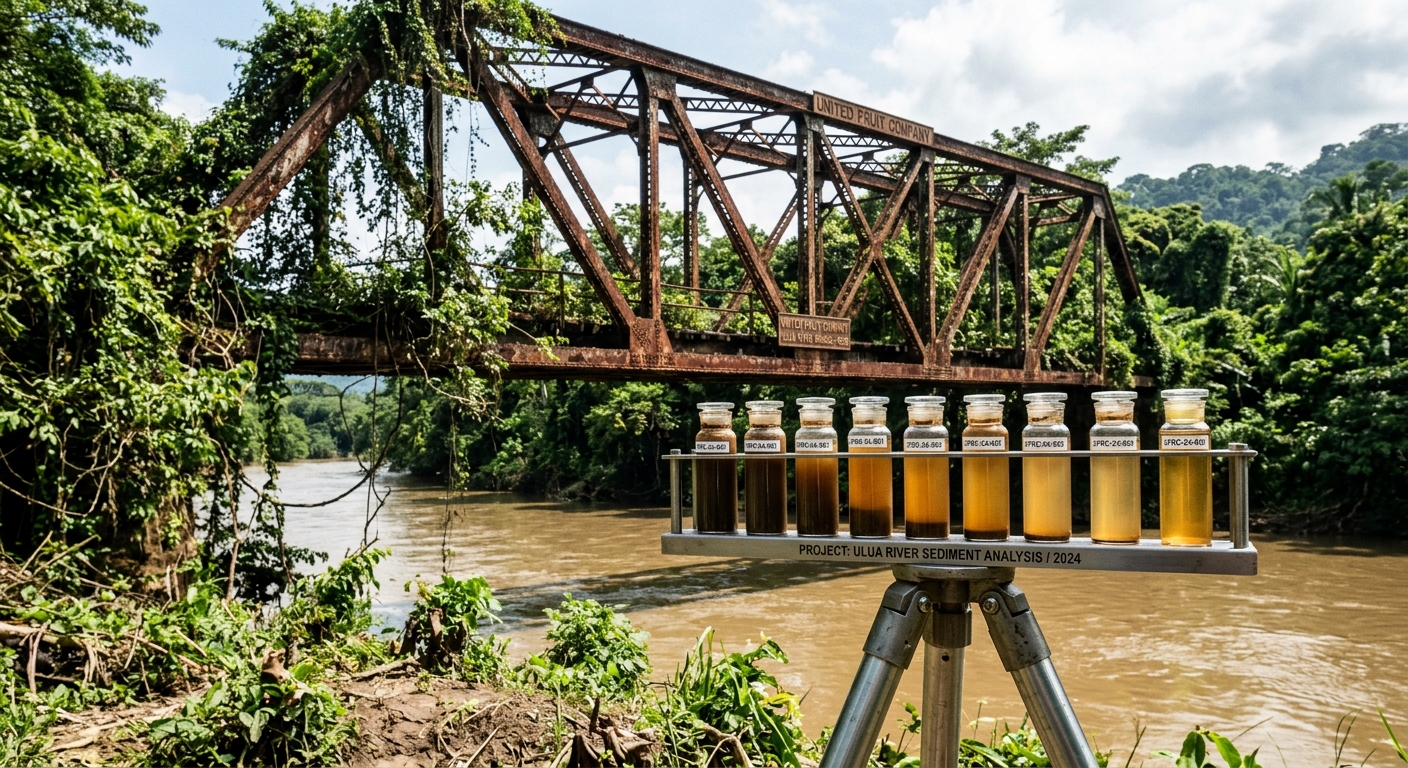
Suspended Ulúa Valley sediment settles, isolating persistent Fusarium chlamydospores from historical plantations. · motion: the slow, microscopic settling of suspended soil particles, revealing the clarified toxic stratum
wall text
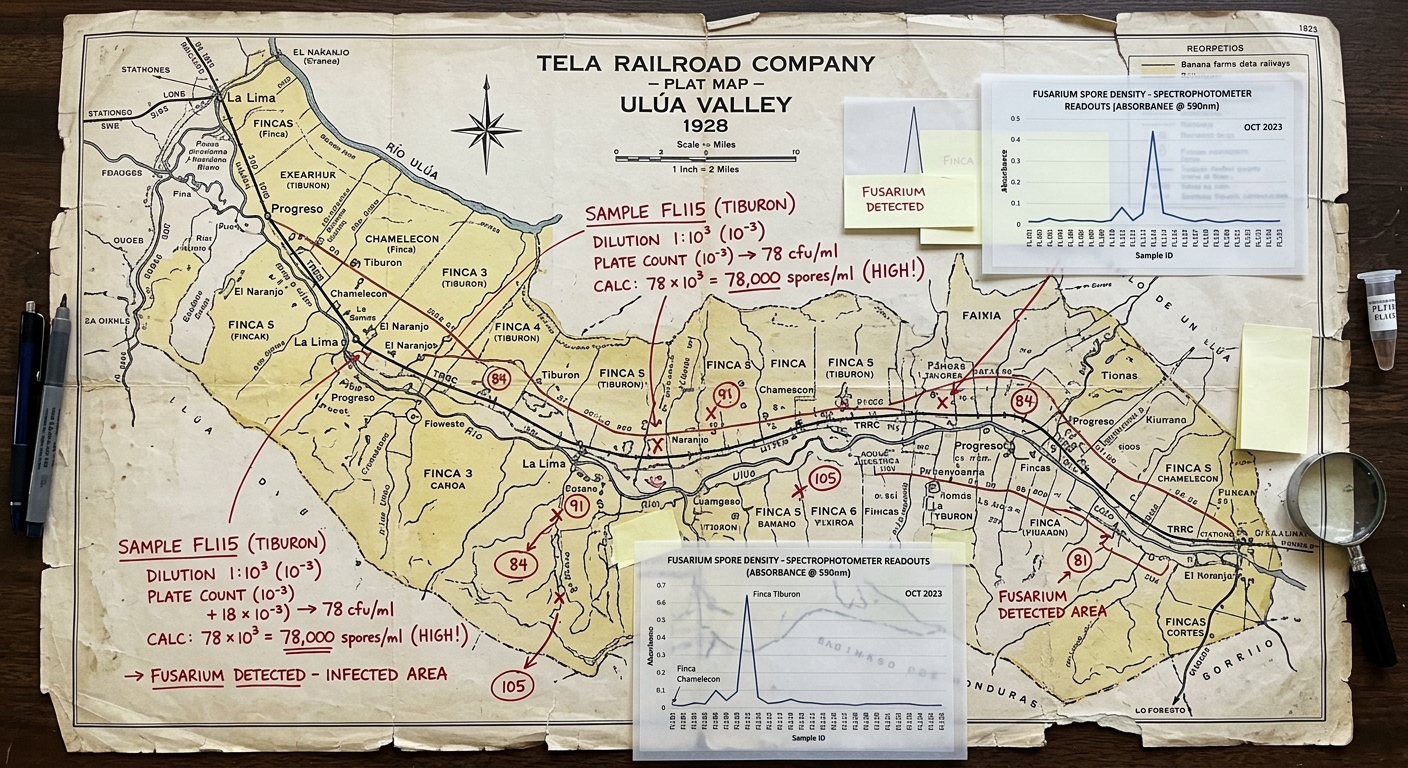
In the 1930s, United Fruit Company abandoned its Gros Michel banana plantations across Honduras's Ulúa Valley after Fusarium oxysporum f.sp. cubense Race 1 rendered the soil untillable. This project maps contemporary soil samples against the Tela Railroad Company’s 1928 plat registers, measuring dormant chlamydospore densities via serial dilution and sucrose-centrifugation flotation. By isolating the persistent fungal load remaining across historical monoculture plots nearly a century post-abandonment, the installation tracks monoculture not merely as historic extractivism, but as an ongoing biological deficit. The residual spore count acts as a durable ledger entry: an unpayable ecological debt left behind by genetic standardization.
shown: Installed permanently at the edge of an active Cavendish plantation in the Ulúa Valley, powered by a small solar array, actively measuring the soil's hostility to its predecessor.
shown: Installed permanently at the edge of an active Cavendish plantation in the Ulúa Valley, powered by a small solar array, actively measuring the soil's hostility to its predecessor.
anchor facts used
- United Fruit Company abandoned massive tracts of the Ulúa Valley in the 1930s as Fusarium oxysporum f.sp. cubense (Race 1) decimated Gros Michel crops.
- The fungus produces chlamydospores that remain viable in the soil for decades, making the land permanently toxic to the Gros Michel.
- The Cavendish cultivar was adopted globally by the 1960s solely because of its resistance to Race 1, despite having a thinner skin.
mechanism
- Systematic spatial sampling — Aligning an abandoned corporate blueprint with the physical geography of its biological failure.
1. Grid-based soil extraction across the Ulúa Valley, correlating contemporary GPS coordinates with United Fruit Company's 1928 Tela Railroad Company plat maps. - Centrifugal flotation extraction — Distilling the microscopic architect of an economic collapse into a measurable, isolated physical substrate.
2. Isolation of Fusarium oxysporum f.sp. cubense Race 1 chlamydospores from the soil matrix using sucrose-centrifugation flotation. - Serial dilution and Most Probable Number (MPN) quantification — Calculating the 'half-life of a promise'—the exact mathematical density of the landscape's ongoing biological hostility to a forgotten commodity.
3. Culturing the extracted spores through a 10-fold serial dilution series in liquid broth to determine the exact pathogenic density. - Spectrophotometric absorbance (OD600) — Converting the biological persistence of the pathogen into an automated financial ticker representing unrecoverable ecological debt.
4. Continuous measurement of the cultures' optical density via a solar-powered spectrophotometer, transmitting the growth curve to a localized ticker display.
lineage
- Center for PostNatural History by Richard Pell — Builds on the archiving of human-altered organisms by measuring and exhibiting the invisible pathogenic void left by an extinct commercial monoculture.
- Earthworks by Robert Smithson — Shifts the focus from macro-geological interventions to the micro-biological soil memory of an abandoned industrial landscape.
- Stranger Visions by Heather Dewey-Hagborg — Applies biological extraction to a landscape's historical economy rather than reconstructing the identity of anonymous human individuals.
curatorial qa (machine verdict, unedited)
SCORE 4/5 after 2 attempt(s)
READS: The archival 1928 plat map overlaid with Fusarium spore spectrophotometry directly links corporate monoculture boundaries to persistent pathogen density. The riverbank sedimentation rack and close-up settling bottle establish the material measurement process.
FAILS: The settling video captures physical particulate sedimentation rather than microbial separation, making the specific Fusarium isolation step feel more like standard hydrometer soil texture testing.
READS: The archival 1928 plat map overlaid with Fusarium spore spectrophotometry directly links corporate monoculture boundaries to persistent pathogen density. The riverbank sedimentation rack and close-up settling bottle establish the material measurement process.
FAILS: The settling video captures physical particulate sedimentation rather than microbial separation, making the specific Fusarium isolation step feel more like standard hydrometer soil texture testing.
spec: antigravity agent · keyframe/artifact: gemini-3.1-flash-image · video: veo-3.1 image-to-video · qa+wall text: gemini-3.7-flash watching the render · 41.9s total