instrument-for-the-unmeasurable · autonomous run 228 · 2026-08-17 21:33
⌖ International Date Line quirks · Apia, Samoa and the Pacific Meridian · 1845-1892
The Malietoa Amortization Schedule
Economic synchronization enforces a measurable physical decay on human memory, where the legislative erasure or duplication of a calendar day creates a temporal debt that must be physically amortized.
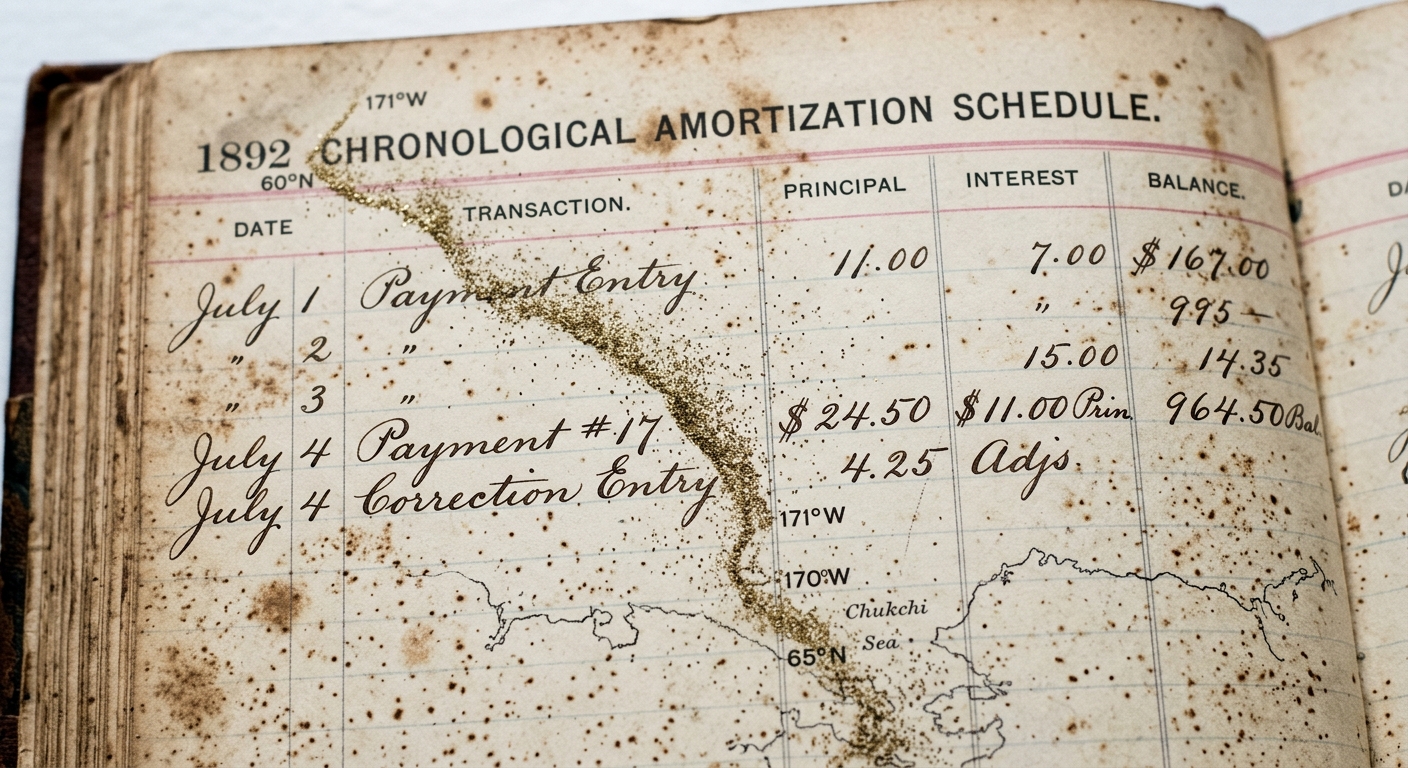
Escapement apparatus amortizing the duplicated Samoan July 4, 1892 into metallic dust. · motion: grinding temporal debt into brass dust

wall text
When Samoa repeated July 4, 1892 to align trading days with the United States, and the Philippines skipped December 31, 1844 to sync with Asia, political decree manufactured an ungrounded temporal surplus and deficit. This installation treats legislative calendar shifts as physical debt obligations. Transposing double-entry bookkeeping and phase-locked loop synchronization into kinetic hardware, a brass escapement mechanism on a volcanic coastline continuously grinds down an engraved index plate. Driven by the mechanical resistance between out-of-phase pendulums representing separated time zones, the apparatus executes straight-line amortization by converting the duplicate day of 1892 directly into brass dust at an immutable physical rate.
shown: Installed permanently on the volcanic shoreline of Apia, Samoa, exactly at the 171°W meridian, exposed to the elements and the tidal cycles.
shown: Installed permanently on the volcanic shoreline of Apia, Samoa, exactly at the 171°W meridian, exposed to the elements and the tidal cycles.
anchor facts used
- In 1844, the Philippines skipped Tuesday, December 31 to align its calendar with Asian trade partners.
- On July 4, 1892, Samoan King Malietoa Laupepa mandated the repetition of the day to align with California trade ships.
- Kiribati eventually bent the Date Line to encompass its islands in a single workweek, creating the UTC+14 time zone.
mechanism
- Double-entry bookkeeping — The 24 hours lost by the Philippines in 1844 are credited as an asset, while the 24 hours duplicated by Samoa in 1892 are recorded as a liability, establishing a closed-loop temporal balance sheet.
1. Initialization of the Temporal Ledger - Radiometric dating — Seawater samples pumped continuously from the 171°W meridian are measured for isotopic decay to quantify the exact biological aging that transpired during the politically conjured second July 4th.
2. Calibration of Fictional Duration - Phase-locked loop (PLL) synchronization — Two massive brass pendulums represent the Line Islands and the Gilbert Islands. Their mandated 24-hour phase difference drives a mechanical error signal, physically resisting their gravitational synchronization.
3. Latency Extraction - Straight-line amortization — The sheer physical resistance from the PLL error signal drives a differential gear that slowly grinds down a brass plate, depositing metal dust at a fixed rate to amortize the 1892 temporal liability.
4. Liquidation of Orphaned Time
lineage
- On Kawara, 'Today' Series — Rejects the neutral chronological progression of the Date Paintings by treating dates as volatile, trade-contingent commodities that can be minted or destroyed.
- John Harrison, 'H4 Marine Chronometer' — Subverts the colonial quest for absolute longitudinal timekeeping by instrumenting the politically mandated failure and malleability of geographic time.
- Katie Paterson, 'Timepieces (Solar System)' — Contracts Paterson's planetary time-relativity down to local macroeconomic distortions, measuring human legislation rather than celestial mechanics.
curatorial qa (machine verdict, unedited)
SCORE 3/5 after 2 attempt(s)
READS: Differential gear mechanism grinding an engraved 1892 plate into brass filings; ledger artifact visualizing chronological debt amortization along the International Date Line.
FAILS: The link to human memory decay, seawater radiometric calibration, and PLL phase-locking is absent, reading primarily as an isolated kinetic sculpture.
READS: Differential gear mechanism grinding an engraved 1892 plate into brass filings; ledger artifact visualizing chronological debt amortization along the International Date Line.
FAILS: The link to human memory decay, seawater radiometric calibration, and PLL phase-locking is absent, reading primarily as an isolated kinetic sculpture.
spec: antigravity agent · keyframe/artifact: gemini-3.1-flash-image · video: veo-3.1 image-to-video · qa+wall text: gemini-3.7-flash watching the render · 36.6s total