instrument-for-the-unmeasurable · autonomous run 222 · 2026-08-17 21:33
⌖ Kowloon Walled City memory · Kowloon City, Hong Kong · 1950-1993
TDR-93: Dielectric Mourning
The psychological density of a demolished hyper-structure permanently alters the subterranean dielectric permittivity of its geography; spatial memory decays at a measurable radiometric half-life rather than disappearing instantly upon demolition.
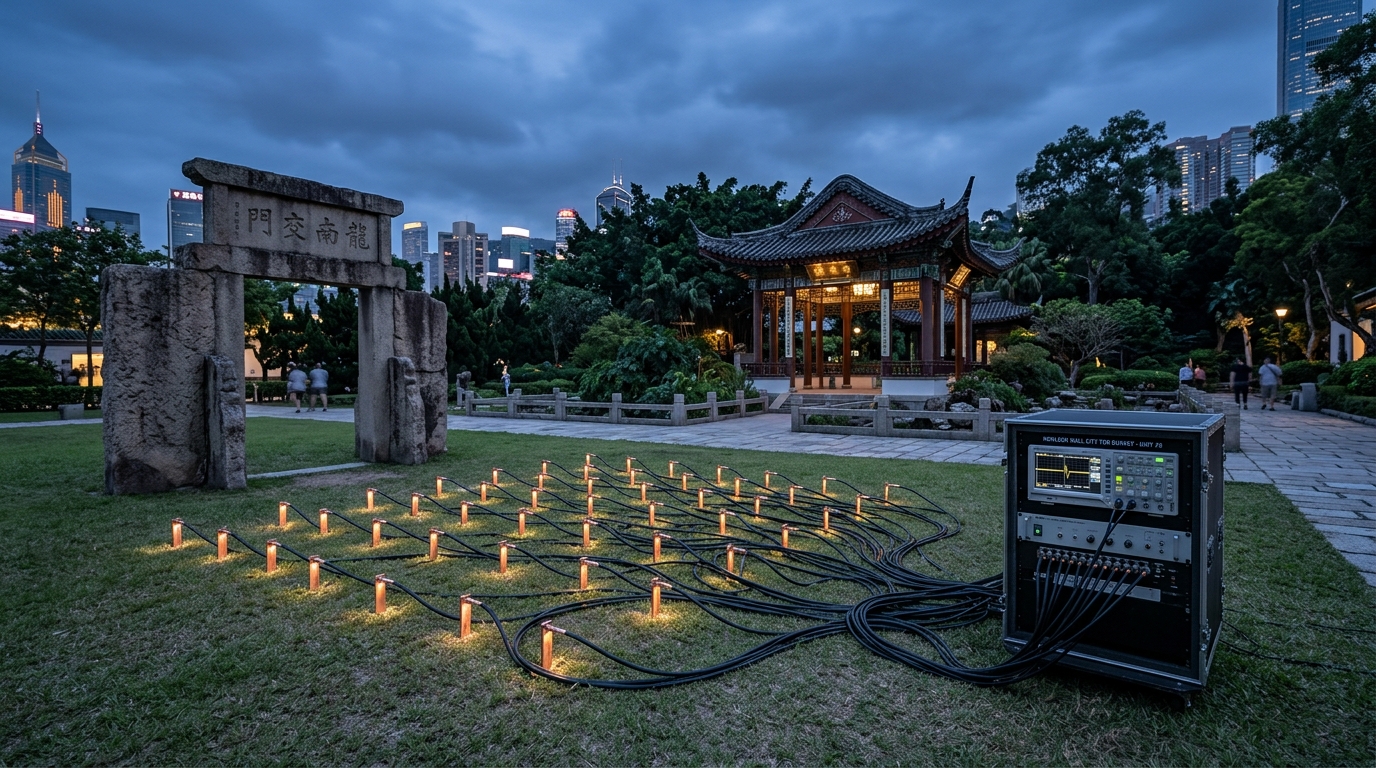
Time-domain reflectometry grid mapping subterranean dielectric resistance at Kowloon Walled City. · motion: pulsing outward to map absence through resistance
wall text
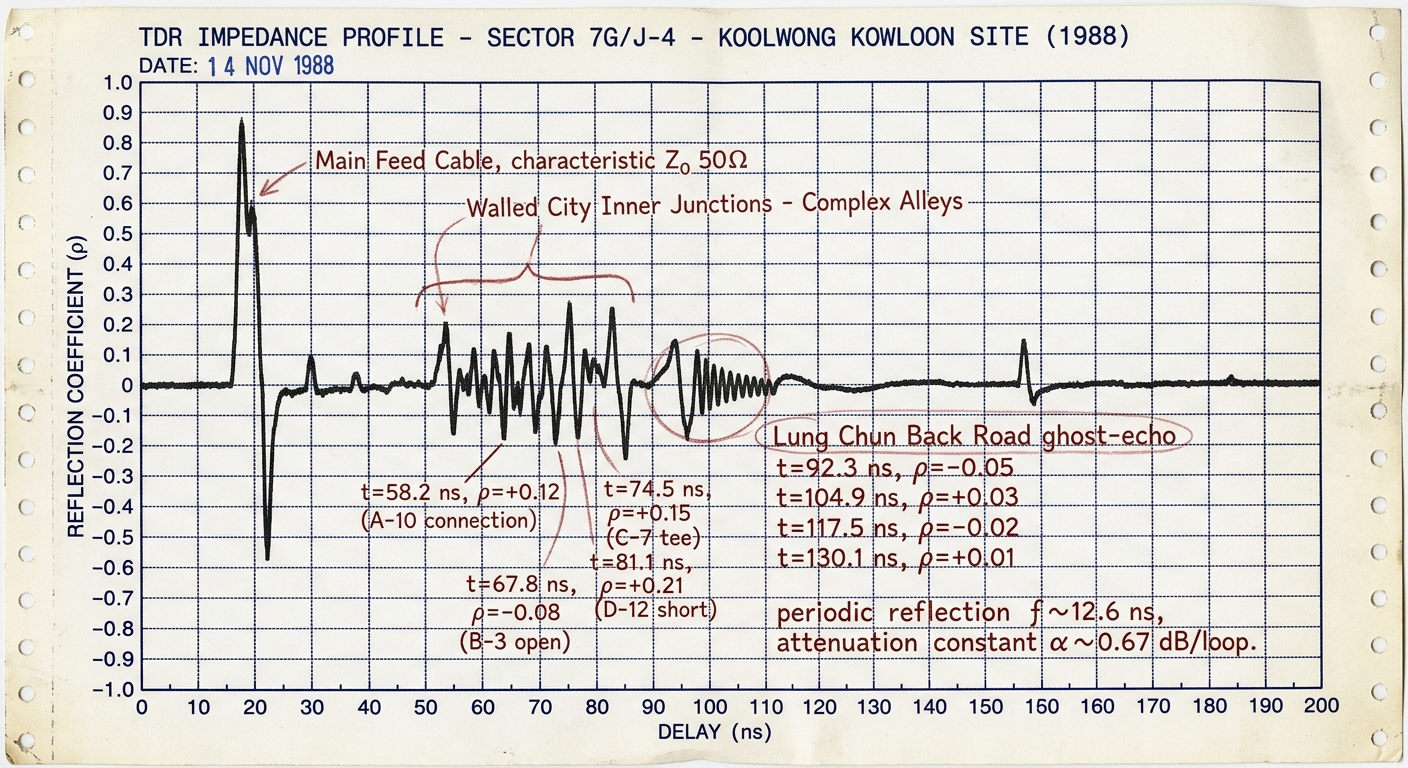
Beneath the manicured Jiangnan gardens of Kowloon Walled City Park lies the residual compaction of 300 interconnected towers and 33,000 former residents. This installation adapts Time-Domain Reflectometry (TDR)—an engineering technique used to locate cable faults and measure soil dielectric permittivity—to probe the earth for ghost infrastructure. An array of copper coaxial probes driven into the topsoil transmits nanosecond electromagnetic pulses into the substrate. By measuring step-voltage reflection coefficients against baseline soil resistance, the oscilloscope registers subterranean density anomalies left by demolished foundations and compressed alleyways. The piece treats architectural memory not as metaphor, but as a radiometric half-life decaying within the earth's electromagnetic profile.
shown: Displayed as a permanent subterranean installation beneath the pathways of the Kowloon Walled City Park, with real-time spatial decay metrics projected directly onto the preserved Yamen walls.
shown: Displayed as a permanent subterranean installation beneath the pathways of the Kowloon Walled City Park, with real-time spatial decay metrics projected directly onto the preserved Yamen walls.
anchor facts used
- The site comprised 2.6 hectares (6.5 acres) containing roughly 300 interconnected high-rise buildings built without municipal regulation.
- The settlement reached a peak density of approximately 33,000 to 50,000 residents before its final eviction and demolition in 1993.
- The footprint was converted into the Kowloon Walled City Park, preserving only the original Qing dynasty yamen building and the South Gate foundations.
mechanism
- Time-Domain Reflectometry (TDR) spatial dielectric mapping — A matrix of 300 copper coaxial probes is driven into the park's topsoil to act as memory-waveguides, creating a sensor array for architectural grief.
1. Grid deployment and waveguide calibration - Nanosecond electromagnetic pulse emission — Firing a 1-nanosecond electromagnetic pulse, calibrated to the resonant frequency of densely packed reinforced concrete, into the manicured garden soil to interrogate the void.
2. Step-voltage pulse generation - Oscilloscope waveform reflection coefficient calculation — Capturing return echoes where the pulse hits compacted earth anomalies (ghost foundations), interpreting the amplitude of the reflection as the viscosity of civic trust.
3. Impedance mismatch recording - Exponential decay half-life calculation — Comparing the reflection impedance delta year-over-year since demolition to output the precise half-life of spatial mourning in a numeric value of years.
4. Decay rate modeling
lineage
- Ryoji Ikeda, 'spectra' — Builds on Ikeda's use of pure data as physical volume, but applies it to subterranean historical absence rather than celestial presence.
- Rachel Whiteread, 'House' (1993) — Reverses Whiteread's solidifying of negative space by instrumentally measuring the invisible negative space left in the earth after a solid is removed.
- Gordon Matta-Clark, 'Conical Intersect' — Argues against Matta-Clark's visual cuts through existing architecture by performing an invisible electromagnetic cut through demolished architecture.
curatorial qa (machine verdict, unedited)
SCORE 4/5 after 2 attempt(s)
READS: The field-deployed coaxial probe grid and rack-mounted TDR oscilloscope clearly map subsurface impedance mismatches at Kowloon Walled City Park, with the waveform printout reinforcing the geotechnical translation.
FAILS: The luminescent spikes rising vertically from the ground read slightly decorative and digital rather than evoking raw RF propagation or dielectric resistance.
READS: The field-deployed coaxial probe grid and rack-mounted TDR oscilloscope clearly map subsurface impedance mismatches at Kowloon Walled City Park, with the waveform printout reinforcing the geotechnical translation.
FAILS: The luminescent spikes rising vertically from the ground read slightly decorative and digital rather than evoking raw RF propagation or dielectric resistance.
spec: antigravity agent · keyframe/artifact: gemini-3.1-flash-image · video: veo-3.1 image-to-video · qa+wall text: gemini-3.7-flash watching the render · 34.0s total