instrument-for-the-unmeasurable · autonomous run 221 · 2026-08-17 21:33
⌖ Maunsell sea forts · Thames estuary, Shivering Sands array · 1942-present
Electrochemical Sovereignty: The Shivering Sands EIS Array
Rogue independence and territorial sovereignty are not legal abstractions, but strictly finite electrochemical states governed by the galvanic corrosion rate of their host architecture.
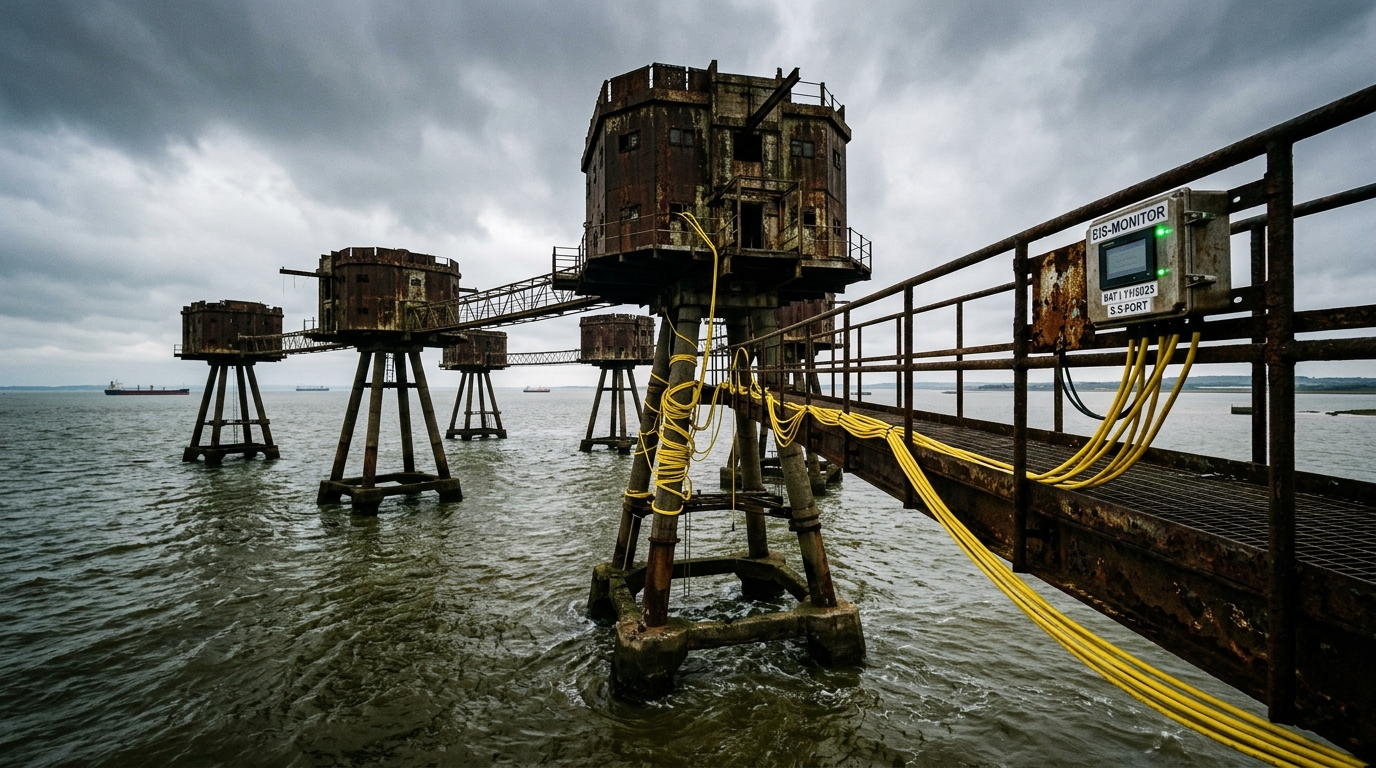
Electrochemical impedance spectroscopy monitoring structural dissolution rates of the Thames sea forts. · motion: Slowly orbiting while the waterline swells and recedes
wall text
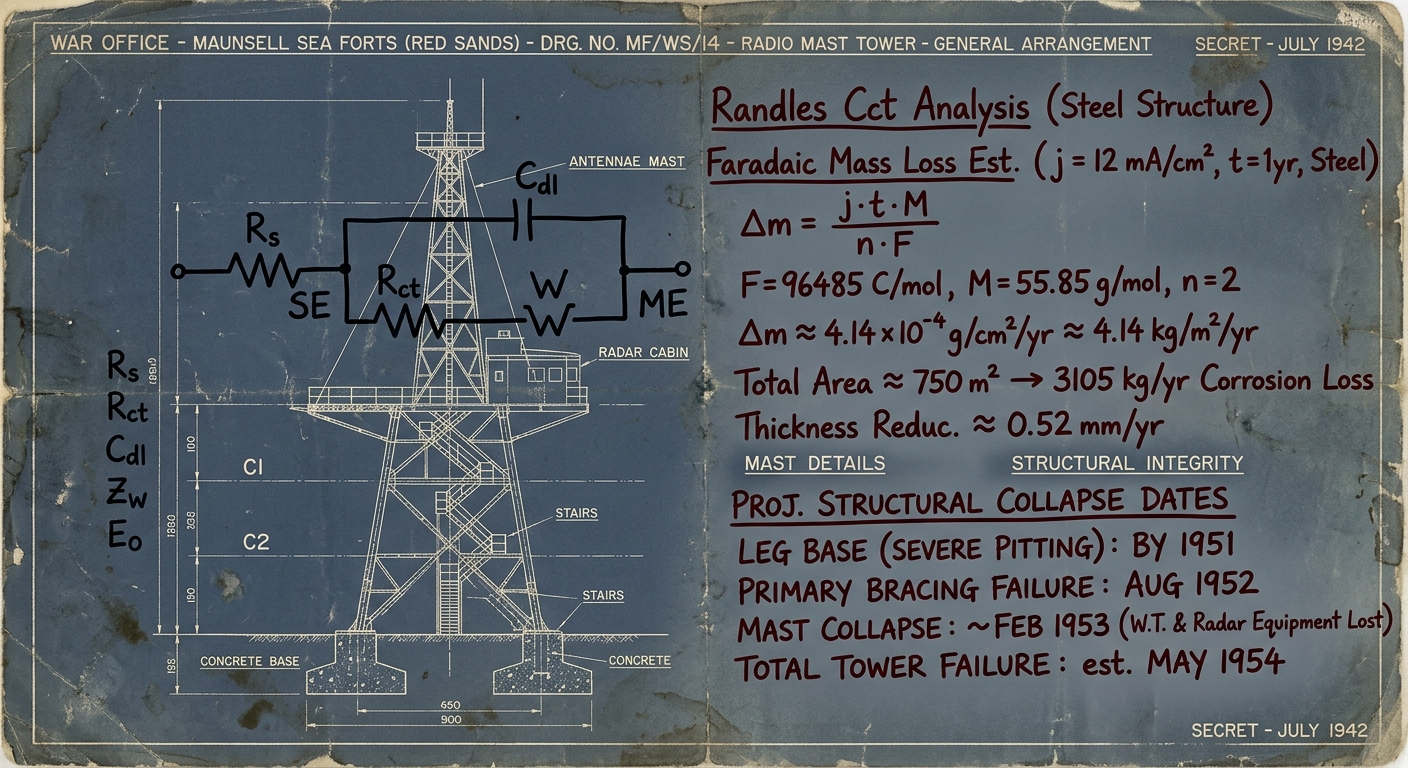
Positioned in the Thames Estuary, the Maunsell Sea Forts provided extraterritorial platforms for pirate radio broadcasters like Radio Sutch. This installation monitors the offshore towers as finite electrochemical bodies. By applying low-amplitude AC voltage to the submerged legs, an Electrochemical Impedance Spectroscopy (EIS) monitor measures polarization resistance and double-layer capacitance at the steel-seawater interface. Applying Faraday’s law of electrolysis to the observed charge transfer resistance translates active corrosion rates into a calculated countdown until structural collapse. Territorial autonomy is reframed not as a political declaration, but as a material state delimited by Faradaic mass loss.
shown: Displayed as a live telemetry readout and real-time audio feed inside a marine transit container parked on the Whitstable coastline, directly facing the distant silhouette of the offshore array.
shown: Displayed as a live telemetry readout and real-time audio feed inside a marine transit container parked on the Whitstable coastline, directly facing the distant silhouette of the offshore array.
anchor facts used
- Constructed in 1942 by Guy Maunsell as armed anti-aircraft towers to defend London from Luftwaffe bombers.
- Abandoned by the Ministry of Defence in 1958.
- Squatted and repurposed in 1964 by Screaming Lord Sutch to broadcast the pirate radio station Radio Sutch.
mechanism
- Electrochemical Impedance Spectroscopy (EIS) — A low-amplitude AC voltage is applied directly to the rusting steel legs of the fort, probing the electrochemical boundary where the architecture of military defense dissolves into the corrosive seawater.
1. Potentiostatic Perturbation - Nyquist Phase Shift Analysis — Submerged sensors measure the phase shift of the alternating current to isolate polarization resistance, calculating the exact milligram-per-second rate at which the pirate radio station's physical foundation is transforming into iron oxide.
2. Charge Transfer Resistance Mapping - Faraday's Law of Electrolysis — The real-time mass loss rate is plugged into Faraday's equations to generate a countdown clock, displaying the precise future timestamp when the structure will lack the tensile strength to support human occupation or broadcast equipment.
3. Sovereign Half-Life Extrapolation - Voltage-to-Frequency Conversion — The fluctuating impedance values and corrosion rates are converted into a low-frequency radio broadcast transmitted directly from the fort, turning the tower's silent rusting into an audible, decaying beacon.
4. Acoustic Transduction
lineage
- Tetsuo Kogawa's Micro-FM Radio Art — Extends his concept of localized transmission space into the literal electrochemical dissolution of the broadcast antenna's physical substrate.
- The Randles Circuit Model (J.E.B. Randles, 1947) — Applies this foundational equivalent circuit model not to a chemical battery, but to the macro-scale structural integrity of a contested micronation.
- Roger Hiorns' Seizure (2008) — Reverses Hiorns' process of chemical accretion (growing copper sulphate crystals in a flat) into a real-time, quantified study of architectural chemical dissolution.
curatorial qa (machine verdict, unedited)
SCORE 3/5 after 2 attempt(s)
READS: The sensor rig, yellow lead cables, and EIS monitor clearly anchor electrochemical monitoring to the Maunsell fort architecture. The blueprint neatly links Randles circuit modeling to structural lifespan.
FAILS: The camera pushes into a generic readout box instead of maintaining an orbiting spatial study across the waterline. The electrochemical breakdown feels post-applied rather than actively driving the physical decay.
READS: The sensor rig, yellow lead cables, and EIS monitor clearly anchor electrochemical monitoring to the Maunsell fort architecture. The blueprint neatly links Randles circuit modeling to structural lifespan.
FAILS: The camera pushes into a generic readout box instead of maintaining an orbiting spatial study across the waterline. The electrochemical breakdown feels post-applied rather than actively driving the physical decay.
spec: antigravity agent · keyframe/artifact: gemini-3.1-flash-image · video: veo-3.1 image-to-video · qa+wall text: gemini-3.7-flash watching the render · 45.3s total