instrument-for-the-unmeasurable · autonomous run 220 · 2026-08-17 21:33
⌖ Soviet bus stops · M39 Highway, Jambyl Region, Kazakhstan · 1980s architecture, abandoned post-1991
Green's Function for a Discontinued Route
Abandonment is not a static condition but a measurable physical viscosity, where the earth itself retains and resists the propagation of missing infrastructure.
Geophone array cross-correlating ambient steppe vibrations into transit corridor viscosity. · motion: The split-flap display continuously clicking and rolling
wall text
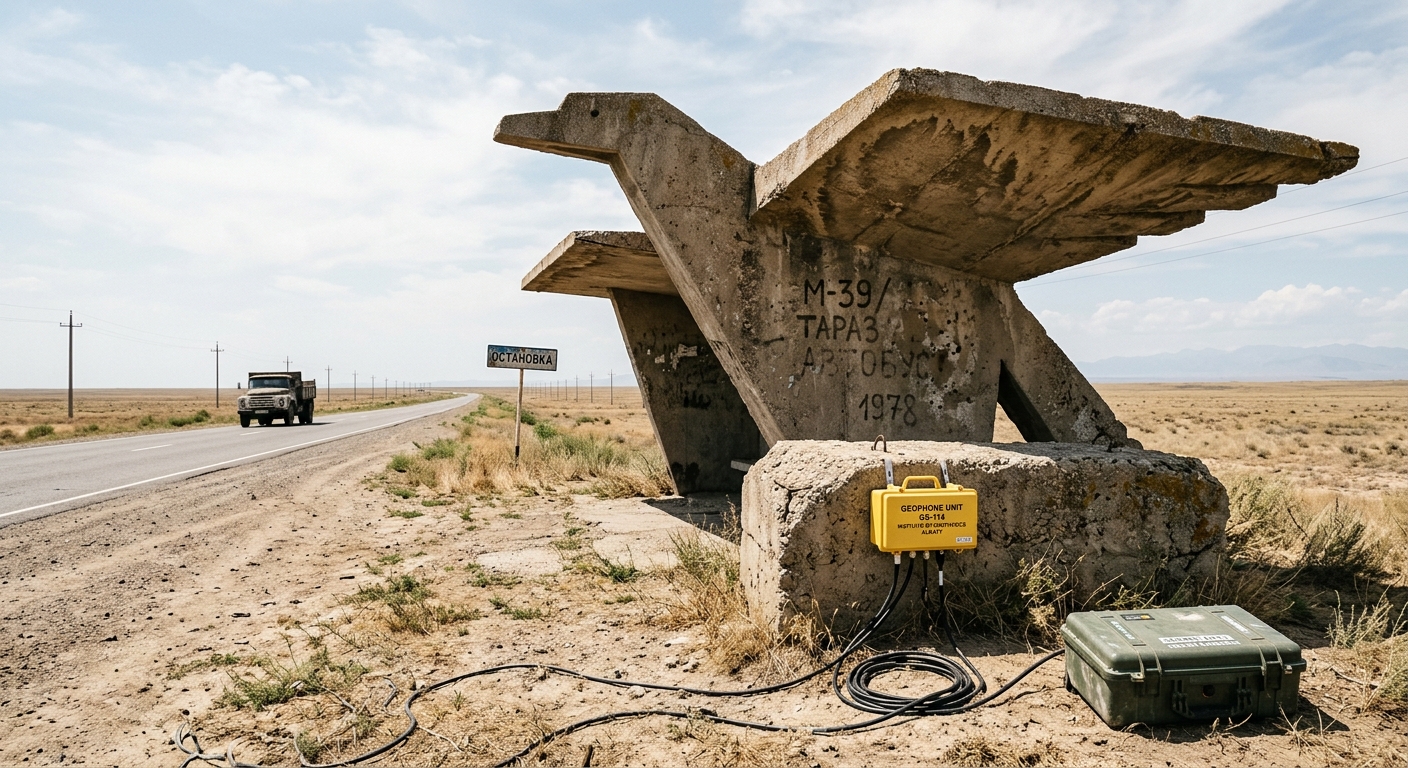
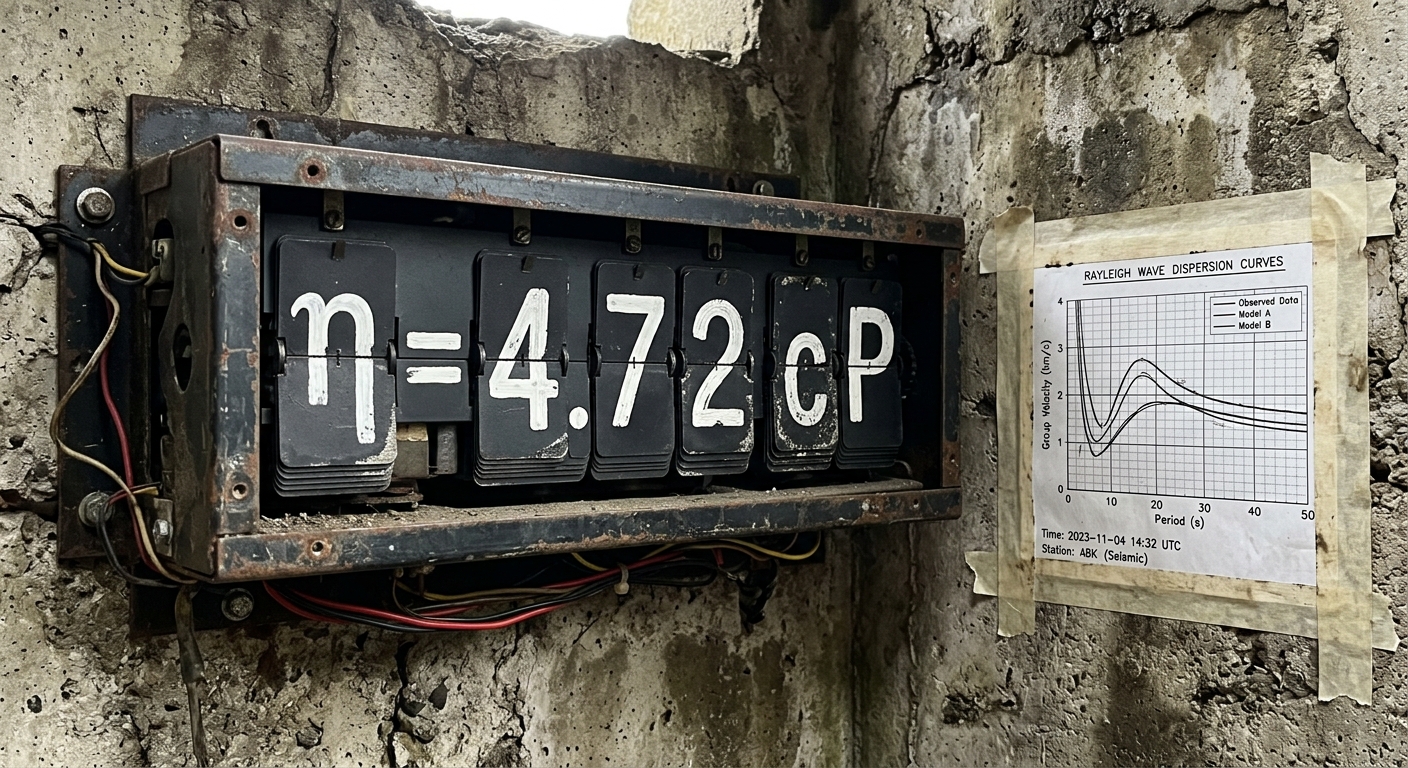
Positioned 42 kilometers apart along Kazakhstan's M39 highway, two monolithic 1970s bus shelters are repurposed as seismic ground-coupling anchors. Paired three-component geophones record ambient noise—steppe winds, ground microtremors, and sparse highway traffic—over continuous observation windows. Transposing ambient noise tomography (ANT) and seismic cross-correlation, the system isolates empirical Green's functions across the inter-station expanse. Instead of velocity profiles, the setup computes the acoustic shear attenuation of the unserviced transit corridor, translating the infrastructural void into dynamic viscosity (centipoise). A modified Soviet-era split-flap unit mechanically displays the shifting resistance of the dormant route.
shown: Installed permanently at the M39 highway bus stop in Kazakhstan, running autonomously on solar power until the concrete structure finally collapses.
shown: Installed permanently at the M39 highway bus stop in Kazakhstan, running autonomously on solar power until the concrete structure finally collapses.
anchor facts used
- The M39 highway connected key Central Asian Soviet republics but saw massive drops in public transit funding after 1991, leaving structures stranded.
- The shelters were often built using surplus local concrete quotas without standardized rebar, resulting in heavy, rigid footings perfectly coupled to the steppe crust.
- The LAZ-695 buses that originally serviced these intercity routes created specific low-frequency seismic and acoustic signatures that vanished after the collapse.
mechanism
- Seismic station deployment and acoustic coupling — The bus stops are repurposed as massive acoustic couplers to the steppe, turning the brutalist architecture into a sensory array listening for a transit network that no longer exists.
1. Two three-component geophones are anchored directly into the unreinforced structural concrete footings of adjacent abandoned bus shelters exactly 42 kilometers apart on the M39 highway. - Ambient Noise Tomography (ANT) data acquisition — Passively collecting the silence of the discontinued route, treating the absolute absence of the LAZ-695 bus engine vibrations as the primary dataset.
2. The sensor nodes continuously record ambient seismic noise—steppe wind, tectonic microtremors, and roaming saiga antelope—for a period of exactly 365 days. - Cross-correlation of ambient seismic noise — Extracting a phantom impulse response: measuring exactly how the ground would propagate the shockwave if a bus were to travel between the two stops today.
3. The raw time-series data from both stops is continuously cross-correlated to mathematically collapse the random noise and extract the empirical Green's function. - Surface wave dispersion inversion — Quantifying the earth's mechanical resistance to the memory of the route, manifesting the unmeasurable 'viscosity of abandonment' as a shifting physical metric.
4. The system calculates the dispersion curve of the resulting Rayleigh waves, outputting a real-time coefficient of 'abandonment viscosity' displayed locally on a mechanical flap display.
lineage
- Campillo and Paul (2003) 'Long-Range Correlations in the Diffuse Seismic Coda' — Provides the mathematical foundation for extracting coherent signals from diffuse wavefields, transposed here to measure socio-economic absence rather than geological structure.
- Christopher Herwig's 'Soviet Bus Stops' (2014) — Documents the visual and architectural absurdity of the shelters; this piece shifts the focus entirely to their physical mass and acoustic properties.
- Susan Schuppli's 'Material Witness' (2020) — Builds on her concept of matter recording historical events, extending the framework to demonstrate how the earth records the ongoing absence of an event.
curatorial qa (machine verdict, unedited)
SCORE 3/5 after 2 attempt(s)
READS: Brutalist concrete bus stop functioning as an acoustic coupling base; field-deployed geophone nodes; split-flap display outputting dynamic viscosity units (cP).
FAILS: The computational cross-correlation between the two distant stations is invisible; the split-flap flipper suffers from digital warping artifacts instead of crisp mechanical rotation.
READS: Brutalist concrete bus stop functioning as an acoustic coupling base; field-deployed geophone nodes; split-flap display outputting dynamic viscosity units (cP).
FAILS: The computational cross-correlation between the two distant stations is invisible; the split-flap flipper suffers from digital warping artifacts instead of crisp mechanical rotation.
spec: antigravity agent · keyframe/artifact: gemini-3.1-flash-image · video: veo-3.1 image-to-video · qa+wall text: gemini-3.7-flash watching the render · 55.5s total