instrument-for-the-unmeasurable · autonomous run 217 · 2026-08-17 21:33
⌖ Michigan Central Station · Detroit, Michigan · 1913-1988-2024
Acoustic Hysteresis: Train 353
The restoration of physical infrastructure cannot reset the acoustic memory of a space; the 36-year latency between abandonment and corporate renewal functions as an irreversible structural hysteresis that permanently alters the reverberation of public trust.
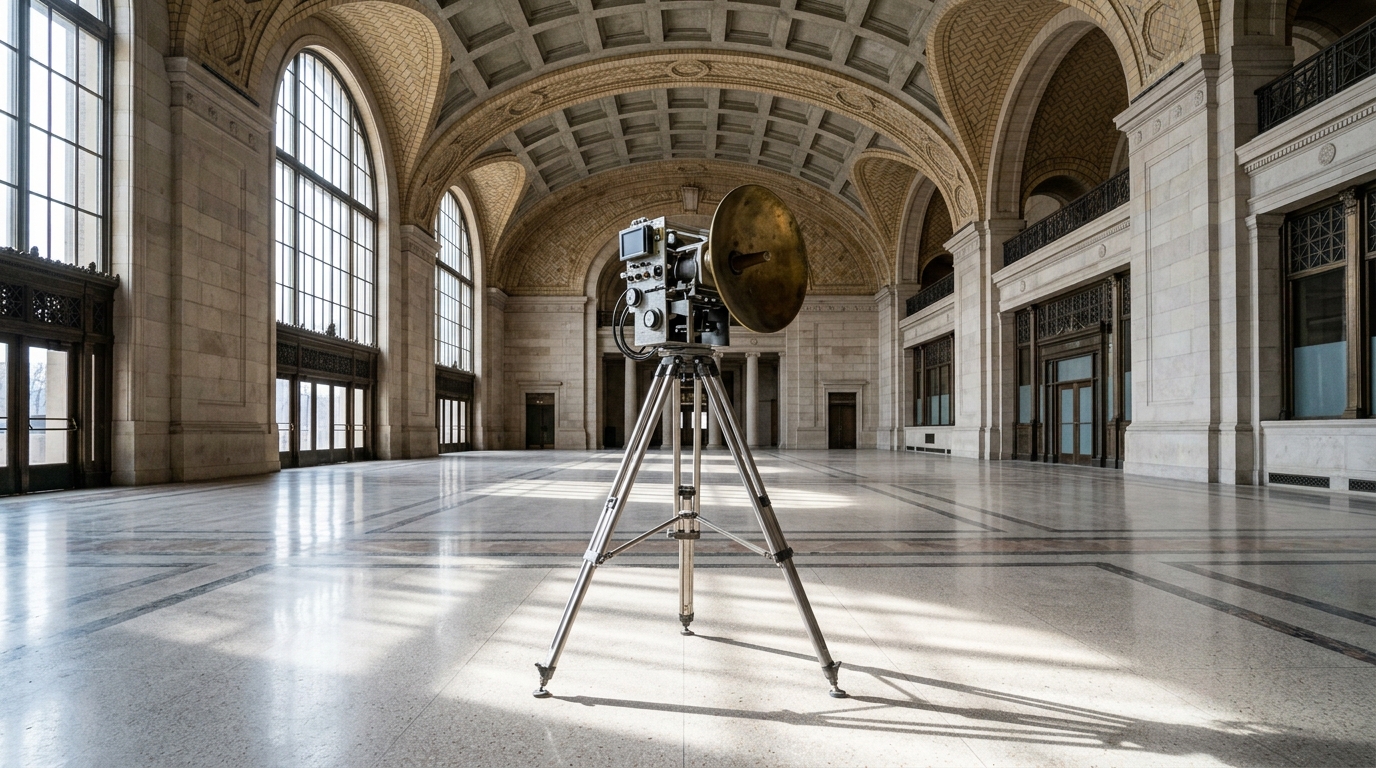
Directional acoustic sweeps measure lingering decay signatures across restored vault masonry. · motion: scanning the vault's acoustic decay
wall text
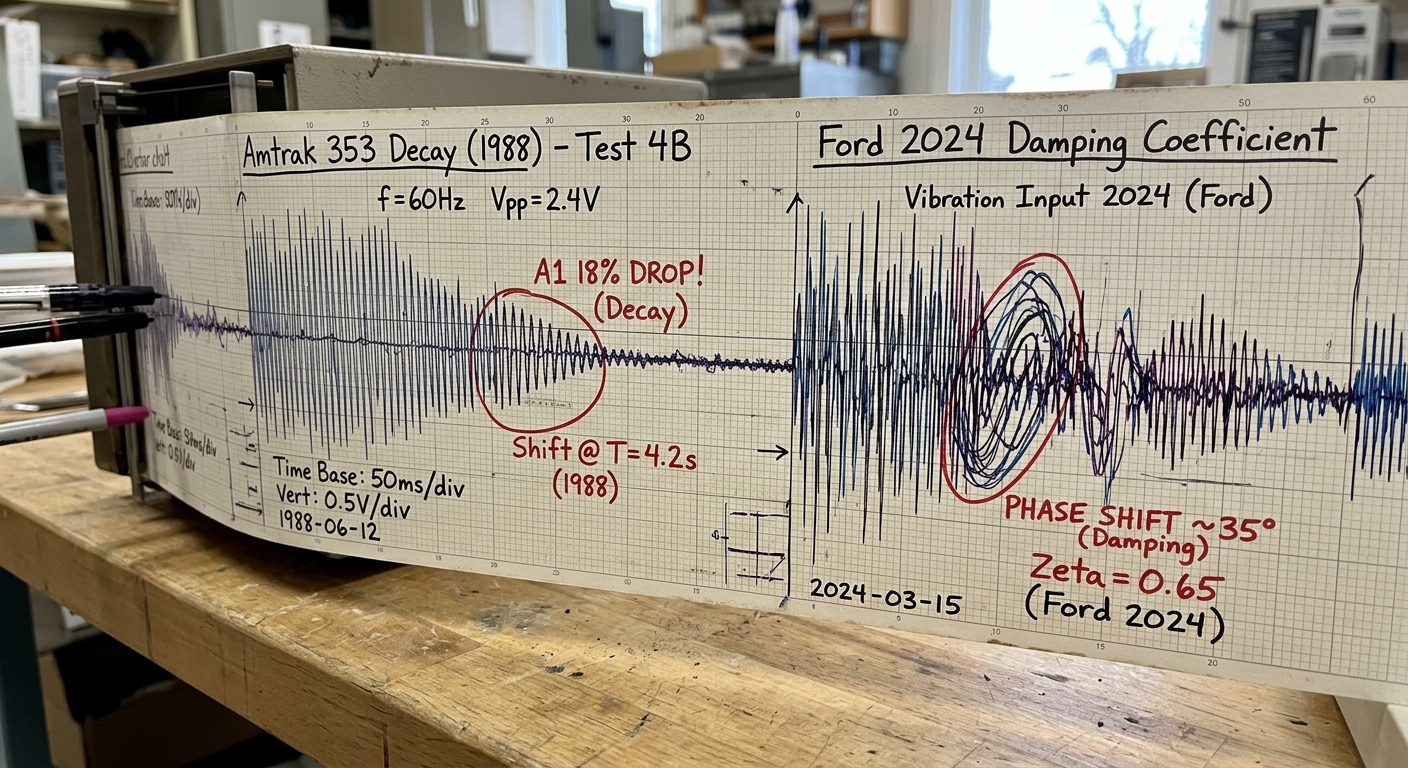
Repurposing time-delay spectrometry and phase-locked loop tracking, this installation audits the structural hysteresis of Michigan Central Station. A directional transducer emits ultrasonic sine sweeps across the 1913 Guastavino tile vaults, cross-correlating returning reflections against historical baseline data recorded prior to corporate intervention. By isolating phase shifts introduced by contemporary polymer dampeners and structural reinforcements, the apparatus measures how material aging permanently alters architectural resonance, treating restoration not as a reset, but as an ongoing acoustic accumulation.
shown: Permanently installed precisely at the geographic center of the Michigan Central Station's grand waiting room, operating continuously to output a real-time RT60 index.
shown: Permanently installed precisely at the geographic center of the Michigan Central Station's grand waiting room, operating continuously to output a real-time RT60 index.
anchor facts used
- Designed with massive Guastavino tile vaults in the main waiting room in 1913.
- Completely abandoned after the departure of the last Amtrak train, Number 353, on January 5, 1988.
- Underwent a massive corporate restoration by Ford Motor Company, officially reopening in June 2024.
- Stood as a vacant, open-to-the-elements 18-story tower for exactly 36 years.
mechanism
- Time-Delay Spectrometry (Sweep Generation) — Repurposing acoustic measurement to physically probe the preserved structural voids of the station.
1. Emit a continuous, frequency-modulated ultrasonic sine sweep into the grand waiting room, targeting the specific resonant frequencies of the original masonry. - Phase-Locked Loop (PLL) Tracking — Calibrating the tracking delay proportionally to the precise historical gap of civic abandonment.
2. Track the returning echoes using a receiver with a dynamically adjusting time delay, locking onto specific acoustic reflections. - Cross-Correlation Function — Mathematically filtering out the acoustic signatures of newly added modern materials to isolate the 'sound' of the original abandoned stone.
3. Multiply the received acoustic signal against a digital baseline model of the space to extract differential interference patterns. - RT60 Reverberation Time Measurement — Quantifying the 'latency of mourning' as a definitive, quantifiable half-life of civic memory and institutional promises.
4. Calculate the time required for the isolated historical frequencies to decay by 60 decibels within the restored space.
lineage
- Alvin Lucier, 'I Am Sitting in a Room' (1969) — Shifts the focus from the degradation of a personal, biological voice to the structural degradation and reconstitution of civic capital.
- Lawrence Abu Hamdan, 'Walled Unwalled' (2018) — Builds on acoustic forensics to map spatial trauma, but applies it to municipal abandonment rather than carceral violence.
- Gordon Matta-Clark, 'Conical Intersect' (1975) — Replaces the physical cutting of urban voids with the acoustic measurement of a temporal void.
curatorial qa (machine verdict, unedited)
SCORE 3/5 after 2 attempt(s)
READS: The directional acoustic transceiver apparatus and visible wave patterns sweeping the Guastavino vaulting, complemented by the comparative strip-chart telemetry.
FAILS: The connection between physical acoustic damping and the socio-political decay of public trust remains purely conceptual without visible systemic data integration.
READS: The directional acoustic transceiver apparatus and visible wave patterns sweeping the Guastavino vaulting, complemented by the comparative strip-chart telemetry.
FAILS: The connection between physical acoustic damping and the socio-political decay of public trust remains purely conceptual without visible systemic data integration.
spec: antigravity agent · keyframe/artifact: gemini-3.1-flash-image · video: veo-3.1 image-to-video · qa+wall text: gemini-3.7-flash watching the render · 51.8s total