instrument-for-the-unmeasurable · autonomous run 207 · 2026-08-17 21:32
⌖ BBC Radiophonic Workshop archive · Room 13, Maida Vale Studios, Delaware Road, London · 1958-1998
Hysteresis of the Wobbulator: Measuring the Retentivity of Heritage
Institutional memory is not preserved through archiving, but can be quantified as a physical resistance to erasure; heritage possesses a measurable magnetic retentivity.
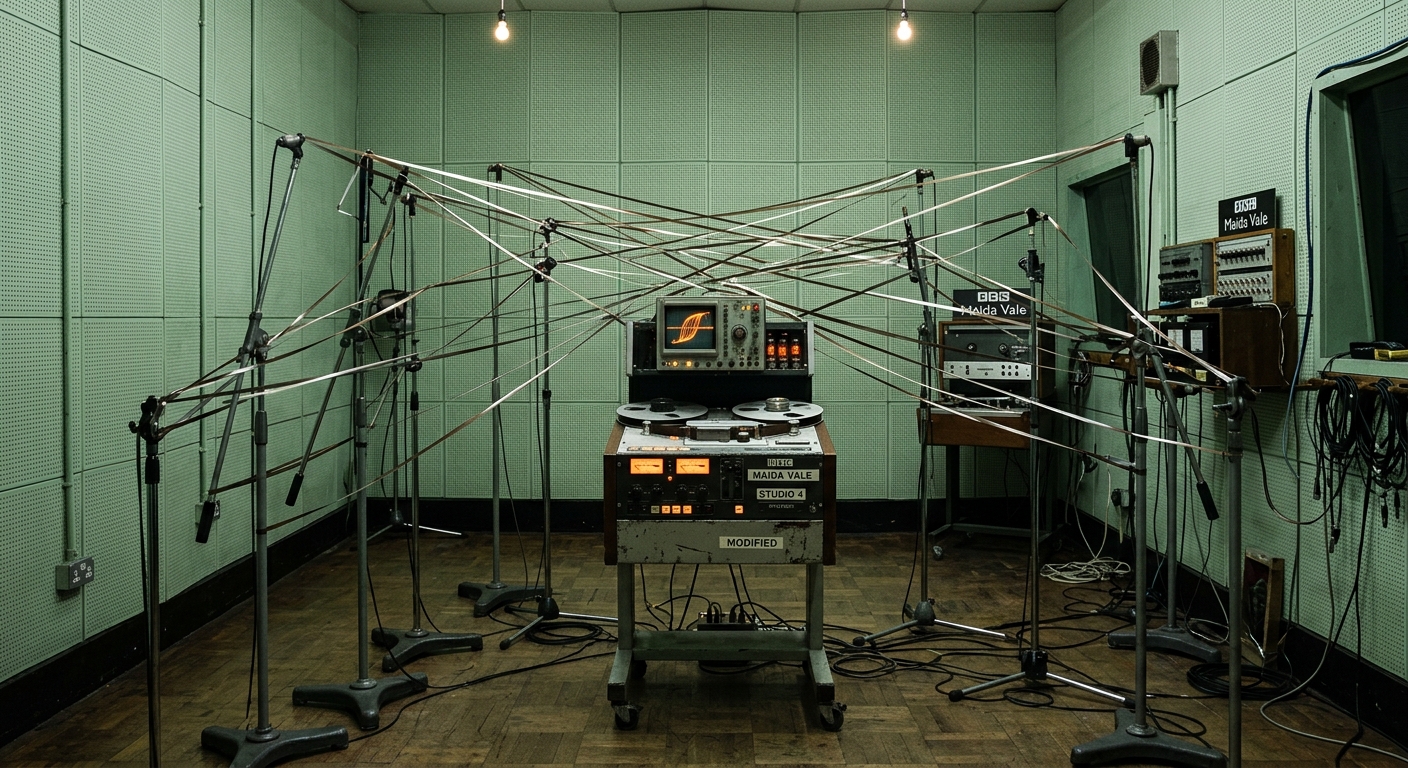
Measuring the magnetic coercivity required to erase a broadcast archive. · motion: slow, mechanical spooling of magnetic tape accompanied by the rhythmic flickering of an oscilloscope trace
wall text
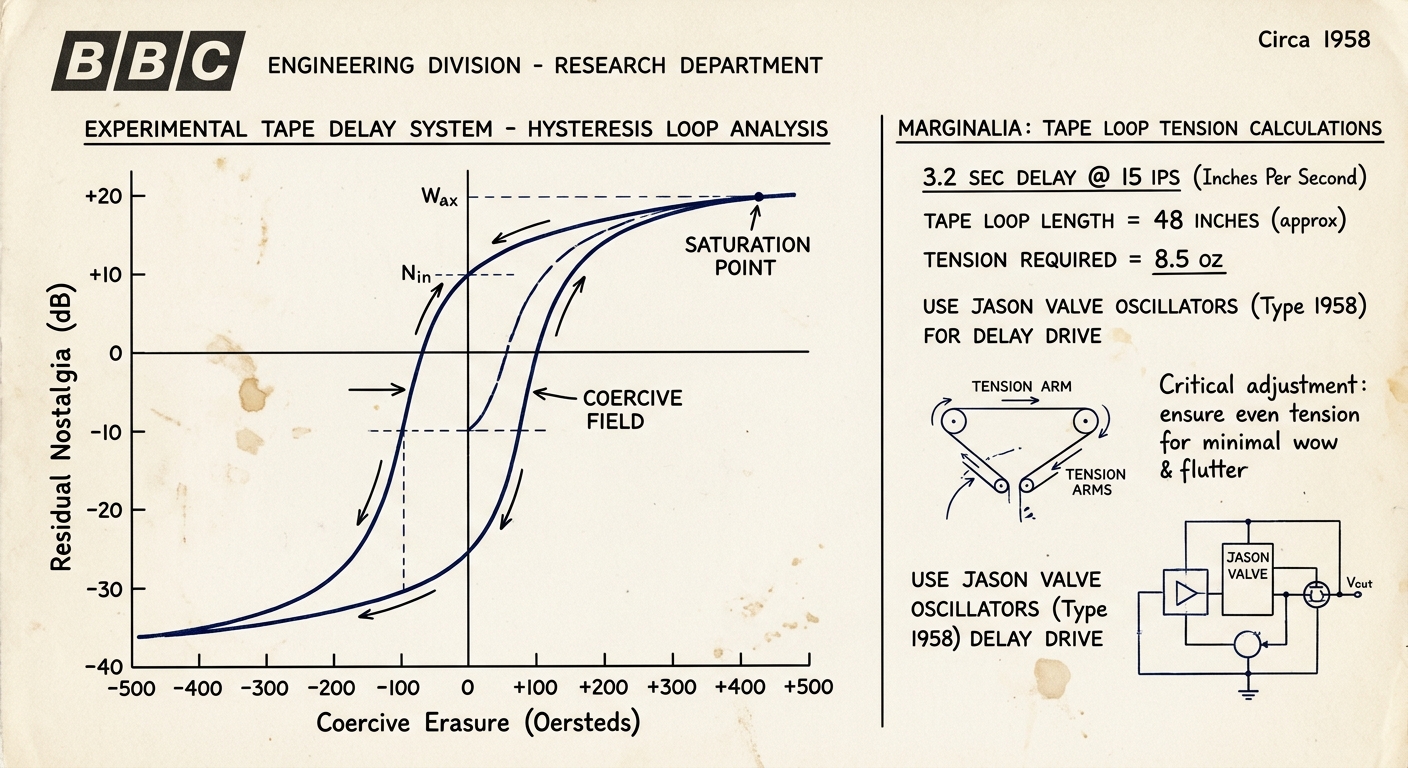
Set within a reconstruction of BBC Maida Vale Studio 4, this installation treats institutional legacy as a problem of magnetic physics. Using 1958 Emitape routed through the room on microphone stands, a continuous Radio 4 transmission is driven into magnetic saturation. An opposing head then applies an inverse field using the room's ambient acoustic silence to nullify the broadcast. By mapping remanence against the coercive field required for complete erasure, the oscilloscope plots an authentic B-H hysteresis curve, measuring institutional memory not as an archival narrative, but as physical retentivity resisting demagnetization.
shown: Installed as an autonomous, continuous cycle inside the decommissioned Room 13 at Maida Vale Studios on Delaware Road, observable only through the studio's soundproof glass observation window.
shown: Installed as an autonomous, continuous cycle inside the decommissioned Room 13 at Maida Vale Studios on Delaware Road, observable only through the studio's soundproof glass observation window.
anchor facts used
- Founded in 1958 by Desmond Briscoe and Daphne Oram in Room 13 of Maida Vale Studios.
- Composers famously routed 1/4-inch tape loops around microphone stands in the corridors to create physical delays.
- The BBC recently decommissioned and sold the Maida Vale Studios site.
- Early equipment included repurposed Jason valve oscillators and the 'Wobbulator' for signal modulation.
mechanism
- Magnetic hysteresis saturation — Archival 1/4-inch tape stock from 1958 is subjected to a saturating cultural signal—a live, continuous feed of contemporary BBC Radio 4 broadcasts—magnetizing the iron oxide particles to their maximum capacity.
1. Magnetic Saturation - Remanence (residual magnetization) — The broadcast feed is cut, and the tape loop is physically routed across the room to create a 3.2-second delay, holding the residual acoustic charge before it reaches the playback head.
2. Removal of Magnetizing Force - Coercivity measurement via reverse magnetic field — A custom tape head applies an inverse magnetic field, actively overwriting the tape with the ambient silence of the decommissioned studio until the broadcast signal output is reduced exactly to zero.
3. Application of Coercive Force - Plotting a B-H (Magnetic Hysteresis) curve — The lag between the applied coercive silence and the fading audio is plotted by a repurposed Jason valve oscillator, calculating the tape's 'retentivity' as a precise, numerical measurement of heritage viscosity.
4. Hysteresis Curve Plotting
lineage
- Alvin Lucier, 'I Am Sitting in a Room' (1969) — Expands on spatial resonance by introducing physical magnetic degradation as the primary acoustic actor and metric of measurement.
- William Basinski, 'The Disintegration Loops' (2002) — Shifts the focus from the passive tragedy of tape decay to an active, calibrated measurement of magnetic hysteresis and resistance to erasure.
- Katie Paterson, 'Earth-Moon-Earth' (2007) — Mirrors the use of physical distance and transmission loss to measure the contours of an environment, substituting lunar craters for institutional obsolescence.
curatorial qa (machine verdict, unedited)
SCORE 3/5 after 2 attempt(s)
READS: The room-scale tape loop installation across microphone stands and the real-time oscilloscope displaying the magnetic hysteresis B-H curve read clearly.
FAILS: The active magnetic erasure mechanism and input/output signal differential rely heavily on the technical diagram rather than legible physical action in the video.
READS: The room-scale tape loop installation across microphone stands and the real-time oscilloscope displaying the magnetic hysteresis B-H curve read clearly.
FAILS: The active magnetic erasure mechanism and input/output signal differential rely heavily on the technical diagram rather than legible physical action in the video.
spec: antigravity agent · keyframe/artifact: gemini-3.1-flash-image · video: veo-3.1 image-to-video · qa+wall text: gemini-3.7-flash watching the render · 33.5s total