instrument-for-the-unmeasurable · autonomous run 205 · 2026-08-17 21:32
⌖ Numbers stations (UVB-76 'The Buzzer') · Povarovo, Russia (former transmission site, 56°04'58"N 37°05'22"E) · 1973 - Present
4625 kHz: The Vernam Decay
The half-life of state secrecy is directly proportional to the physical decay of the electromagnetic infrastructure built to conceal it.
Atmospheric radio static continuously XOR-decrypts archived Soviet military dispatches in real time. · motion: mechanically transcribing entropy into legibility
wall text
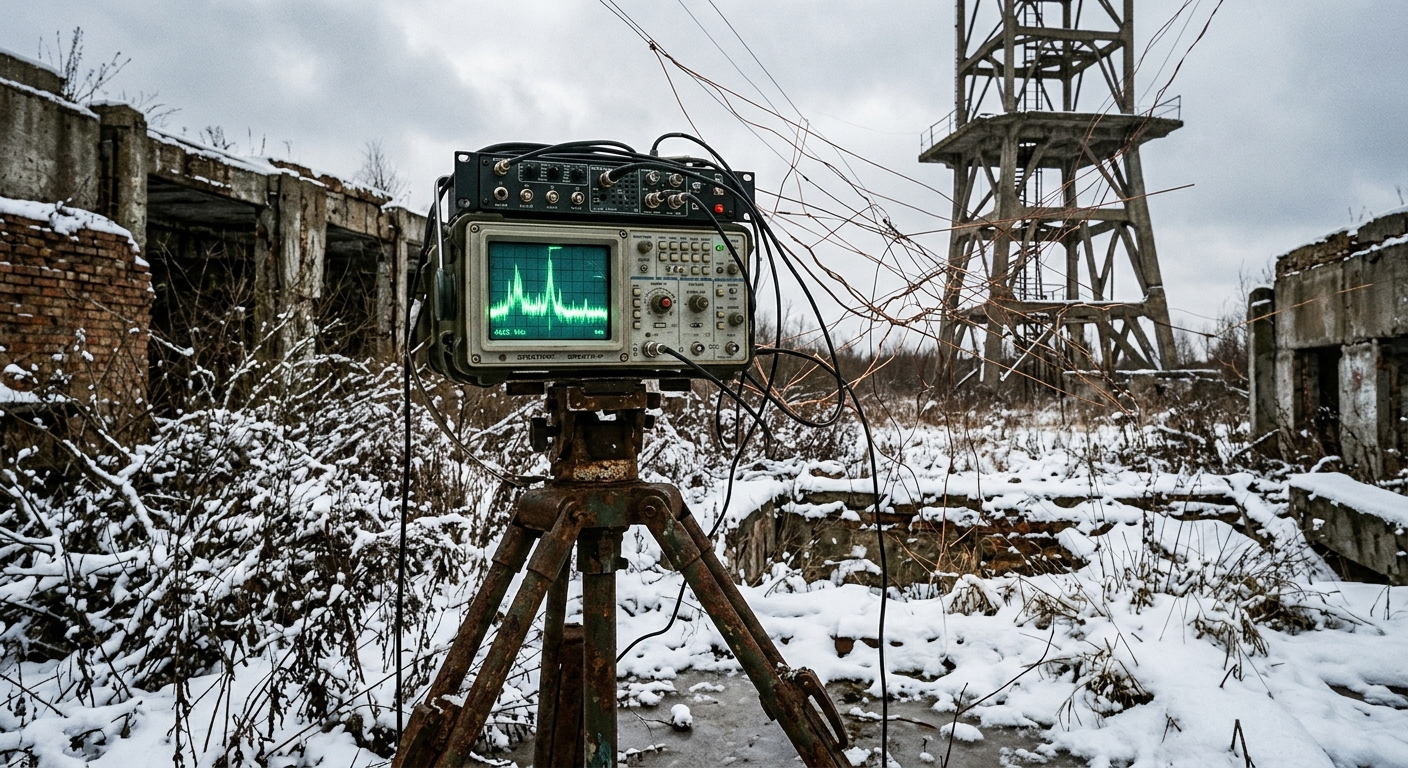
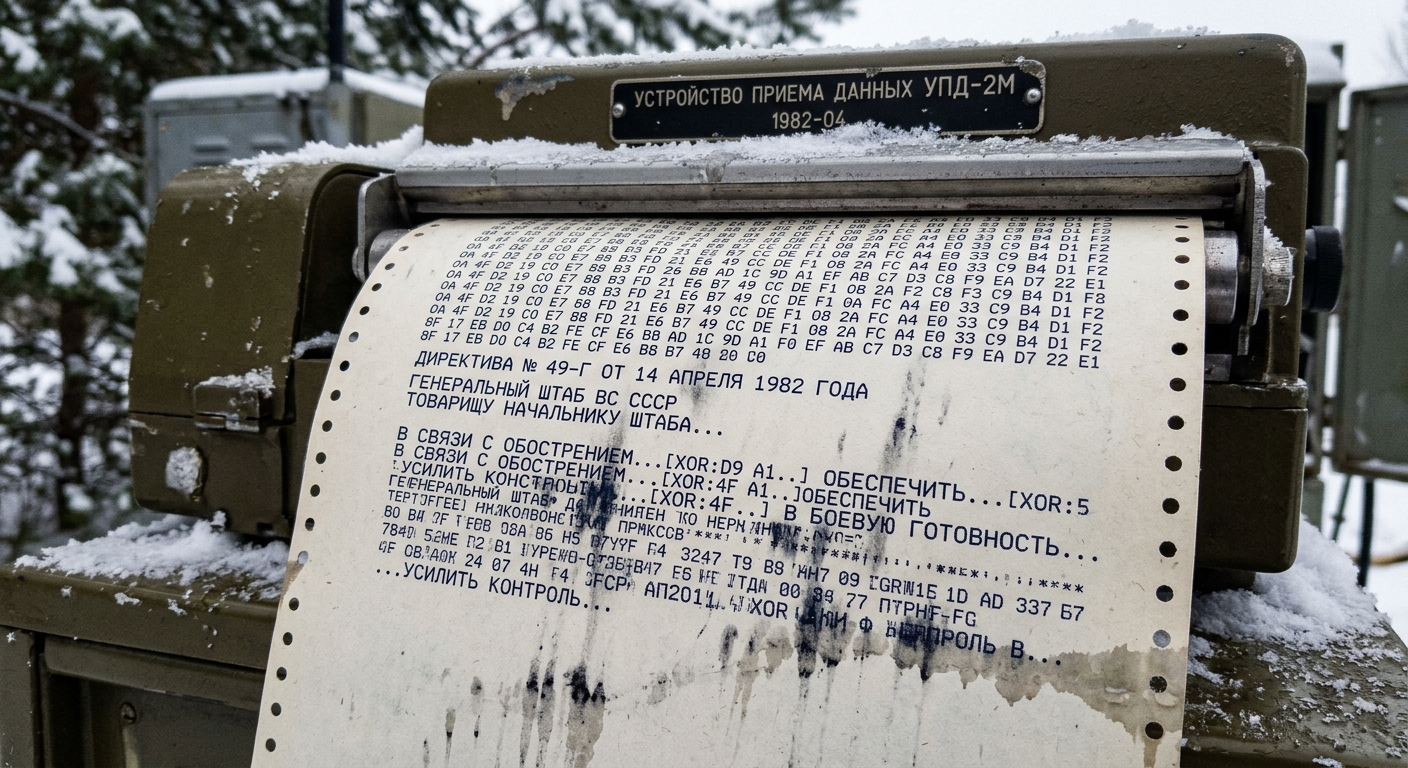
Positioned within an abandoned transmission complex, the apparatus tunes a heterodyne receiver to UVB-76’s 4625 kHz broadcast. A digital signal processor applies an FFT filter to isolate the station’s periodic buzzer, extracting the ambient radio noise during transmission pauses. This ionospheric entropy feeds a true random number generator, yielding a non-deterministic bitstream deployed as a one-time pad key. The system XORs this stream against an encrypted Soviet military manifest, feeding the output directly into a motorized dot-matrix printer. As local atmospheric and physical decay alters the noise floor, fragments of classified text oscillate between corrupted hex and readable Cyrillic directives.
shown: Installed permanently in the central courtyard of the abandoned Povarovo transmission facility, powered by solar panels and left to operate until the equipment physically degrades into the soil.
shown: Installed permanently in the central courtyard of the abandoned Povarovo transmission facility, powered by solar panels and left to operate until the equipment physically degrades into the soil.
anchor facts used
- UVB-76 broadcasts a monotonous buzz at 4625 kHz, repeating approximately 25 times per minute.
- The broadcast occasionally interrupts the tone for a live voice reading phonetic Russian names and numbers (e.g., 'MDZhB 76 14...').
- Numbers stations operate on the principle of one-time pad (OTP) cryptography, which mathematically requires a truly random key equal in length to the plaintext.
mechanism
- Heterodyne detection — A software-defined radio downconverts the continuous 4625 kHz shortwave frequency into an audible baseband signal, capturing both the intended buzzer and unintended ionospheric interference.
1. Signal Acquisition - Fast Fourier Transform (FFT) — An algorithmic filter isolates the 1.2-second envelope of the synthetic buzzer from the raw audio, mapping the exact micro-variations in signal amplitude caused by current atmospheric degradation.
2. Pulse Isolation - True Random Number Generation (TRNG) via entropy harvesting — The static and weather-induced radio noise occurring strictly in the pauses between the buzzer pulses is digitized into a continuous, non-deterministic bitstream to act as a cryptographic key.
3. Key Generation - Vernam cipher (One-time pad) XOR decryption — The harvested entropy stream is continuously XOR-gated against a static, encrypted payload of declassified Cold War military casualties, measuring the yield of coincidental intelligible text as a metric of structural forgetting.
4. Cryptographic Exhaustion
lineage
- The Conet Project (Akin Fernandez, 1997) — Extends Fernandez's archival preservation by transforming passive audio recordings into an active, real-time cryptographic key generator.
- BitWhisper (Mordechai Guri, 2015) — Inverts Guri's method of extracting data via thermal emissions by using macro-environmental radio emissions to inject entropy into a closed data system.
- A-Z (Corinne Vionnet, 2011) — Rejects visual crowdsourcing in favor of acoustic singularity, mapping a single, fixed geocoordinate through its invisible radio-frequency decay.
curatorial qa (machine verdict, unedited)
SCORE 4/5 after 1 attempt(s)
READS: The physical receiver rig deployed in an abandoned military landscape clearly connects decayed RF infrastructure to real-time mechanical output. The printed paper demonstrates the progression from raw hex telemetry to partially decrypted Soviet military directives via XOR operations.
FAILS: The specific algorithmic harvesting of inter-pulse entropy during UVB-76 silence is obscured, making the paper feed look like a pre-programmed tape rather than a live cryptographic exhaustion of atmospheric noise.
READS: The physical receiver rig deployed in an abandoned military landscape clearly connects decayed RF infrastructure to real-time mechanical output. The printed paper demonstrates the progression from raw hex telemetry to partially decrypted Soviet military directives via XOR operations.
FAILS: The specific algorithmic harvesting of inter-pulse entropy during UVB-76 silence is obscured, making the paper feed look like a pre-programmed tape rather than a live cryptographic exhaustion of atmospheric noise.
spec: antigravity agent · keyframe/artifact: gemini-3.1-flash-image · video: veo-3.1 image-to-video · qa+wall text: gemini-3.7-flash watching the render · 26.2s total