instrument-for-the-unmeasurable · autonomous run 204 · 2026-08-17 21:32
⌖ Lloyd's of London names disaster · Lime Street, London · 1973-1996
The IBNR Extensometer: Viscoelastic Rupture of a Promise
The latency of an unpayable financial obligation is physically identical to viscoelastic creep: it incubates invisibly under constant stress until a microscopic, long-buried catalyst triggers catastrophic, exponential rupture.
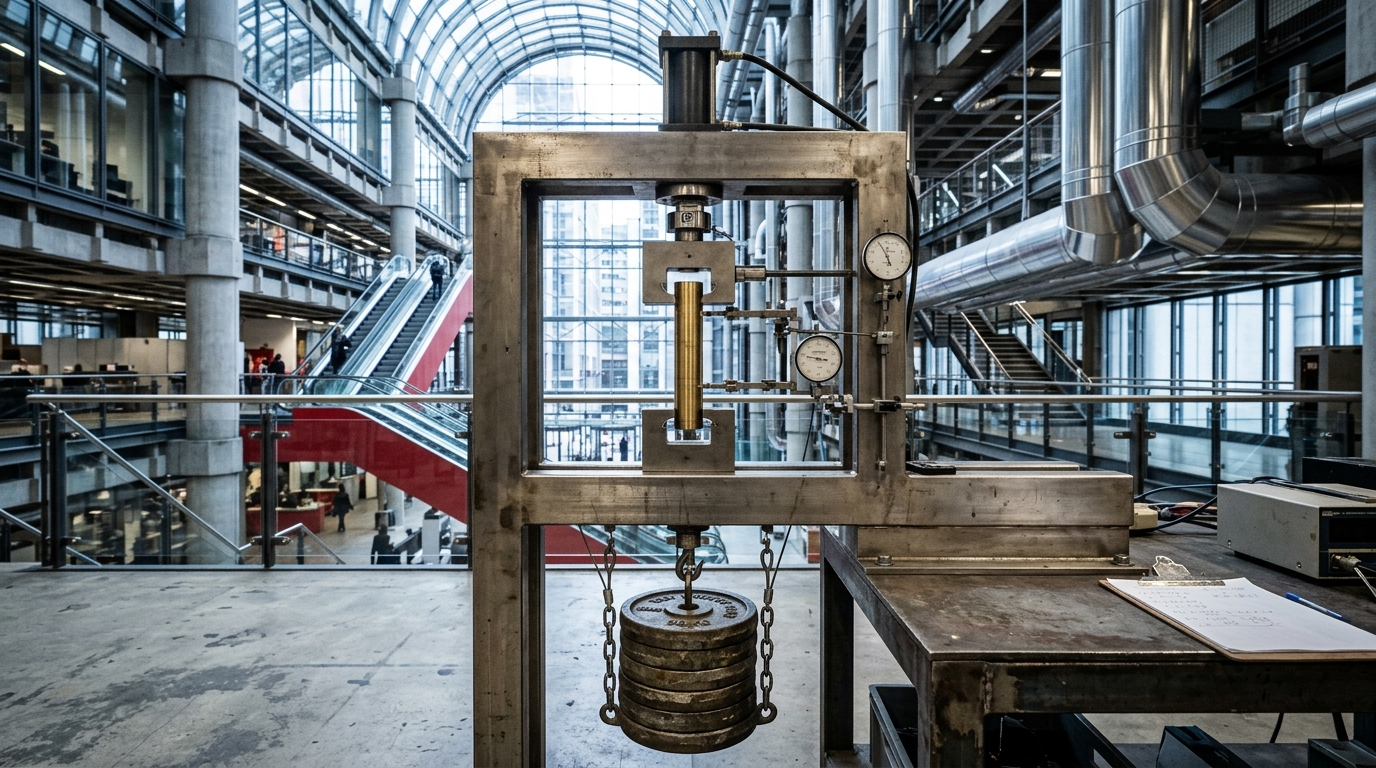
Calibrated deadweights induce runaway tensile failure in a standardized brass cylinder. · motion: microscopically stretching to the point of catastrophic ductile fracture
wall text
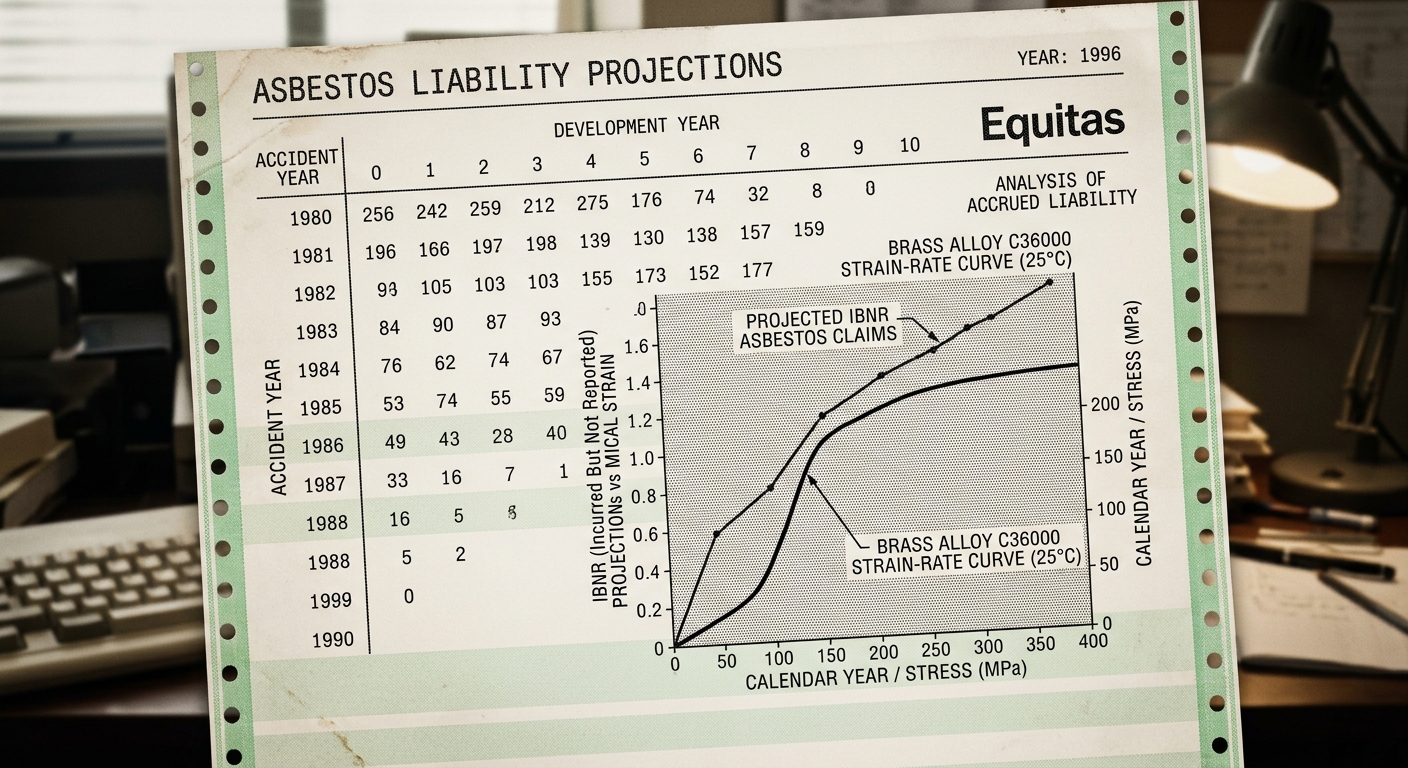
In materials science, viscoelastic creep describes the slow, permanent deformation of a material subjected to persistent mechanical stress below its yield point. Over decades, microscopic void coalescence silently thins the structure until necking exponentially increases true localized stress, triggering abrupt failure. This installation transposes the 1990s Lloyd's of London collapse into a mechanical creep test. Actuarial chain-ladder estimates for latent asbestos liabilities—Incurred But Not Reported (IBNR) losses—mirror the imperceptible primary and secondary creep phases of a loaded brass alloy. The eventual catastrophe reflects the London Market Excess of Loss (LMX) spiral: a recursive feedback loop where diminishing structural margin accelerates terminal rupture.
shown: Installed directly beneath the salvaged Lutine Bell in the center of the Lloyd's of London Underwriting Room on Lime Street, physically anchored to the floorboards.
shown: Installed directly beneath the salvaged Lutine Bell in the center of the Lloyd's of London Underwriting Room on Lime Street, physically anchored to the floorboards.
anchor facts used
- Names operated under the principle of 'unlimited liability', meaning their entire personal wealth was collateralized.
- The 1973 Borel v. Fibreboard ruling triggered decades of latent, long-tail asbestos claims.
- In 1996, the Equitas vehicle was created to ring-fence £14 billion of toxic pre-1993 liabilities.
- The LMX (London Market Excess of Loss) spiral caused syndicates to unknowingly reinsure the same toxic risks.
mechanism
- Viscoelastic Creep Testing (Constant Stress Load) — A continuous, calibrated gravitational load of lead weights is hung from a standardized brass cylinder, physically representing the unlimited financial liability placed on the Names.
1. Application of the Unlimited Load - Incurred But Not Reported (IBNR) Actuarial Chain-Ladder Projection — Micro-extensometers measure the primary creep—the invisible, slow-motion lengthening of the brass over years—charting the hidden accumulation of liability before rupture is visible to the naked eye.
2. The Latency Triangulation - True Stress Increase (Neckling) / Thermal Runaway — As the brass stretches, its cross-sectional area narrows, exponentially increasing the stress per square inch and accelerating deformation without adding new weight.
3. The Excess of Loss Feedback Loop - Ductile Fracture / Acoustic Emission Monitoring — The material reaches tertiary creep and violently snaps; a piezoelectric acoustic sensor records the exact millisecond of material death, stopping the system's clock.
4. The Equitas Severance
lineage
- Hans Haacke, Shapolsky et al. Manhattan Real Estate Holdings, a Real-Time Social System, as of May 1, 1971 — Builds on Haacke's mapping of hidden financial structures by rendering the latent temporal decay of those obligations into physical material failure.
- Edward Andrade, On the Viscous Flow in Metals, and Allied Phenomena (1910) — Directly employs Andrade's metallurgical creep formula to calculate and physicalize the exact half-life of a financially ruined Name's solvency.
- Michael Asher, Untitled (1974) at Claire Copley Gallery — Mirrors Asher's removal of partition walls to expose the gallery's business operations, but exposes the architectural latency of risk in the Lloyd's building.
curatorial qa (machine verdict, unedited)
SCORE 3/5 after 2 attempt(s)
READS: The deadweight creep apparatus sited within the Lloyd's atrium establishes the physical metaphor, while the Equitas actuarial printout clearly bridges IBNR claim triangles with metallurgical strain rates.
FAILS: The specimen shatters outward like hollow brittle ceramic rather than undergoing gradual viscoelastic thinning, necking, and ductile cup-and-cone mechanical rupture.
READS: The deadweight creep apparatus sited within the Lloyd's atrium establishes the physical metaphor, while the Equitas actuarial printout clearly bridges IBNR claim triangles with metallurgical strain rates.
FAILS: The specimen shatters outward like hollow brittle ceramic rather than undergoing gradual viscoelastic thinning, necking, and ductile cup-and-cone mechanical rupture.
spec: antigravity agent · keyframe/artifact: gemini-3.1-flash-image · video: veo-3.1 image-to-video · qa+wall text: gemini-3.7-flash watching the render · 36.5s total