instrument-for-the-unmeasurable · autonomous run 201 · 2026-08-17 21:32
⌖ Ecuador Yasuní-ITT initiative · Yasuní National Park, Block 43, Ecuador · 2007-2013
The Tiputini Decay Yield
The geopolitical valuation of an unkept ecological promise decays at a measurable, algorithmic rate identical to sovereign debt default probabilities.
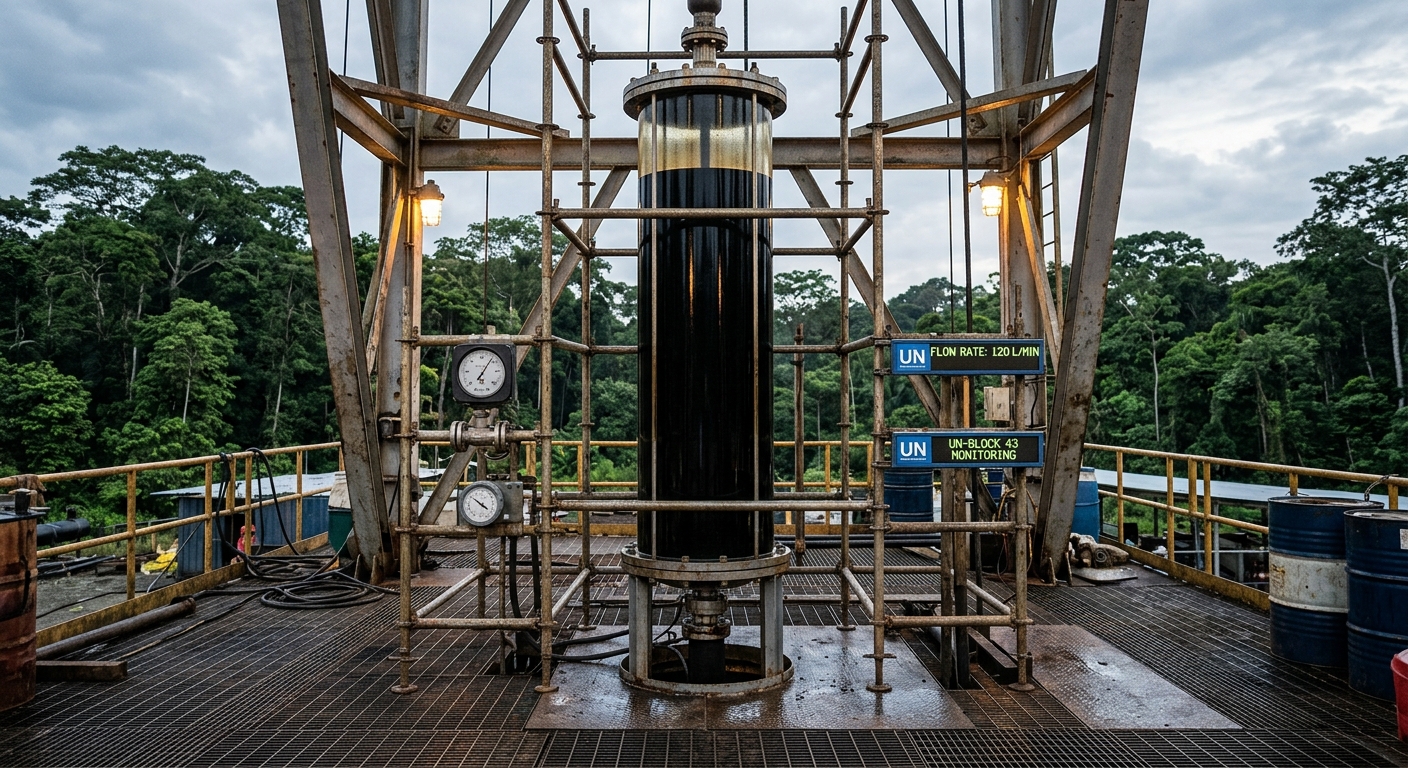
Crude oil overflow triggered by sovereign default hazard rate thresholds. · motion: viscous percolation accelerating into an uncontrolled hemorrhage

wall text
In 2007, Ecuador offered to leave 846 million barrels of crude beneath Yasuní National Park unextracted if international donors compensated half its value. The initiative collapsed in 2013 having raised a fraction of the target. This installation treats that failed environmental trust as a sovereign credit default swap. Transposing Poisson hazard rate modeling and Loss Given Default calculations, the rig continuously maps the widening pledge deficit against actual UN deposits. As mathematical default probability escalates, a pump drives heavy crude upward through an atmospheric borosilicate cylinder until pressure breaches containment. The resulting overflow mechanicalizes the exact statistical inflection point where sovereign ecological conservation collapses into industrial extraction.
shown: Installed permanently on a decommissioned Petroamazonas drilling pad within Block 43 of the Yasuní National Park, powered by residual flare gas.
shown: Installed permanently on a decommissioned Petroamazonas drilling pad within Block 43 of the Yasuní National Park, powered by residual flare gas.
anchor facts used
- In 2007, President Rafael Correa proposed leaving 846 million barrels of oil underground in exchange for $3.6 billion.
- Only $13 million in actual cash was deposited into the UN-administered trust fund by 2013.
- In August 2013, Correa cancelled the initiative, and Petroamazonas subsequently began drilling operations.
mechanism
- Poisson process hazard rate modeling — The daily shortfall between the pledged $3.6 billion and actual UN trust fund deposits is calculated as a continuous-time default intensity, driving the speed of a peristaltic pump.
1. Hazard Rate Calibration - LGD (Loss Given Default) estimation — The impending ecological loss is quantified physically, calibrating the total internal volume of an array of borosilicate holding tanks to perfectly scale to the unextracted reserve.
2. Loss Given Default Estimation - Credit Default Swap (CDS) premium calculation — As the mathematical probability of the initiative's failure widens, the system increases the pressure of viscous synthetic crude being pumped upward into the transparent atmospheric tanks.
3. Premium Spread Calculation - ISDA credit event auction — A mechanical liquidation protocol is triggered by the timeline reaching the structural failure point, opening solenoid valves that purge the accumulated fluid onto the exhibition floor.
4. Credit Event Auction
lineage
- Hans Haacke, 'Condensation Cube' (1965) — Establishes the closed-system physicalization of environmental data, which this work extends into the realm of financialized ecological failure.
- Michael Najjar, 'high altitude' (2008-2010) — Maps market data onto physical topography, inverted here to map financial default onto the literal extraction of subterranean geology.
- Carey Young, 'Declared Void' (2005) — Explores the physical boundaries of legal agreements, which this piece expands to the physical collapse of international UN trust fund covenants.
curatorial qa (machine verdict, unedited)
SCORE 4/5 after 1 attempt(s)
READS: The physicalization of financial failure through rising crude oil within an industrial monitoring apparatus in Yasuní; the overflow directly translates sovereign risk modeling into environmental spillover.
FAILS: The direct connection between the specific Poisson hazard math on the printout ledger and the exact moment of cylinder overflow relies heavily on the paper artifact rather than in-situ telemetry.
READS: The physicalization of financial failure through rising crude oil within an industrial monitoring apparatus in Yasuní; the overflow directly translates sovereign risk modeling into environmental spillover.
FAILS: The direct connection between the specific Poisson hazard math on the printout ledger and the exact moment of cylinder overflow relies heavily on the paper artifact rather than in-situ telemetry.
spec: antigravity agent · keyframe/artifact: gemini-3.1-flash-image · video: veo-3.1 image-to-video · qa+wall text: gemini-3.7-flash watching the render · 38.1s total