instrument-for-the-unmeasurable · autonomous run 199 · 2026-08-17 21:32
⌖ Argentina corralito · Buenos Aires · December 2001
Acoustic Hysteresis of the 250-Peso Limit
Institutional trust degrades not as an abstract societal shift, but as a quantifiable material hysteresis—permanent acoustic micro-fractures within financial architecture that permanently alter its resonant frequency.
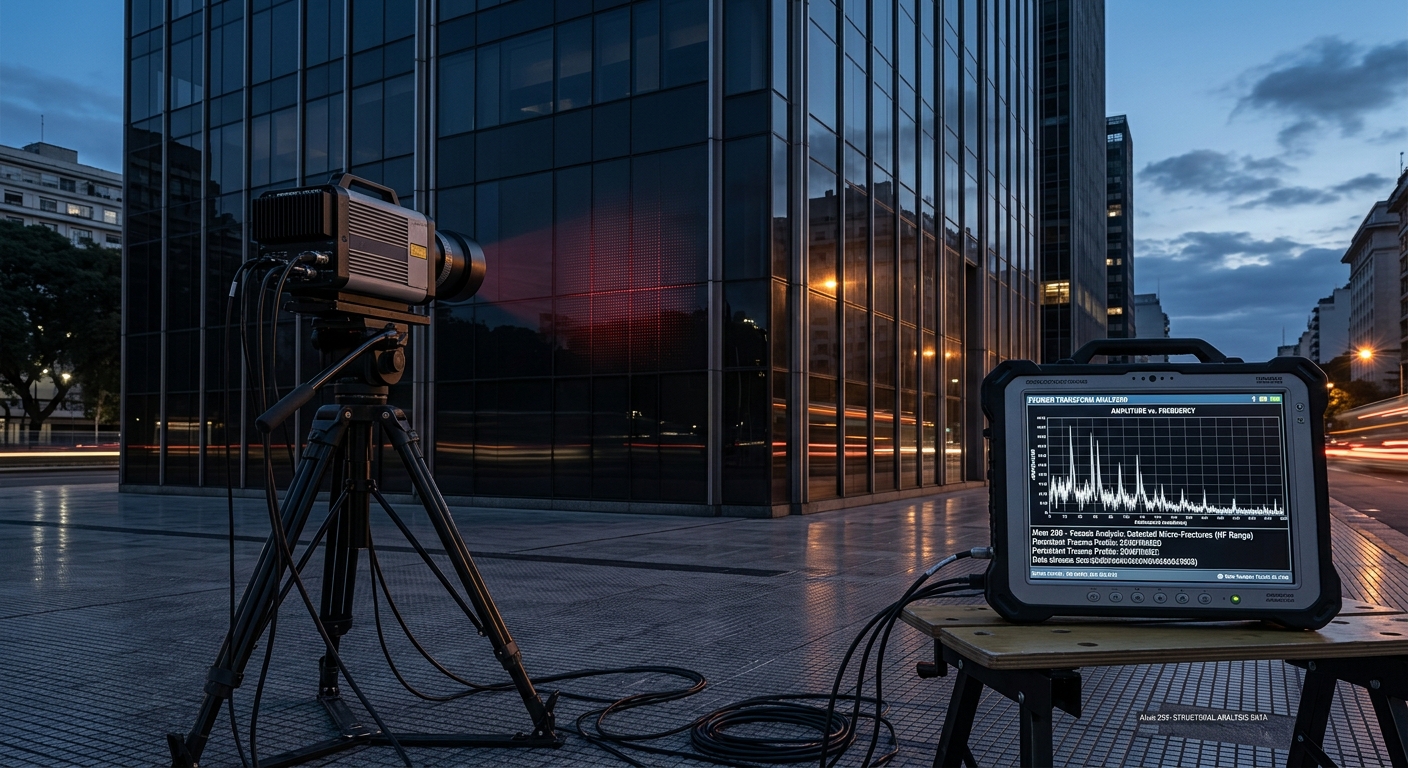
Laser Doppler vibrometer mapping residual acoustic trauma on corporate architectural glazing. · motion: sweeping slowly across the architectural glass to reveal invisible structural scars
wall text
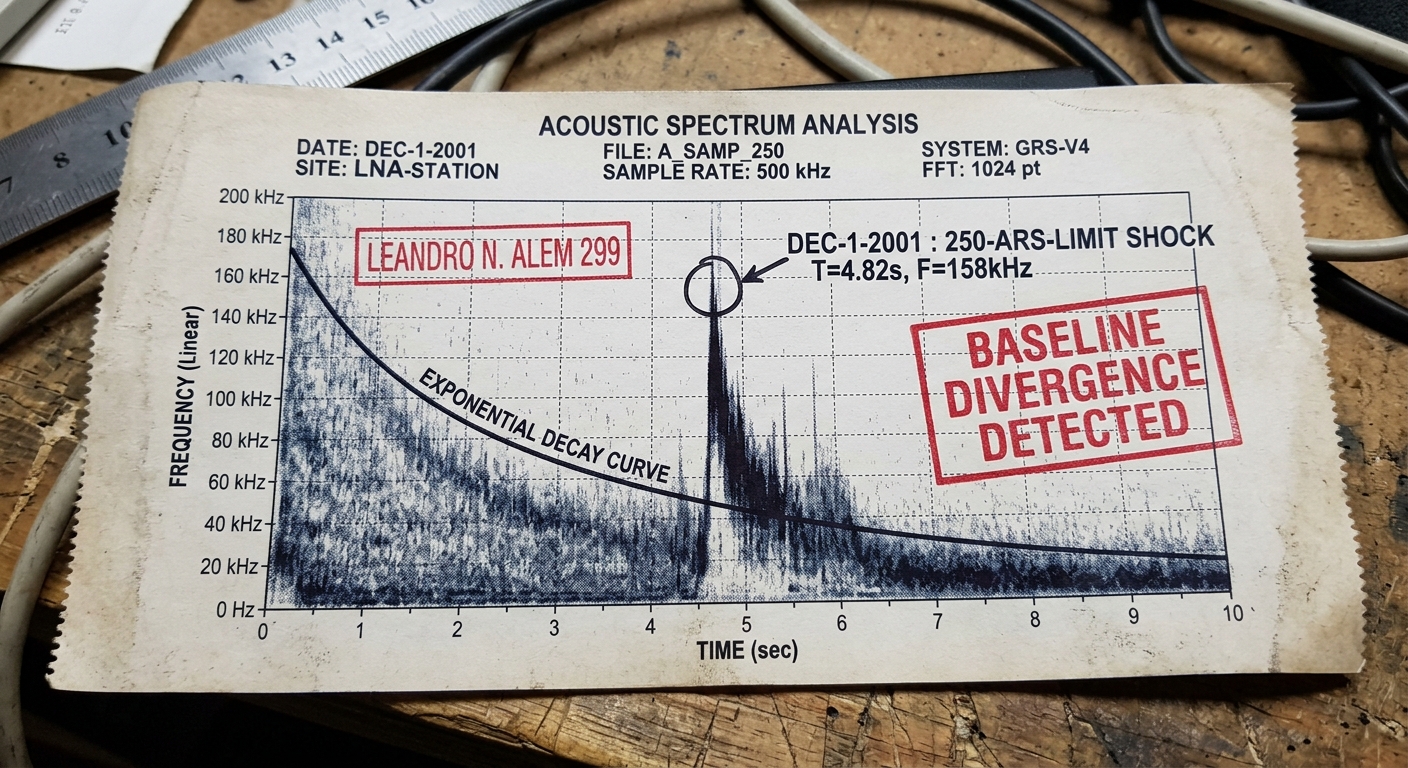
Completed just months before the 2001 Argentine economic collapse, the BankBoston tower in Buenos Aires absorbed the concentrated kinetic fury of the 'cacerolazo' protests against its ground-floor facade. This installation adapts non-destructive Laser Doppler Vibrometry (LDV) and Acoustic Emission Testing to interrogate the building's structural memory. By scanning the curtain-wall glass, the system measures micro-strain variations and resonant shifts caused by thousands of sustained metallic impacts. Comparing ground-level panes against pristine upper-floor baselines, the piece isolates the physical hysteresis of the panic—treating institutional collapse not as economic metaphor, but as a permanent, quantifiable alteration of architectural resonance.
shown: Installed permanently on the sidewalk outside Avenida Leandro N. Alem 299, locked in position to continuously scan the exact pane of glass that absorbed the heaviest cacerolazo impacts in December 2001.
shown: Installed permanently on the sidewalk outside Avenida Leandro N. Alem 299, locked in position to continuously scan the exact pane of glass that absorbed the heaviest cacerolazo impacts in December 2001.
anchor facts used
- On December 1, 2001, Economy Minister Domingo Cavallo enacted the decree freezing bank accounts.
- Cash withdrawals were legally restricted to a maximum of 250 Argentine pesos per week.
- Citizens responded with 'cacerolazos', violently banging pots and pans against the reinforced glass of foreign banks like the BankBoston tower at Avenida Leandro N. Alem 299.
mechanism
- Laser Doppler Vibrometry (LDV) — Scanning the exterior glass panes of the BankBoston tower to measure minute variations in surface velocity and map the residual stress fractures left by the acoustic impacts.
1. Surface Excitation and Capture - Acoustic Emission Testing (AET) — Comparing the current acoustic impedance of the heavily struck ground-floor glass against the baseline frequency of an upper-floor pristine pane.
2. Baseline Deviation Analysis - Exponential Decay Law — Calculating the half-life of structural faith by measuring the rate at which the material matrix sheds the kinetic memory of the panic.
3. Trust Viscosity Quantification - Inverse Fast Fourier Transform (IFFT) — Converting the detected structural deficits back into an audio waveform that emits a localized, continuous low-frequency hum representing the missing civic trust.
4. Sonification of Deficits
lineage
- Susan Schuppli, 'Material Witness' — Extends her thesis of non-human witnesses by turning commercial bank architecture into a passive seismograph of economic trauma.
- Lawrence Abu Hamdan, 'Walled Unwalled' — Moves beyond Abu Hamdan's focus on acoustic leakage to quantify acoustic scarring permanently embedded within the obstacle itself.
- Teresa Margolles, 'En el Aire' — Adapts her transposition of violent forensic residue into civic space to the realm of state-sanctioned financial violence.
curatorial qa (machine verdict, unedited)
SCORE 4/5 after 1 attempt(s)
READS: The field deployment of Laser Doppler Vibrometry against corporate glass curtain walls is immediately legible, connecting optical non-destructive testing directly with live FFT acoustic readouts.
FAILS: The laser grid remains static rather than actively sweeping across pane seams, missing the visual translation of structural hysteresis across elevation zones.
READS: The field deployment of Laser Doppler Vibrometry against corporate glass curtain walls is immediately legible, connecting optical non-destructive testing directly with live FFT acoustic readouts.
FAILS: The laser grid remains static rather than actively sweeping across pane seams, missing the visual translation of structural hysteresis across elevation zones.
spec: antigravity agent · keyframe/artifact: gemini-3.1-flash-image · video: veo-3.1 image-to-video · qa+wall text: gemini-3.7-flash watching the render · 39.3s total