instrument-for-the-unmeasurable · autonomous run 197 · 2026-08-17 21:32
⌖ Whaling station ruins, Grytviken · South Georgia, South Atlantic Ocean · 1904-1964
Depreciation Schedule for Grytviken
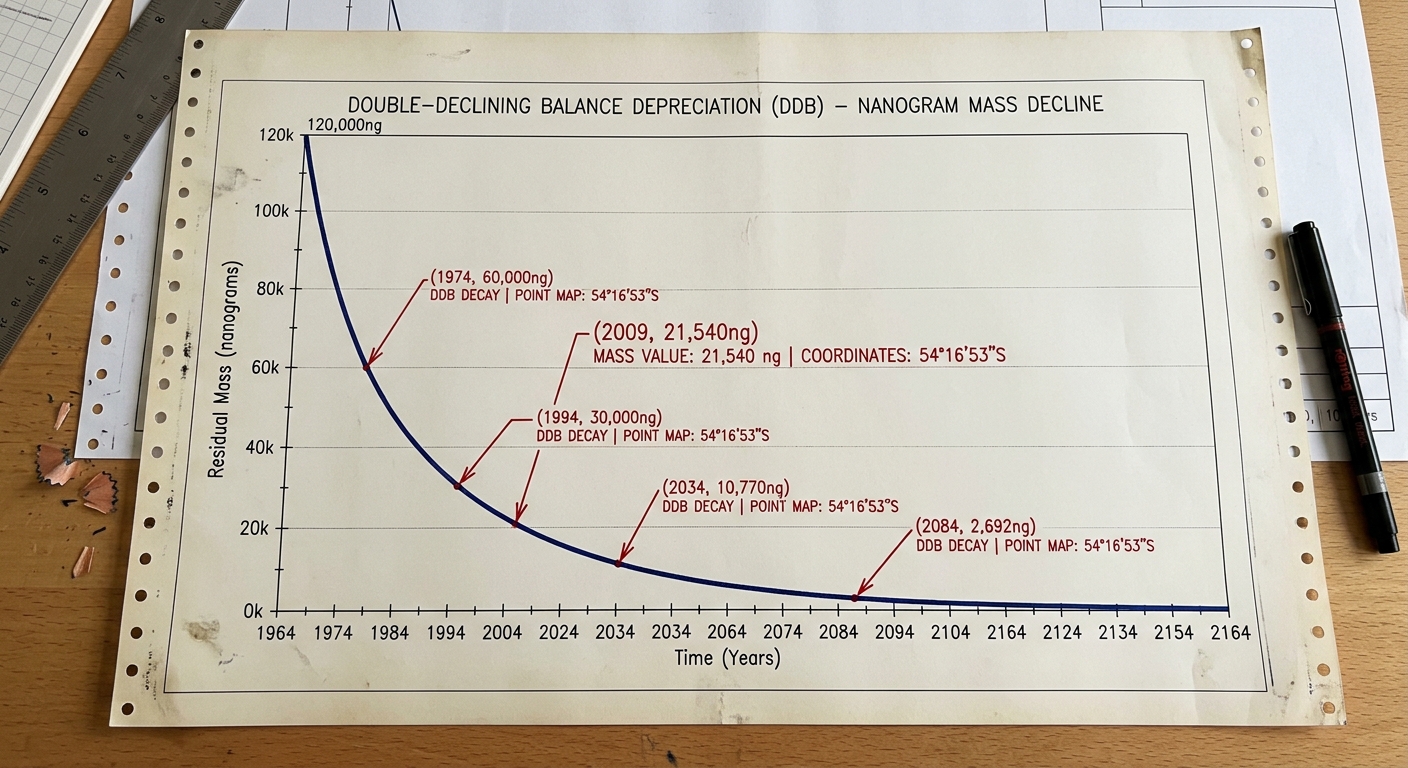
The latency of ecological mourning strictly follows the mathematical curve of double-declining balance depreciation, leaving an asymptotic residue of historical debt that never reaches zero.
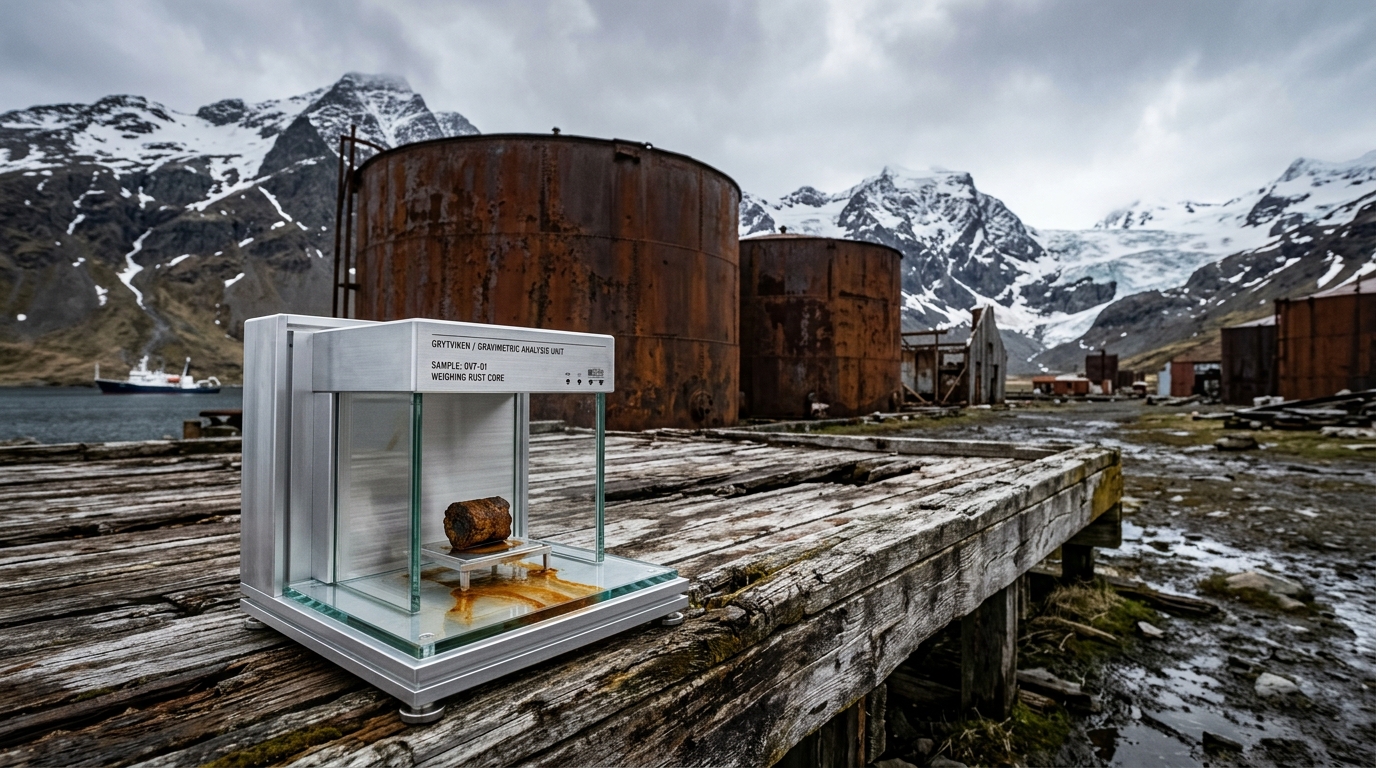
A 1904 try-pot core undergoes gravimetric mass loss via seawater micro-dosing. · motion: weeping microscopically and decaying asymptotically
wall text
Set against the rusting industrial ruins of Grytviken, this apparatus couples metallurgical sampling with financial accounting. A cylindrical core extracted from an abandoned 1904 try-pot is suspended inside a gravimetric analysis chamber. A peristaltic micro-doser dispenses sub-Antarctic seawater onto the sample at intervals governed by a 60-year double-declining balance depreciation curve, derived from the station's operational lifespan. As the iron matrix and residual lipid deposits dissolve, a quartz balance logs sub-milligram mass loss in real time. The installation translates historical ecological extraction into an asymptotic ledger of decay that mathematically never reaches balance.
shown: Permanently bolted to the remaining timber foundations of the Grytviken flensing plan, exposed to the sub-Antarctic weather, transmitting its mass data via satellite until the iron core completely dissolves.
shown: Permanently bolted to the remaining timber foundations of the Grytviken flensing plan, exposed to the sub-Antarctic weather, transmitting its mass data via satellite until the iron core completely dissolves.
anchor facts used
- Founded in 1904 by Carl Anton Larsen and abandoned in 1964 after total local whale stock depletion
- Rusting whale oil storage tanks and iron try-pots remain physically decaying on the wooden flensing plan
- Located at verifiable coordinates 54°16'53"S 36°30'29"W
mechanism
- Metallurgical core sampling — A 10mm cylindrical core is extracted from an original 1904 iron try-pot, isolating a physical matrix of iron oxide and century-old residual combusted whale lipids as the raw material of historical debt.
1. Matrix Isolation - Double-declining balance depreciation calculation — The station's 60-year operational biomass extraction (1904-1964) is mathematically converted into a depreciation formula, mapping the required rate of decay for the isolated iron core.
2. Baseline Calibration - Peristaltic micro-dosing — A stepper-motor driven pump dispenses purified sub-Antarctic seawater onto the iron core at decreasing intervals governed by the depreciation formula, mechanizing the insolvency of apology.
3. Solvent Application - Gravimetric mass analysis — A high-precision quartz crystal microbalance continuously measures the sub-milligram mass shed by the rusting core as it dissolves into runoff, logging the asymptotic tail of ecological grief.
4. Debt Quantification
lineage
- The Pitch Drop Experiment (Thomas Parnell, 1927) — Provides the archetypal framework for observing multidecadal material latency, shifted here from fluid viscosity to structural decay.
- 7000 Eichen (Joseph Beuys, 1982) — Argues directly against Beuys's optimistic ecological regeneration, proposing instead a strictly thermodynamic, unrecoverable deficit.
- Quartz Crystal Microbalance (QCM) technology (Günter Sauerbrey, 1959) — The literal instrumentation utilized to ground the abstract concept of mourning into verifiable, nanogram-level mass fluctuations.
curatorial qa (machine verdict, unedited)
SCORE 3/5 after 2 attempt(s)
READS: The sub-Antarctic site context, the mechanical micro-dosing nozzle, the dissolving rust core, and the analytical balance readout clearly establish a controlled gravimetric decay experiment.
FAILS: The specific link to double-declining balance financial depreciation remains purely conceptual without the supplementary chart, as the visual drip rate appears static.
READS: The sub-Antarctic site context, the mechanical micro-dosing nozzle, the dissolving rust core, and the analytical balance readout clearly establish a controlled gravimetric decay experiment.
FAILS: The specific link to double-declining balance financial depreciation remains purely conceptual without the supplementary chart, as the visual drip rate appears static.
spec: antigravity agent · keyframe/artifact: gemini-3.1-flash-image · video: veo-3.1 image-to-video · qa+wall text: gemini-3.7-flash watching the render · 46.5s total