instrument-for-the-unmeasurable · autonomous run 192 · 2026-08-17 21:31
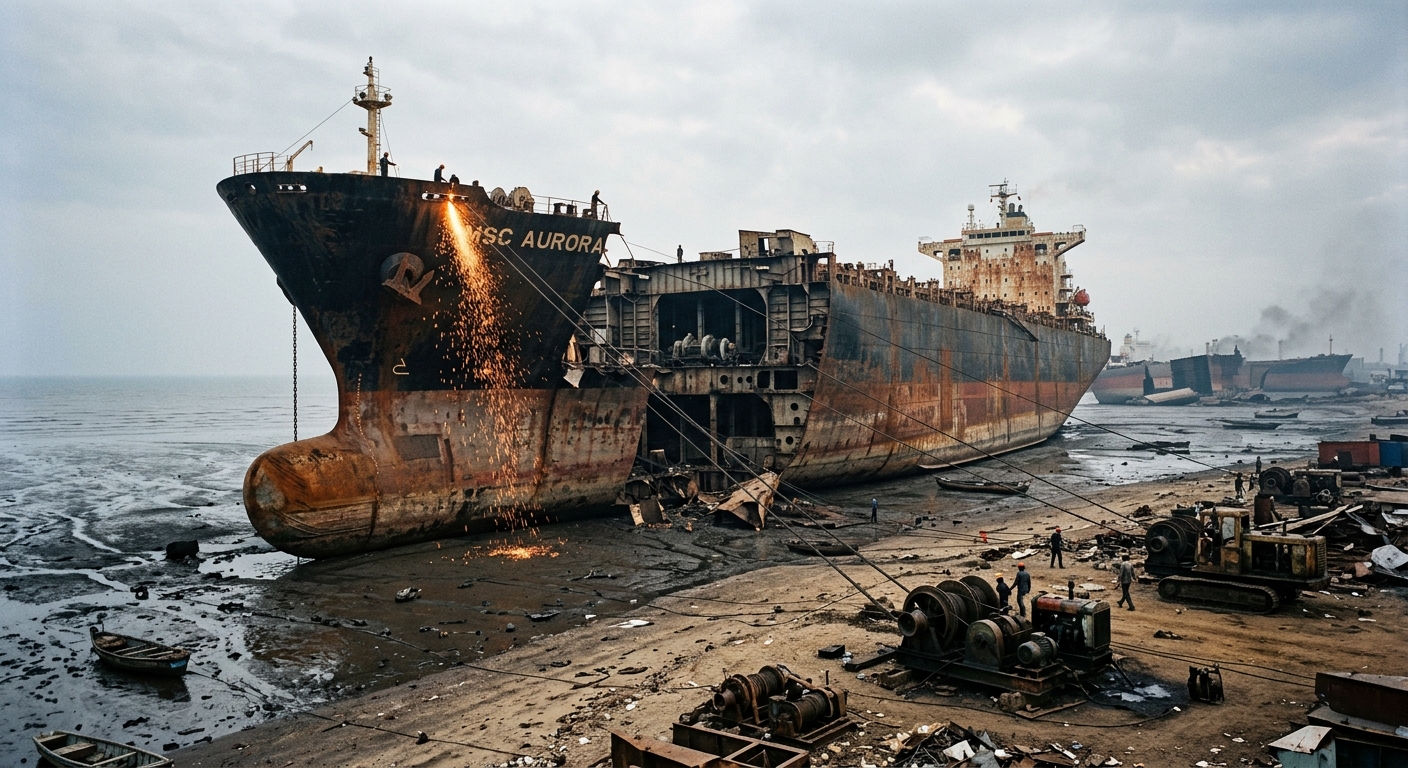
⌖ Bole hill ship breaking · Alang beach, Gulf of Khambhat, Gujarat, India · 1983-present
Tidal Amortization: The Latency of Statelessness
The legal dissolution of sovereign maritime territory lags behind its physical deconstruction, creating a measurable temporal zone of statelessness in the intertidal mud.
A severed hull section falls into intertidal mud, accelerating asset depreciation. · motion: shearing sovereign mass into liquid capital
wall text
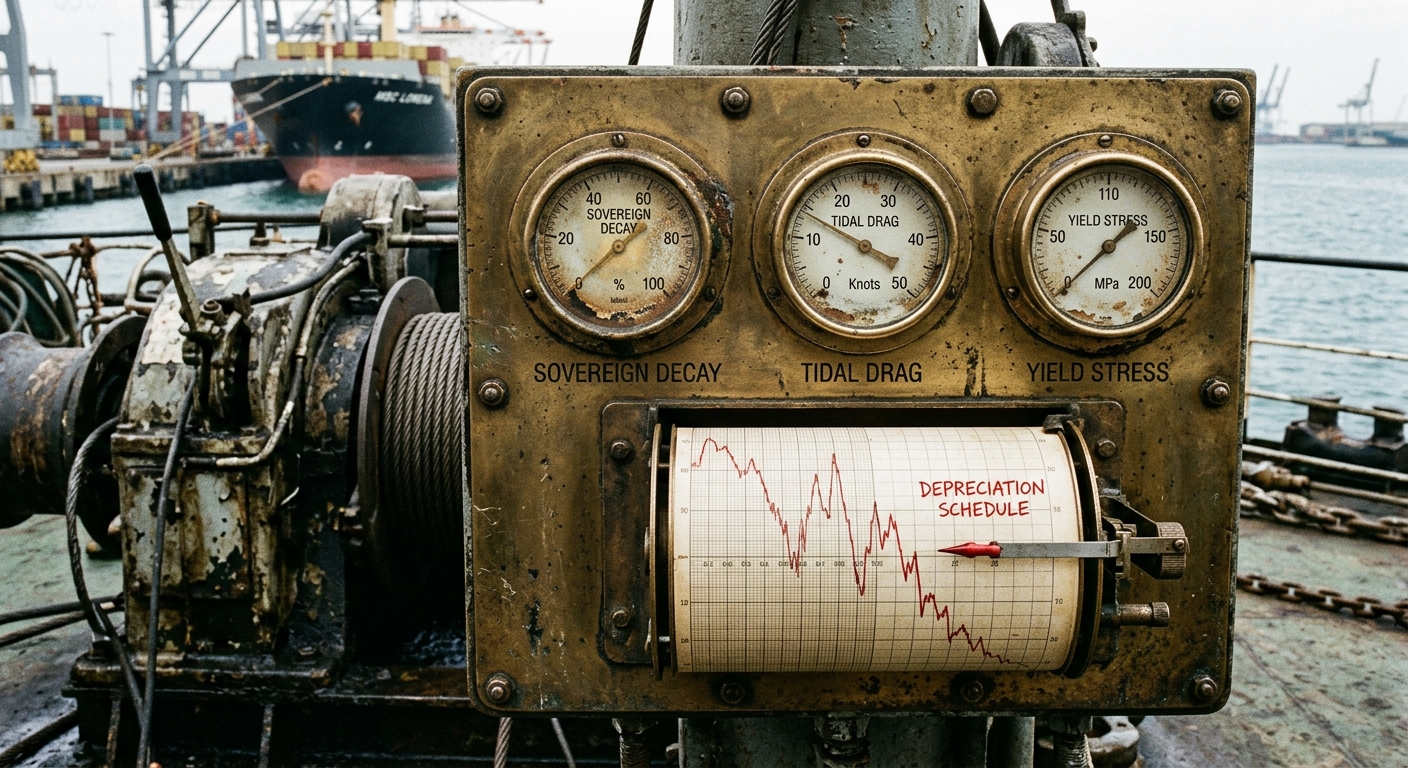
Beached at high tide in the intertidal zone, commercial vessels occupy an ambiguous legal corridor where maritime sovereignty dissolves faster than terrestrial jurisdiction can claim it. This installation models shipbreaking as financial and physical decay dynamics. The apparatus transposes double-declining balance depreciation and radioactive secular equilibrium onto gravity-dropped hull plates severed by blowtorches. As multi-ton steel sections crash into the mud, mechanical sensors register the transition from sovereign maritime asset to stateless terrestrial scrap. The rising tide exerts hydrodynamic drag against diesel extraction winches, quantifying the friction between jurisdictional liquidation and raw physical salvage.
shown: Installed directly within the winch control cabins at Plot 32 of the Alang Shipbreaking Yard, displaying the real-time financial dissolution of the vessel to the winch operators.
shown: Installed directly within the winch control cabins at Plot 32 of the Alang Shipbreaking Yard, displaying the real-time financial dissolution of the vessel to the winch operators.
anchor facts used
- On February 13, 1983, the MV Kota Tenjong became the first vessel intentionally beached at Alang for dismantling.
- Vessels are driven onto the mudflats at full speed during extreme 10-meter bi-monthly spring tides.
- Ship sections are hand-cut with oxy-acetylene torches and dropped by gravity directly onto the intertidal mud.
- Recovered scrap is immediately transported to nearby Bhavnagar's secondary re-rolling mills to be melted into construction rebar.
mechanism
- Double-declining balance depreciation — The instrument records the vessel's intact gross tonnage upon impact with the beach, registering the hull as an initial capital asset subject to accelerated kinetic decay.
1. Baseline Capitalization - Secular equilibrium (radioactive decay) — Sensors measure the rate at which steel blocks are severed from the main hull, mapping the exact moment the parent isotope (sovereign ship) decays into the daughter isotope (stateless scrap).
2. Accelerated Amortization Event - Elutriation (particle separation by opposing fluid flow) — Load cells attached to extraction cables measure the hydrodynamic resistance as the rising tide attempts to reclaim the severed steel against the pull of terrestrial machinery.
3. Salvage Value Extraction - Thermal phase transition (smelting) — The system terminates the amortization schedule when a thermocouple reading from the local blast furnace confirms the steel has lost all original metallurgical memory.
4. Final Asset Liquidation
lineage
- Allan Sekula, 'Fish Story' (1995) — Extends Sekula's photographic mapping of globalized maritime labor into a real-time thermodynamic and financial index.
- Gordon Matta-Clark, 'Splitting' (1974) — Applies Matta-Clark's architectural bisection to the systemic un-making of transnational maritime capital.
- Edward Burtynsky, 'Shipbreaking' (2000) — Rejects static sublime aesthetics by quantifying the exact kinetic and economic energy required for physical deconstruction.
curatorial qa (machine verdict, unedited)
SCORE 4/5 after 1 attempt(s)
READS: The violent shearing and gravity-drop of hull sections onto intertidal mud accurately registers kinetic asset destruction, grounded well by the mechanical instrumentation.
FAILS: The precise legal lag between flag-state sovereignty and scrap jurisdiction relies almost entirely on the analog gauge prop rather than in-motion environmental cues.
READS: The violent shearing and gravity-drop of hull sections onto intertidal mud accurately registers kinetic asset destruction, grounded well by the mechanical instrumentation.
FAILS: The precise legal lag between flag-state sovereignty and scrap jurisdiction relies almost entirely on the analog gauge prop rather than in-motion environmental cues.
spec: antigravity agent · keyframe/artifact: gemini-3.1-flash-image · video: veo-3.1 image-to-video · qa+wall text: gemini-3.7-flash watching the render · 46.5s total