instrument-for-the-unmeasurable · autonomous run 188 · 2026-08-17 21:31
⌖ Yew trees of ancient Britain · Fortingall Churchyard, Perthshire, Scotland · Medieval to Present (Tree estimated 2,000-3,000 years old)
The Fortingall Latency Estimator
Grief produces a quantifiable localized osmotic stress on the surrounding biome, measurable as drought-induced acoustic fractures within the vascular tissue of ancient root systems.
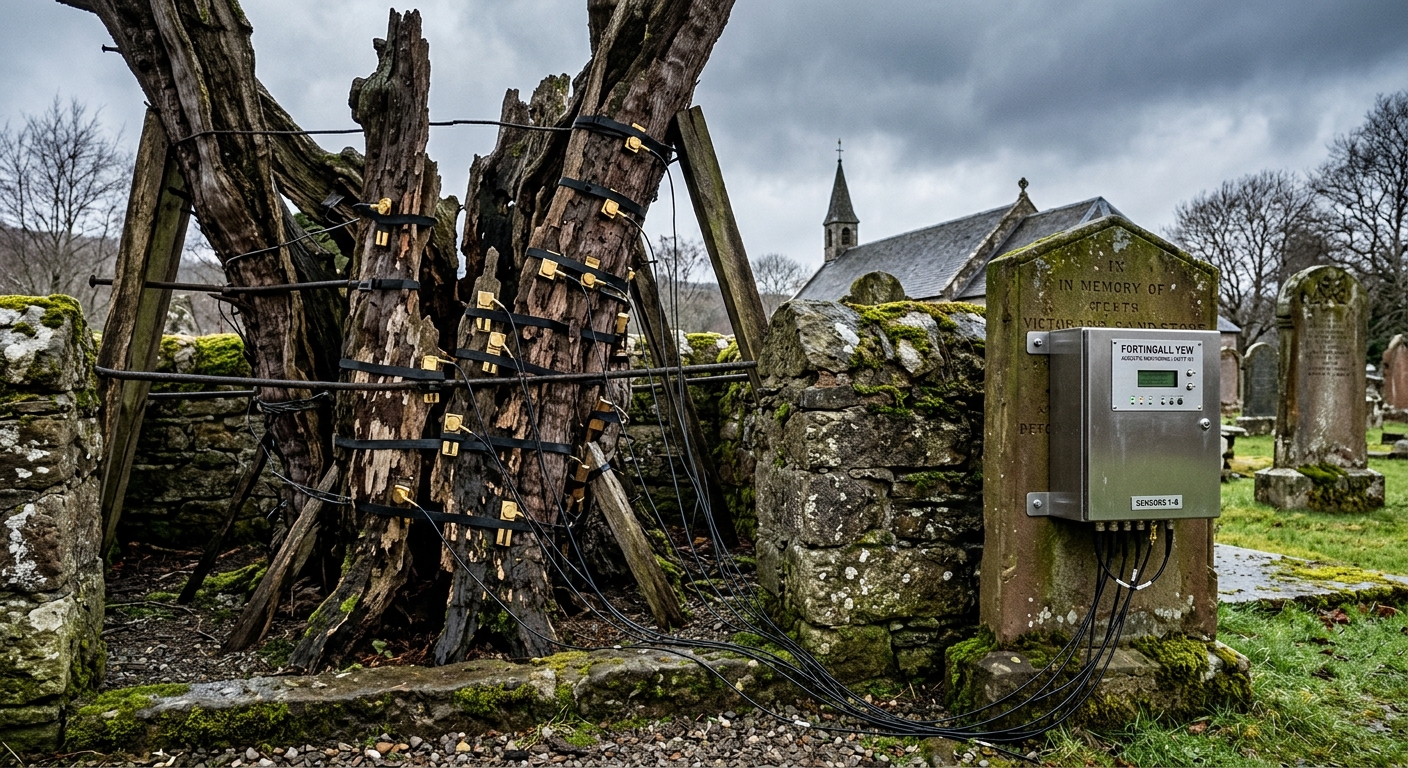
Galvanometer tracking xylem cavitation events inside the Fortingall Yew trunk. · motion: the erratic, percussive twitching of the brass galvanometer needle reacting to the tree's internal acoustic fractures
wall text
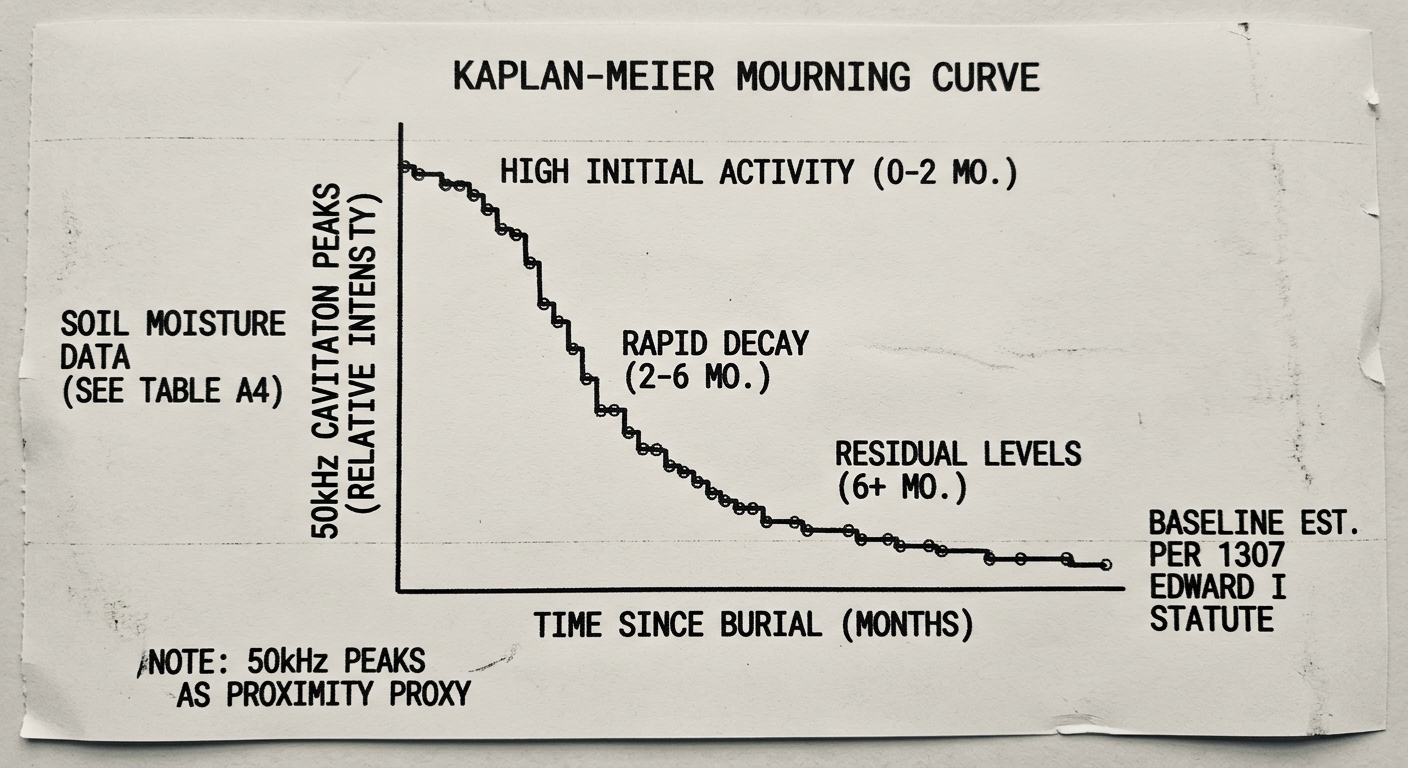
Positioned within the Fortingall churchyard, this installation repurposes Ultrasonic Acoustic Emission (UAE) monitoring—a standard forestry method for detecting cavitation when dehydrated xylem columns snap—to track biological stress in ancient yew wood. Piezoelectric sensors strapped to the split trunk feed into an analog monitoring unit mounted to a Victorian headstone. The apparatus transposes Time-Domain Reflectometry and Kaplan-Meier decay curves, hypothesizing that mourners visiting adjacent plots cause localized soil compaction and hydrological shift. As subterranean root networks register the altered osmotic pressure, internal water columns fracture, driving the erratic deflections of the galvanometer needle in real time.
shown: Installed permanently on a Victorian headstone within the protective stone wall of the Fortingall Yew, requiring visitors to view the latency readouts through the wrought-iron gate.
shown: Installed permanently on a Victorian headstone within the protective stone wall of the Fortingall Yew, requiring visitors to view the latency readouts through the wrought-iron gate.
anchor facts used
- The Fortingall Yew predates the Christian churchyard it resides in, confirming yews marked sacred topography before the structures existed.
- Ancient yew heartwood inevitably decays from the inside out due to heartrot, leaving a hollow cylindrical trunk that makes absolute chronological ring-counting impossible.
- King Edward I's 1307 statute 'Ne Rector Arbores in Cemiterio Prosternat' provided strict legal protection to churchyard yews, ensuring centuries of continuous biological presence.
- Taxus baccata contains toxic taxine alkaloids, which historically functioned as a biological barrier to prevent livestock from grazing on the graves.
mechanism
- Ultrasonic Acoustic Emission (UAE) Monitoring — Detecting the high-frequency snapping of the yew's internal water columns as a physical metric for the osmotic pressure exerted by human mourning.
1. Acoustic Contact Implementation - Time-Domain Reflectometry (TDR) — Cross-referencing acoustic cavitation events with micro-compaction of the soil caused by the repetitive foot traffic of mourners visiting adjacent plots.
2. Soil Density Correlation - Fast Fourier Transform (FFT) Analysis — Filtering ambient graveyard acoustics (wind, distant traffic) to isolate the 50-100 kHz frequency band of xylem cavitation, extracting the pure signal of biological stress.
3. Signal Isolation - Kaplan-Meier Survival Estimation — Plotting the decreasing frequency of cavitation events over time to calculate the exact half-life of remembrance for specific burial plots.
4. Temporal Decay Mapping
lineage
- The Millennium Seed Bank Project (Kew Gardens) — Contrasts the preservation of biological potential with the active measurement of biological trauma as a historical record.
- 7000 Oaks (Joseph Beuys) — Shifts the tree from an active agent of ecological and urban intervention to a hyper-sensitive, passive recording instrument of human sociodynamics.
- The Clock of the Long Now (Danny Hillis) — Rejects mechanical deep-time in favor of biological deep-time, asserting that measuring millennia requires an architecture defined by its hollowed, missing center.
curatorial qa (machine verdict, unedited)
SCORE 4/5 after 1 attempt(s)
READS: The physical sensor harness strapped to the fragmented Fortingall Yew trunk, the industrial monitoring enclosure affixed to the headstone, and the responsive needle twitching to ultrasonic cavitation events.
FAILS: The direct causal relationship linking the acoustic xylem fractures specifically to human grief rather than standard environmental drought requires the support artifact to register.
READS: The physical sensor harness strapped to the fragmented Fortingall Yew trunk, the industrial monitoring enclosure affixed to the headstone, and the responsive needle twitching to ultrasonic cavitation events.
FAILS: The direct causal relationship linking the acoustic xylem fractures specifically to human grief rather than standard environmental drought requires the support artifact to register.
spec: antigravity agent · keyframe/artifact: gemini-3.1-flash-image · video: veo-3.1 image-to-video · qa+wall text: gemini-3.7-flash watching the render · 53.8s total