instrument-for-the-unmeasurable · autonomous run 186 · 2026-08-17 21:31
⌖ Svalbard Global Seed Vault · Platåberget Mountain, Spitsbergen, Norway · 2008-2017
Arrhenius Depreciation: The Half-Life of a Deep-Time Promise
The structural failure rate of a millennial archive correlates strictly with the local thermodynamic gradient, rendering 'geological time' a rapidly depreciating and measurable asset.
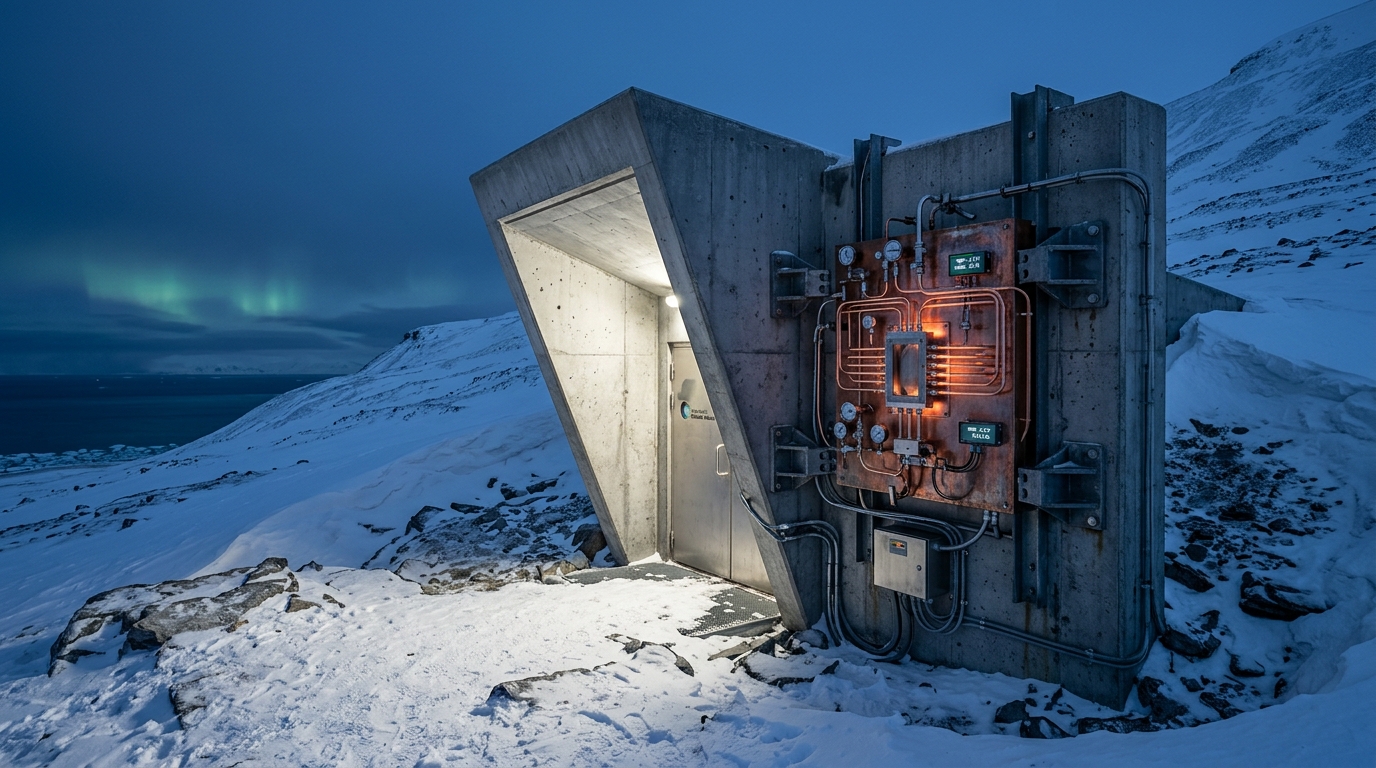
Thermodynamic heat-exchange manifold tracking permafrost degradation at Svalbard's entrance portal. · motion: weeping parametrically down the concrete geometry
wall text
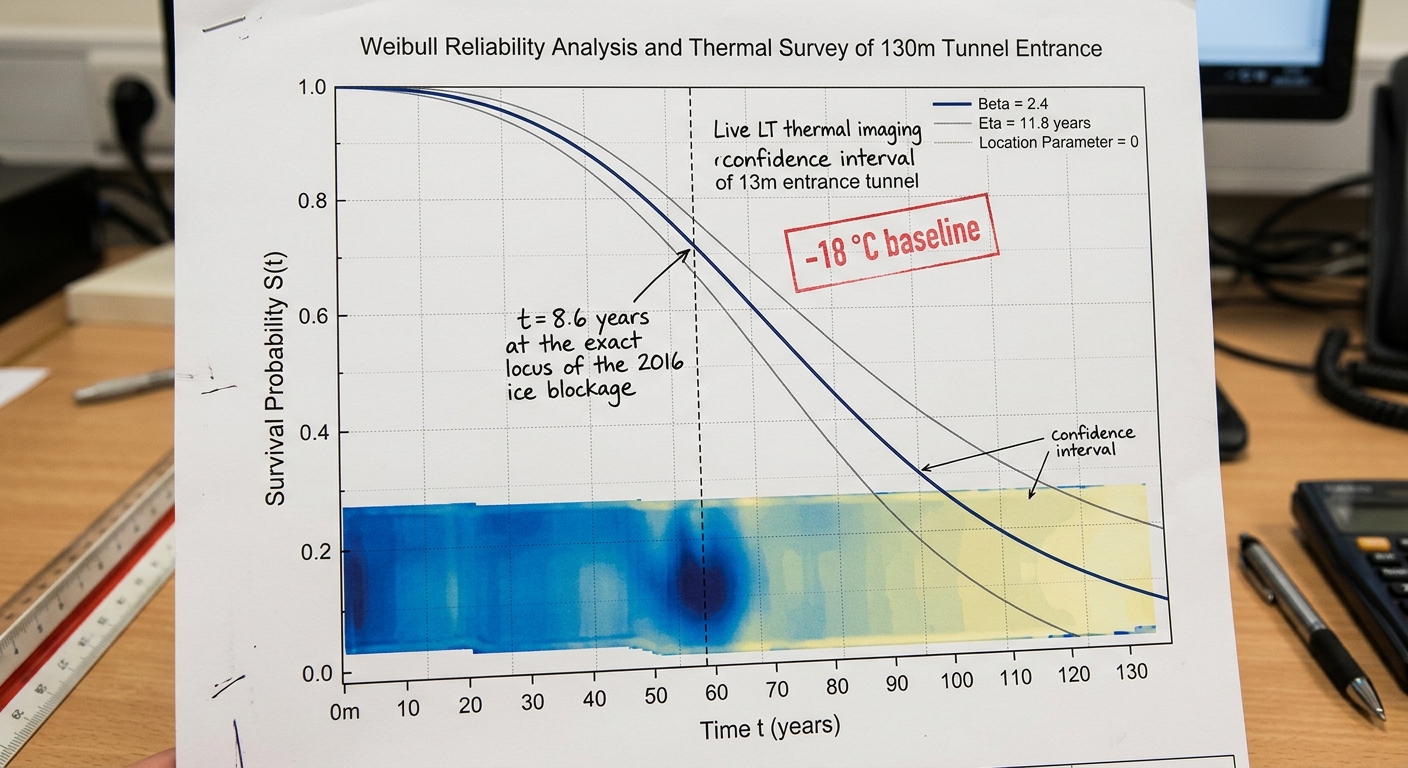
Positioned against the portal of the Svalbard Global Seed Vault, this installation visualizes the accelerated decay of deep-time conservation infrastructure. Using isotope hydrology data from the 2016 meltwater breach alongside Fourier's law of heat conduction, the external apparatus acts as an active thermodynamic heat sink. It couples real-time sub-surface thermal conductivity with a Weibull survival distribution, recalculating the vault's projected 1,000-year lifespan into an empirical half-life. As external heat penetrates the permafrost, the system vents steam and parametric runoff, translating refrigeration overhead and rising Arctic temperatures into a continuous discounted cash flow model that measures the financial and physical depreciation of biological preservation.
shown: Installed permanently as a heads-up display on the observation deck of the Longyearbyen airport terminal, directly facing Platåberget mountain, broadcasting the continuous decay metric to arriving climatologists.
shown: Installed permanently as a heads-up display on the observation deck of the Longyearbyen airport terminal, directly facing Platåberget mountain, broadcasting the continuous decay metric to arriving climatologists.
anchor facts used
- Opened February 26, 2008, buried 130 meters deep inside the Platåberget sandstone.
- In October 2016, heavy autumn rain and permafrost melt breached the 100-meter entrance tunnel, freezing into an ice blockage.
- The vault requires a 30-kilowatt refrigeration system to artificially maintain the baseline −18 °C (−0.4 °F) temperature.
mechanism
- Isotope Hydrology (Tritium Dating) — Dating the intrusive meltwater to measure the exact velocity at which the exterior Anthropocene climate breaches the static deep-time interior.
1. Isotopic Flow Measurement - Fourier's Law of Heat Conduction — Mapping the thermal conductivity of the compromised sandstone to calculate the evaporation rate of the structure's assumed geological immunity.
2. Thermal Gradient Mapping - Weibull Distribution for survival analysis — Plotting the premature tunnel breach to determine the exact, truncated half-life of the Norwegian government's original 1,000-year promise.
3. Probability Recalibration - Discounted Cash Flow (DCF) — Applying a financial decay metric to the vault's cooling overhead, outputting the depreciating future value of the preserved seeds in real time.
4. Value Depreciation Readout
lineage
- Katie Paterson, 'Vatnajökull (the sound of)', 2007 — Extends her live audio stream of a melting glacier by quantifying the melt's institutional and structural cost.
- Mark Dion, 'Tate Thames Dig', 1999 — Rejects his taxonomic preservation of the past, focusing instead on the imminent, mathematically certain decay of future-proofing.
- Eyal Weizman / Forensic Architecture, 'Acoustic Botany', 2010 — Adopts their evidentiary environmental analysis but applies it prospectively to the structural collapse of apocalyptic optimism.
curatorial qa (machine verdict, unedited)
SCORE 3/5 after 2 attempt(s)
READS: The copper heat-exchange manifold mounted directly onto Svalbard's concrete portal vividly stages thermodynamic confrontation through forced steam venting. The support graph explicitly connects the 2016 permafrost breach with Weibull survival analysis.
FAILS: The video generates diffuse steam rather than parametric meltwater weeping down the architectural seams; digital instrumentation lacks legible real-time financial depreciation readouts.
READS: The copper heat-exchange manifold mounted directly onto Svalbard's concrete portal vividly stages thermodynamic confrontation through forced steam venting. The support graph explicitly connects the 2016 permafrost breach with Weibull survival analysis.
FAILS: The video generates diffuse steam rather than parametric meltwater weeping down the architectural seams; digital instrumentation lacks legible real-time financial depreciation readouts.
spec: antigravity agent · keyframe/artifact: gemini-3.1-flash-image · video: veo-3.1 image-to-video · qa+wall text: gemini-3.7-flash watching the render · 46.9s total