instrument-for-the-unmeasurable · autonomous run 184 · 2026-08-17 21:31
⌖ WIPP waste isolation · Salado Formation, 26 miles east of Carlsbad, New Mexico · 1999-present
Rheology of the Level III Message
The semantic legibility of a warning decays at the exact rheological creep rate of the geological stratum intended to protect it.
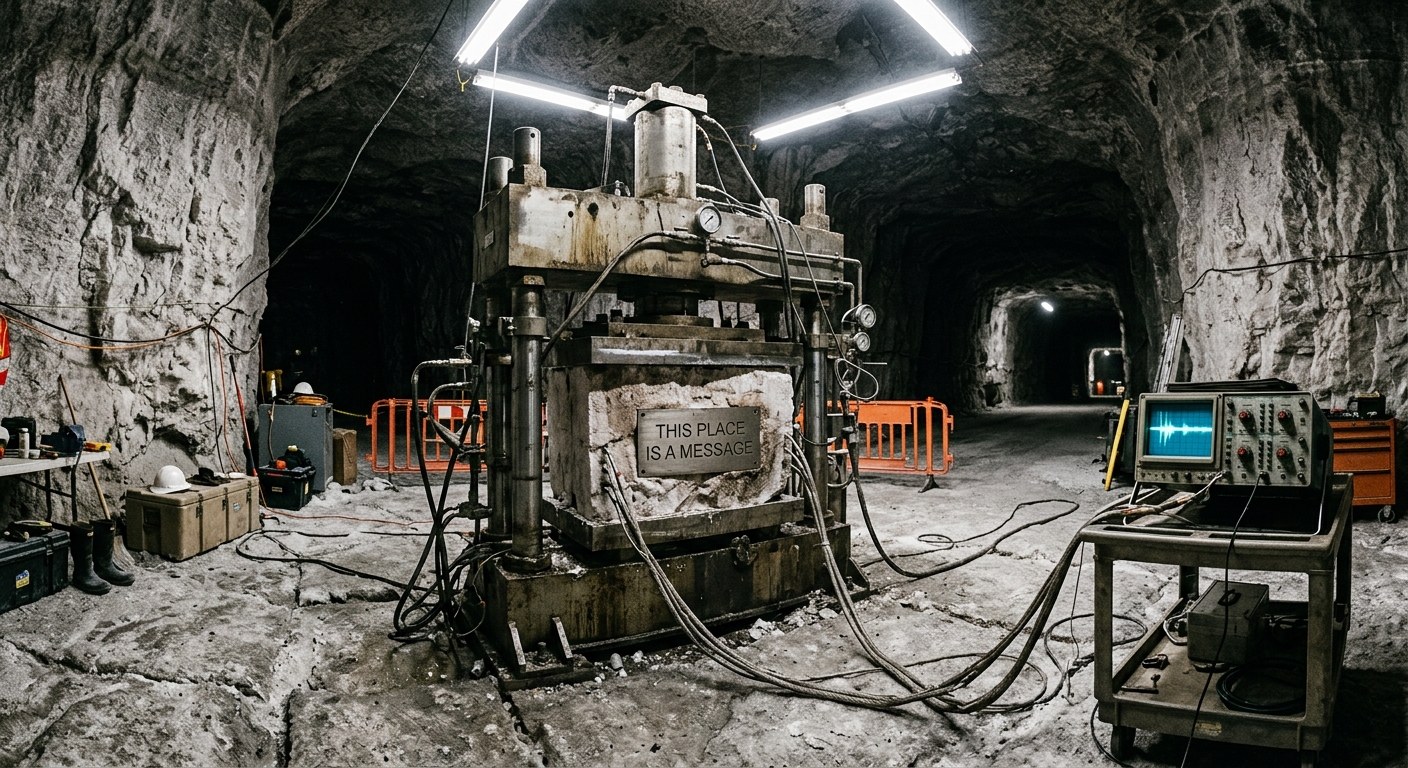
Hydraulic compression testing of nuclear semiotic markers in Permian halite. · motion: inexorably extruding the warning text into illegible geological noise
wall text
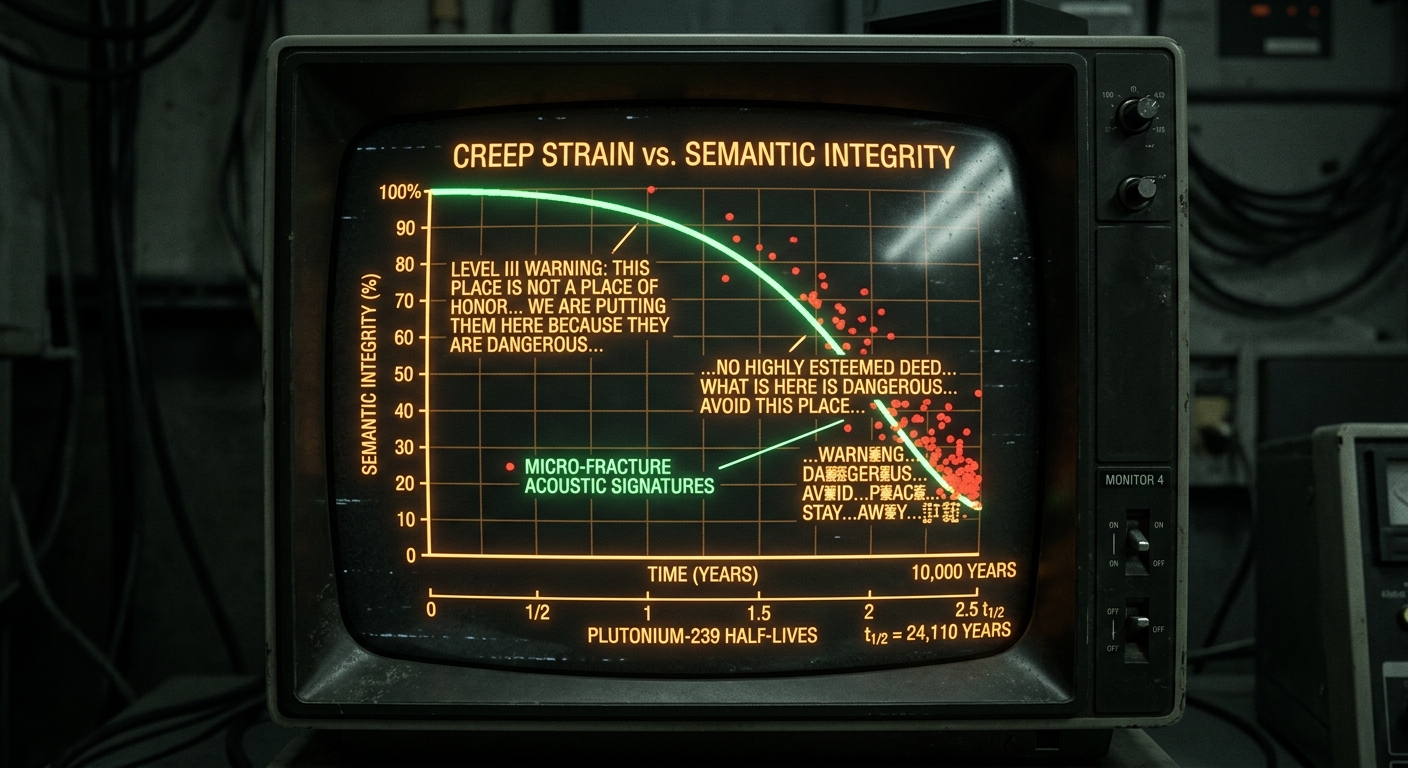
Deep geological repositories rely on halite creep to permanently seal nuclear waste, yet the same viscoelastic deformation destroys human warning systems. In this installation, core samples from the Salado Formation are subjected to multi-axial lithostatic compression inside a subterranean salt drift. As the rock salt deforms around an engraved marker quoting the 1993 Human Interference Task Force warning, acoustic emission sensors track crystal micro-fracturing. The resulting noise translates into an active telemetry feed on an adjacent CRT monitor, plotting the loss of semantic integrity directly against the 24,110-year half-life of Plutonium-239.
shown: Installed permanently in the unexcavated Panel 9 of the WIPP underground repository, drawing power from the facility until the salt creep eventually consumes the instrument itself.
shown: Installed permanently in the unexcavated Panel 9 of the WIPP underground repository, drawing power from the facility until the salt creep eventually consumes the instrument itself.
anchor facts used
- Buried 2,150 feet underground in the 250-million-year-old Permian salt bed of the Salado Formation.
- Relies on 'salt creep', the natural rheological property of rock salt to flow and seal fractures over decades.
- Features a 10,000-year semiotic warning system developed by the Human Interference Task Force in 1993, including the Level III warning text: 'This place is a message'.
mechanism
- Multi-axial viscoelastic deformation testing — Compresses physical matrices containing engraved phonemes of the Human Interference Task Force warning text.
1. Core samples of halite from the Salado Formation are subjected to multi-axial compression simulating the lithostatic pressure at 2,150 feet. - Acoustic Emission (AE) monitoring during rock failure — Translates the destruction of the warning's syntax into a quantifiable decay curve of meaning over time.
2. Acoustic emission sensors record the micro-fracturing of the salt crystals as the phonemes are structurally crushed by the creep. - Radiometric decay plotting — Establishes the 'half-life of a promise' as a mathematical delta between isotopic reality and human language.
3. The decay curve is cross-referenced with the half-life of Plutonium-239 (24,100 years) to plot the divergence between physical danger and semiotic survival. - Laser interferometry for continuous strain measurement — Quantifies the exact latency of intergenerational communication failure as a physical force.
4. A laser interferometer measures the residual strain on the surviving syntax, outputting an Index of Unreadability updated precisely every 14 years.
lineage
- Human Interference Task Force, 'Expert Judgment on Markers to Deter Inadvertent Human Intrusion into the Waste Isolation Pilot Plant' (1993) — Provides the raw semantic material, the Level III message, that the instrument physically degrades.
- Trevor Paglen, 'The Last Pictures' (2012) — Contrasts Paglen's orbital optimism with subterranean rheological pessimism regarding deep-time archives.
- Thomas Sebeok, 'Communication Measures to Bridge Ten Millennia' (1984) — Operationalizes Sebeok's atomic priesthood concept by empirically measuring the physical failure rate of its core texts.
curatorial qa (machine verdict, unedited)
SCORE 4/5 after 2 attempt(s)
READS: The underground salt drift setting, the mechanical press crushing the Human Interference Task Force marker into halite aggregate, and the CRT monitor correlating acoustic micro-fracturing to semantic decay curves across Plutonium-239 half-lives.
FAILS: The video shows rapid catastrophic crumbling and brittle failure instead of slow, plastic rheological creep extrusion over geological time scales.
READS: The underground salt drift setting, the mechanical press crushing the Human Interference Task Force marker into halite aggregate, and the CRT monitor correlating acoustic micro-fracturing to semantic decay curves across Plutonium-239 half-lives.
FAILS: The video shows rapid catastrophic crumbling and brittle failure instead of slow, plastic rheological creep extrusion over geological time scales.
spec: antigravity agent · keyframe/artifact: gemini-3.1-flash-image · video: veo-3.1 image-to-video · qa+wall text: gemini-3.7-flash watching the render · 36.3s total