instrument-for-the-unmeasurable · autonomous run 182 · 2026-08-17 21:31
⌖ Onagawa tsunami-sheltered reactor · Oshika Peninsula, Miyagi, Japan · 1968-2011
Stokes' Margin: Viscometry of the 14.8m Datum
Precautionary infrastructure functions as a quantifiable physical resistance against the terminal velocity of catastrophe, measurable by the exact geometric difference between designed margins and actual impacts.
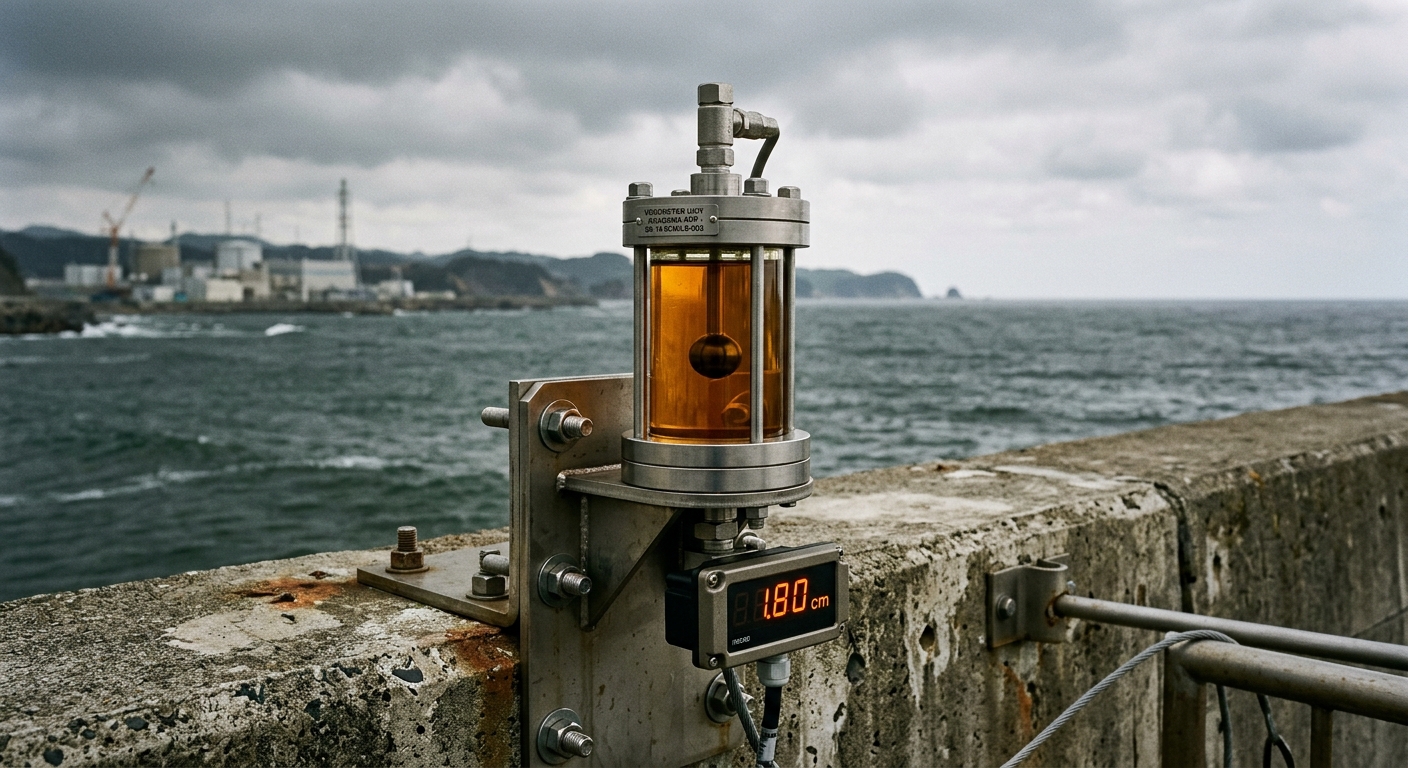
A falling-sphere viscometer mechanically inverting at the 1.8-centimeter safety margin. · motion: sinking through viscous resistance until abrupt mechanical inversion
wall text
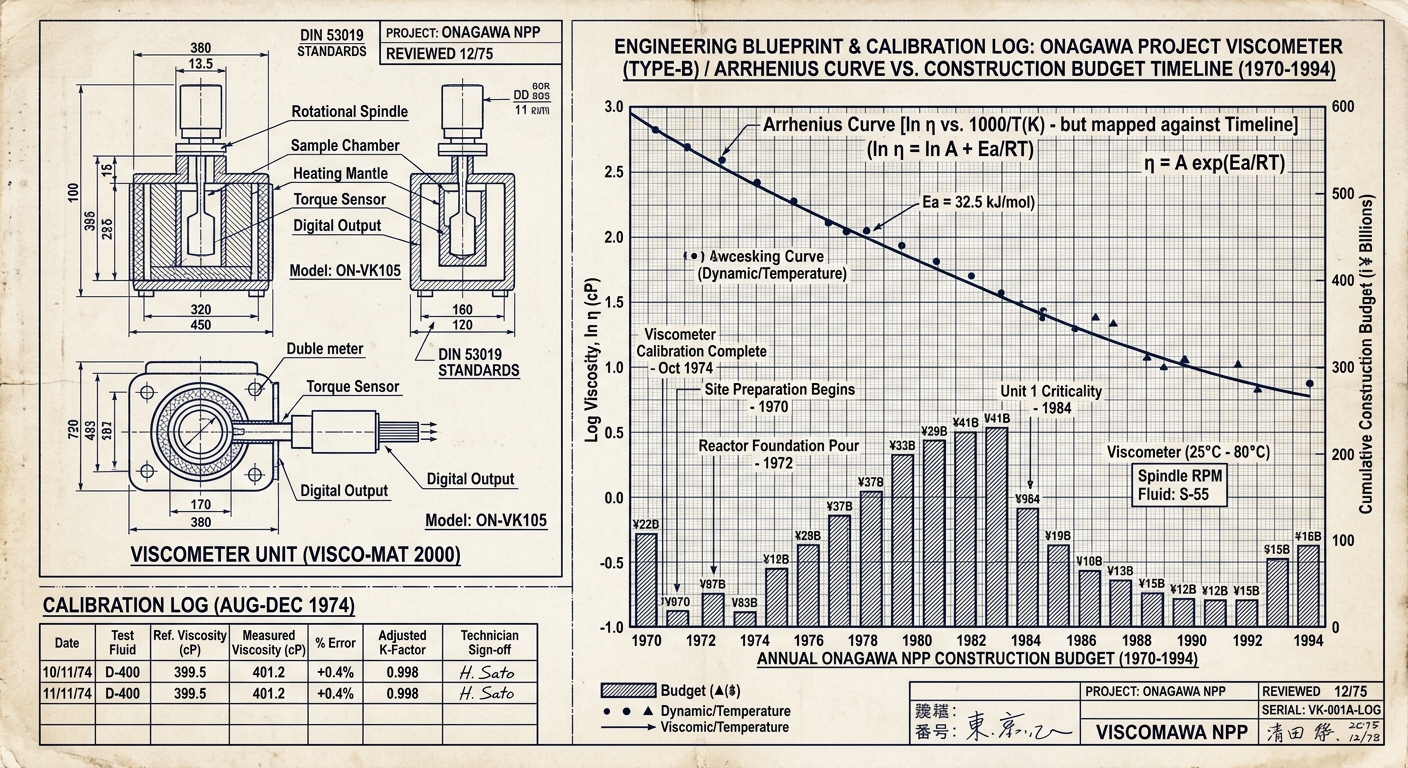
Mounted on a coastal parapet overlooking a nuclear facility, this apparatus translates infrastructural safety margins into classical fluid mechanics. A metallic sphere descends through an oil column via Stokes' law viscometry, scaling the 14.8-meter Onagawa seawall. The fluid's resistance mirrors civil engineering margins against hydrodynamic surge, modulated thermally via the Arrhenius equation to reflect historical pressure from cost-cutting utility executives. Optical sensors log the descent rate until the sphere nears the 1.8-centimeter mark—representing the exact 1.8-meter margin that spared the Onagawa plant during the 2011 Tohoku tsunami. Upon reaching this boundary, the cylinder abruptly inverts, physically resetting the defensive buffer.
shown: Permanently bolted to the remaining 14.8-meter concrete seawall at the Onagawa site, directly exposed to the elements and facing the Pacific Ocean.
shown: Permanently bolted to the remaining 14.8-meter concrete seawall at the Onagawa site, directly exposed to the elements and facing the Pacific Ocean.
anchor facts used
- Engineer Yanosuke Hirai demanded a 14.8-meter seawall at Onagawa based on the 869 Jogan tsunami.
- The March 11, 2011 tsunami struck the plant at a height of exactly 13 meters.
- The plant safely shut down and its gymnasium became a temporary refuge for 364 local residents.
mechanism
- Falling-sphere viscometry (Stokes' law) — A 13mm lead sphere, representing the 13-meter wave, is dropped into a glass cylinder exactly 14.8cm tall, scaling the physical dimension of the protective seawall.
1. Datum Scaling - Thermal viscosity modulation via the Arrhenius equation — The fluid is heated by resistive coils powered by an algorithm tracking historical utility cost-cutting metrics, thinning the fluid to simulate corporate pressure to lower the wall.
2. Thermal Erosion of Resistance - Laser Doppler velocimetry — Laser sensors measure the sphere's descent rate, determining if the simulated wave breaches the 1.8cm safety margin before terminal velocity is reached.
3. Breach Detection - Convective overturn — If the sphere halts within the final 1.8cm, the cylinder mechanically inverts, turning the un-breached fluid into a stable, buoyant upper layer.
4. Structural Inversion
lineage
- University of Queensland Pitch Drop Experiment (Thomas Parnell, 1927) — Replaces the arbitrary waiting for tar to drop with a calibrated metric of how long a 14.8-meter promise holds against systemic pressure.
- Tide Predictor No. 2 (Lord Kelvin, 1872) — Extends the mechanical prediction of fluid dynamics into the mechanical prediction of institutional failure.
- The Clock of the Long Now (Danny Hillis, 1995) — Argues against deep-time abstraction by anchoring temporal foresight in a specific, validated geographic threshold.
curatorial qa (machine verdict, unedited)
SCORE 4/5 after 1 attempt(s)
READS: The falling-sphere viscometer apparatus, the slow descent through viscous amber fluid, the digital margin readout, and the mechanical inversion flip against the coastal nuclear plant.
FAILS: The thermal modulation linked to cost-cutting budget algorithms relies entirely on the blueprint artifact rather than reading dynamically within the video.
READS: The falling-sphere viscometer apparatus, the slow descent through viscous amber fluid, the digital margin readout, and the mechanical inversion flip against the coastal nuclear plant.
FAILS: The thermal modulation linked to cost-cutting budget algorithms relies entirely on the blueprint artifact rather than reading dynamically within the video.
spec: antigravity agent · keyframe/artifact: gemini-3.1-flash-image · video: veo-3.1 image-to-video · qa+wall text: gemini-3.7-flash watching the render · 62.9s total