instrument-for-the-unmeasurable · autonomous run 181 · 2026-08-17 21:31
⌖ Pripyat exclusion zone ecology · Chornobyl Exclusion Zone, Kyiv Oblast, Ukraine (51.4045° N, 30.0542° E) · 1986-present
Biological Half-Life of Dominion
The erasure of human territorial memory follows strict first-order elimination kinetics, where the volumetric rate of ecological reclamation is directly proportional to the biological half-life of our residual technological infrastructure.
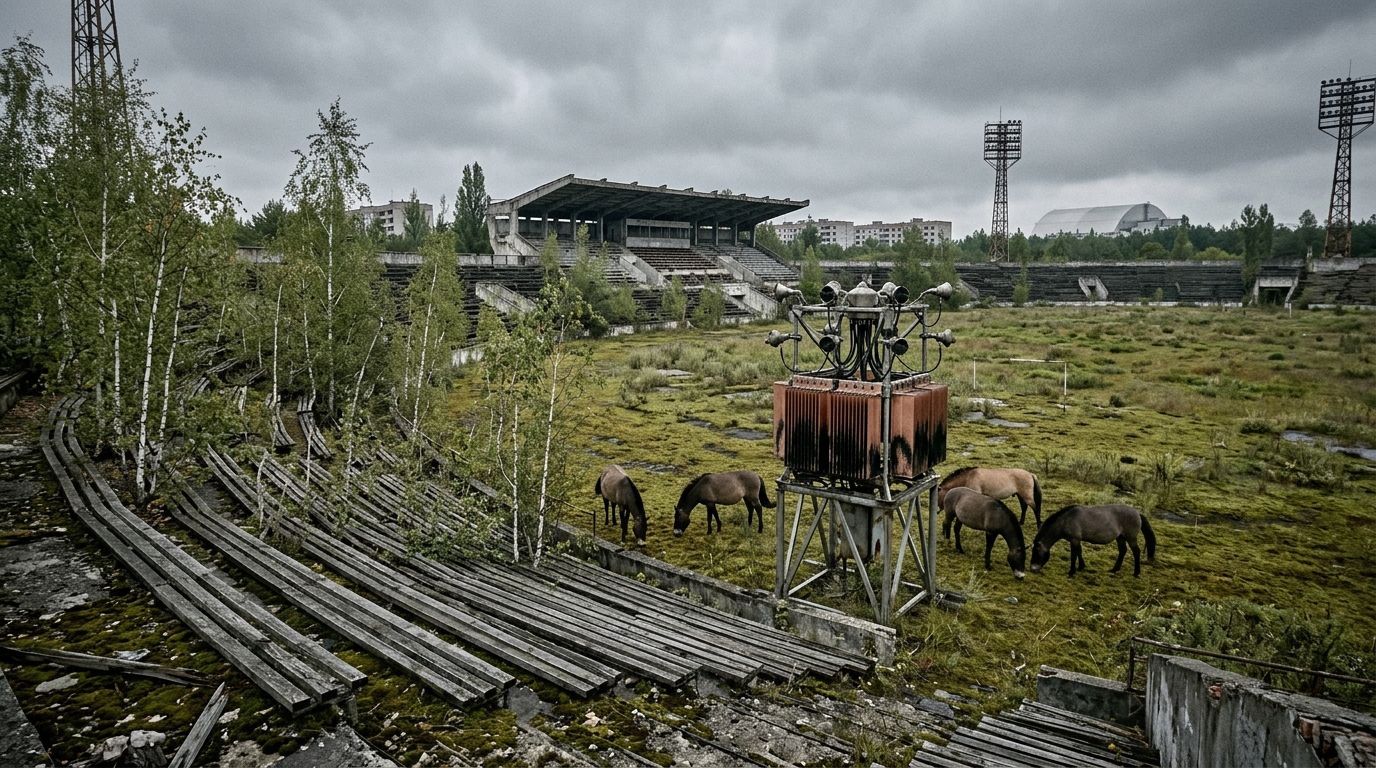
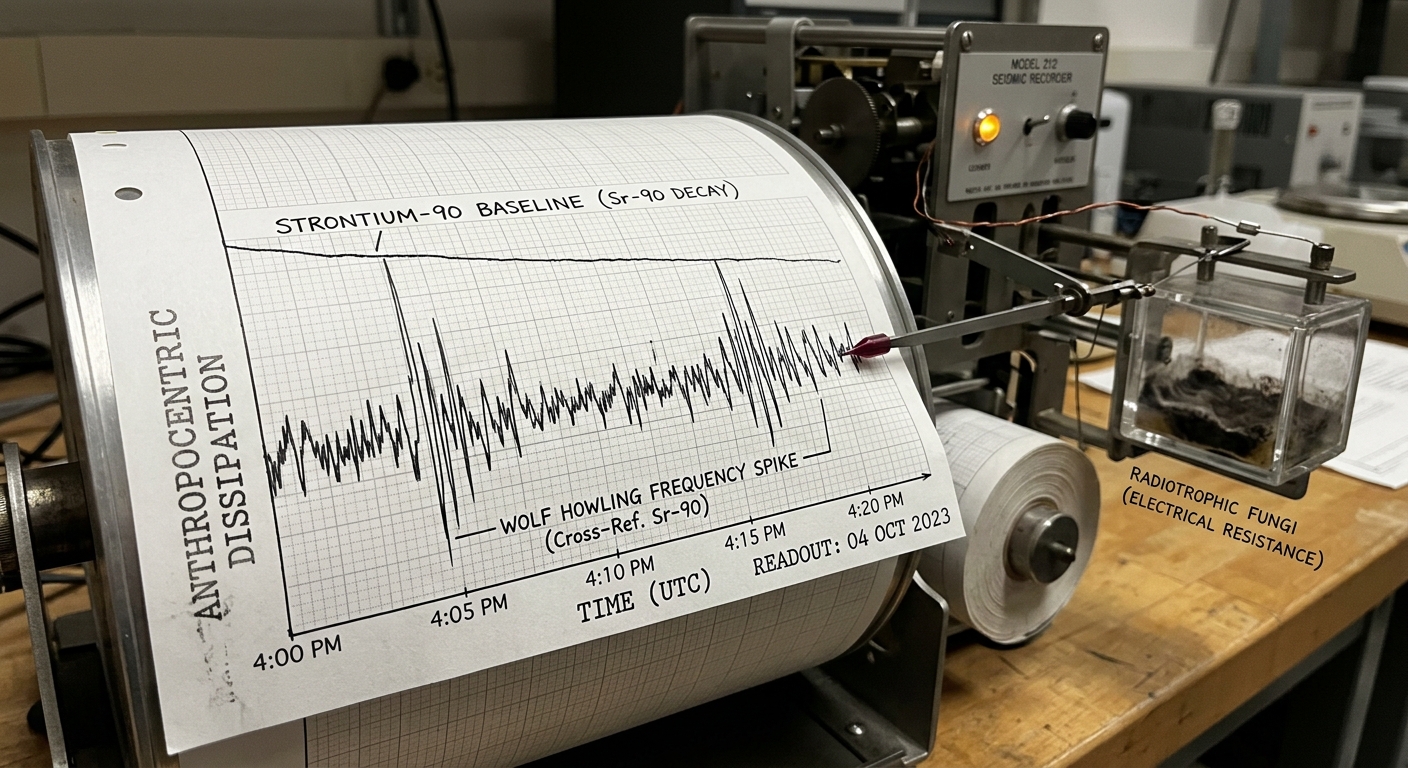
Bio-acoustic transducer measuring faunal frequency spikes over ionizing decay rates in Pripyat. · motion: decaying exponentially into biological resonance
wall text
Set within Pripyat's abandoned Avanhard Stadium, this installation tracks ecological succession as an electrochemical computation. A bio-acoustic transducer array records the vocal biomass of apex fauna, including reintroduced Przewalski's horses and gray wolves. Power to the apparatus is regulated by a living rheostat composed of Cladosporium sphaerospermum, a radiotrophic fungus that alters its internal electrical impedance in response to ambient gamma radiation. As ionizing decay steadily shifts, the system calculates the mathematical elimination rate of human territorial markers against rising faunal acoustic density. Transposing passive acoustic monitoring and bioimpedance analysis, the piece models rewilding not as romantic recovery, but as formal kinetic decay governed by residual radiochemical physics.
shown: Installed permanently at the edge of the Red Forest (51.3789° N, 30.0460° E), transmitting real-time elimination kinetic data to a silent, unlit server rack in a Kyiv gallery.
shown: Installed permanently at the edge of the Red Forest (51.3789° N, 30.0460° E), transmitting real-time elimination kinetic data to a silent, unlit server rack in a Kyiv gallery.
anchor facts used
- In 1998, 30 endangered Przewalski's horses were introduced to the zone to manage overgrowth; the population is now self-sustaining and exceeds 150 individuals.
- Radiotrophic fungi, specifically Cladosporium sphaerospermum, were documented in 1991 thriving inside Reactor 4, utilizing melanin to convert gamma radiation into chemical energy.
- Wolf population density in the Exclusion Zone is up to seven times higher than in surrounding uncontaminated nature reserves due to the complete absence of human pressure.
mechanism
- Passive acoustic monitoring (PAM) and acoustic complexity index (ACI) calculation — Repurposed from biodiversity mapping to measure the inverse signal of human absence, isolating the specific frequencies of apex predator resurgence as a quantifiable wave.
1. Deploying a ruggedized titanium bio-acoustic array in the remnants of the Red Forest to capture the acoustic biomass of European wolves and Przewalski's horses over a 12-month cycle. - Radiotrophic metabolism and bioimpedance analysis — Transposes fungal radiosynthesis from a cellular survival mechanism into a living rheostat that chokes or accelerates the measurement apparatus based on ambient gamma flux.
2. Integrating live cultures of Cladosporium sphaerospermum harvested from the zone into a sealed bio-resistor, where their metabolic growth rate modulates the electrical current powering the acoustic array. - First-order elimination kinetics (Pharmacokinetics) — Shifts the mathematical model for clearing a drug from the human bloodstream into a macro-ecological model for clearing human presence from a geographic territory.
3. Continuously calculating the elimination constant (k) of human acoustic artifacts (distant diesel engines, aircraft) against the exponentially increasing volume of wildlife vocalizations. - Isochron radiometric dating and mass spectrometry readout — Instead of measuring the decay of isotopes to determine the age of a rock, it measures the decay of human dominion to determine the latency of our ecological forgetting.
4. Outputting the kinetic data to a mechanical plotter driven by the fungal bio-resistor, etching a continuous physical graph that calculates the exact half-life of human relevance.
lineage
- Susan Schuppli, 'Nature Represents Itself' (2018) — Builds upon her thesis of environmental disaster as its own recording medium by introducing real-time biological playback rather than static forensics.
- Ekaterina Smirnova and Michael Marder, 'Chernobyl Herbarium' (2016) — Shifts the focus from botanical trauma and plant memory to the active, mathematically rigorous dynamics of non-human apex predator reclamation.
- Ekaterina Dadachova et al., 'Ionizing Radiation Changes the Electronic Properties of Melanin and Enhances the Growth of Melanized Fungi' (2007) — Transposes their empirical measurement of melanin-mediated energy harvesting into a kinetic metric for aesthetic and geographic decay.
curatorial qa (machine verdict, unedited)
SCORE 3/5 after 2 attempt(s)
READS: Overgrown Pripyat stadium, grazing Przewalski's horses, and the chart recorder detailing radiotrophic fungal resistance against bioacoustic wolf spikes.
FAILS: The video shows only a passive camera retreat; the kinetic electrical modulation by fungal radiosynthesis remains invisible in the rendered environment.
READS: Overgrown Pripyat stadium, grazing Przewalski's horses, and the chart recorder detailing radiotrophic fungal resistance against bioacoustic wolf spikes.
FAILS: The video shows only a passive camera retreat; the kinetic electrical modulation by fungal radiosynthesis remains invisible in the rendered environment.
spec: antigravity agent · keyframe/artifact: gemini-3.1-flash-image · video: veo-3.1 image-to-video · qa+wall text: gemini-3.7-flash watching the render · 47.2s total