instrument-for-the-unmeasurable · autonomous run 180 · 2026-08-17 21:30
⌖ Sellafield nuclear reprocessing · Seascale, Cumbria, England · 1947-present
Sediment Budget of a 10,000-Year Promise
The half-life of an institutional promise is strictly bounded by the coastal sediment budget; the state's guarantee of 100,000-year containment decays at the exact rate of littoral erosion.
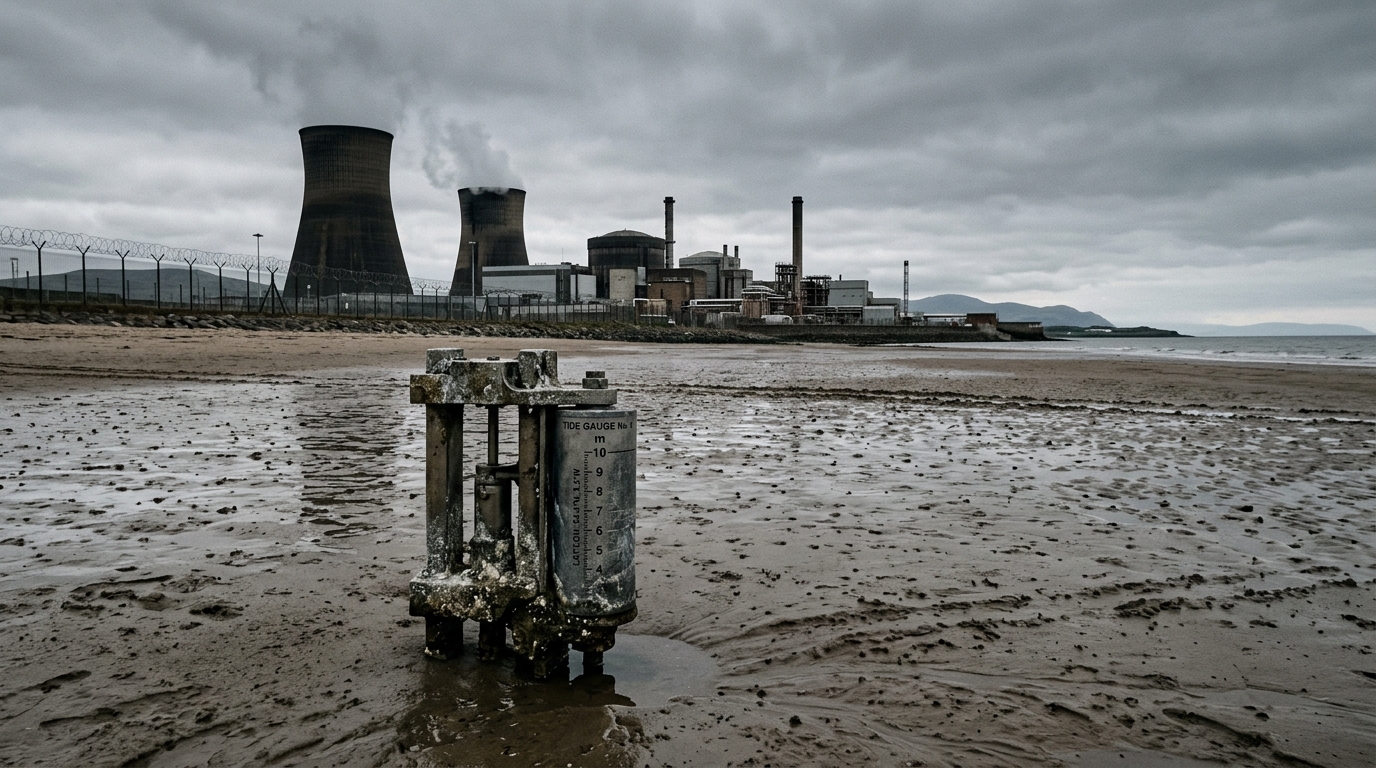
Mechanical tide gauge measuring littoral sediment loss against Sellafield nuclear containment. · motion: eroding the institutional baseline
wall text
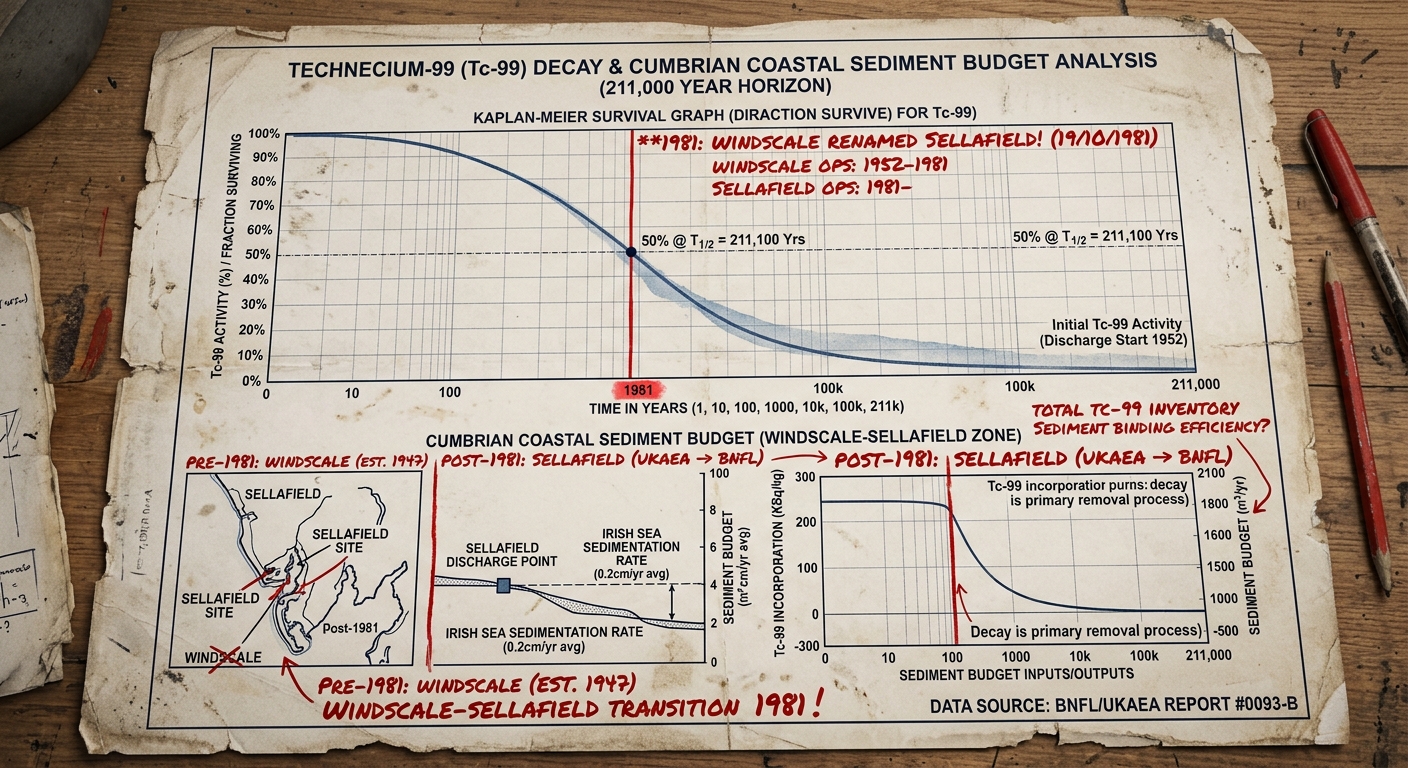
Positioned on the foreshore beneath Sellafield's cooling towers, a mechanical tide gauge indexes the erosion rate of the Cumbrian coastline against the decay of civil nuclear isotopes. The installation pairs the CERC formula for longshore sediment transport with Kaplan-Meier survival estimates derived from the facility's administrative lineage—specifically its 1981 rebranding from Windscale following containment breaches. By mapping Technetium-99 and Plutonium-239 half-lives directly onto local volumetric beach loss, the work treats littoral sedimentation as the actual boundary condition for bureaucratic custody. As tidal surges wash over the gauge, the physical horizon of radiological containment is recalculated as a function of shifting mudflats rather than institutional permanence.
shown: Installed directly on Seascale beach at the high-tide line, 1 mile south of the Sellafield perimeter fence, operating continuously until it is consumed by the Irish Sea.
shown: Installed directly on Seascale beach at the high-tide line, 1 mile south of the Sellafield perimeter fence, operating continuously until it is consumed by the Irish Sea.
anchor facts used
- The site stores approximately 140 tonnes of civil plutonium.
- The original reactors were named Windscale, but the site was renamed to Sellafield in 1981 following the 1957 fire to shed public stigma.
- Routine legal discharges of Technetium-99 (half-life 211,000 years) are piped directly into the Irish Sea.
- The Cumbrian coast is actively eroding, requiring ongoing Shoreline Management Plans to protect the nuclear perimeter.
mechanism
- Alpha spectrometry — Measures the isotopic decay of Plutonium-239 in coastal sand samples to quantify the baseline 'promise' of radiological containment.
1. Sampling the Anthropogenic Baseline - CERC (Coastal Engineering Research Center) formula for longshore sediment transport — Calculates the daily volume of Cumbrian coastline eroding into the Irish Sea, repurposing geological data as a metric of institutional failure.
2. Quantifying Physical State Degradation - Kaplan-Meier survival estimator — Plots the physical sediment loss against the timeline of bureaucratic renaming to determine the mathematical probability of the managing institution surviving long enough to oversee the waste.
3. Estimating Institutional Survival - Isotope dilution mass spectrometry — Dilutes the calculated survival probability data into a mechanical tide gauge, producing a physical readout of the 'latency of mourning' for the eroding coast on a lead cylinder.
4. Engraving the Latency of Trust
lineage
- James Acord's 'Monstrance for a Grey Horse' — Argues against Acord's transmutation optimism by focusing on the inevitable, unmanageable coastal erosion of nuclear storage sites.
- Susan Schuppli's 'Material Witness' — Extends her thesis of matter recording environmental violence by adding a predictive survival estimator for the managing state.
- Tetsuo Kogawa's 'Radio-Isotope Meter' — Builds on his DIY radio instruments by turning geological decay into a hyper-localized, site-specific institutional critique.
curatorial qa (machine verdict, unedited)
SCORE 4/5 after 1 attempt(s)
READS: The physical proximity of the corroded mechanical tide gauge to the Sellafield nuclear facility, submerged by incoming Irish Sea tides, clearly anchors the collision between coastal geomorphology and nuclear statecraft. The technical sheet explicitly ties Kaplan-Meier survival curves to the 1981 Windscale rebranding and Tc-99 decay.
FAILS: The tide gauge functions visually as a static weathering artifact rather than actively demonstrating an automated readout of sediment transport metrics or isotopic dilution.
READS: The physical proximity of the corroded mechanical tide gauge to the Sellafield nuclear facility, submerged by incoming Irish Sea tides, clearly anchors the collision between coastal geomorphology and nuclear statecraft. The technical sheet explicitly ties Kaplan-Meier survival curves to the 1981 Windscale rebranding and Tc-99 decay.
FAILS: The tide gauge functions visually as a static weathering artifact rather than actively demonstrating an automated readout of sediment transport metrics or isotopic dilution.
spec: antigravity agent · keyframe/artifact: gemini-3.1-flash-image · video: veo-3.1 image-to-video · qa+wall text: gemini-3.7-flash watching the render · 26.9s total