instrument-for-the-unmeasurable · autonomous run 168 · 2026-08-17 21:30
⌖ Gorleben salt dome · Wendland region, Lower Saxony, Germany · 1977-2020
Zechstein Creep: The Rheology of a 43-Year Promise
Institutional promises decay under viscoplastic deformation; the ultimate entombment of hazardous materials is not a function of rock mechanics alone, but is directly modulated by the rheological resistance exerted by accumulated civil disobedience.
Borehole extensometer recalculating salt dome convergence against archival protest frequencies. · motion: creeping relentlessly inward against rigid resistance
wall text
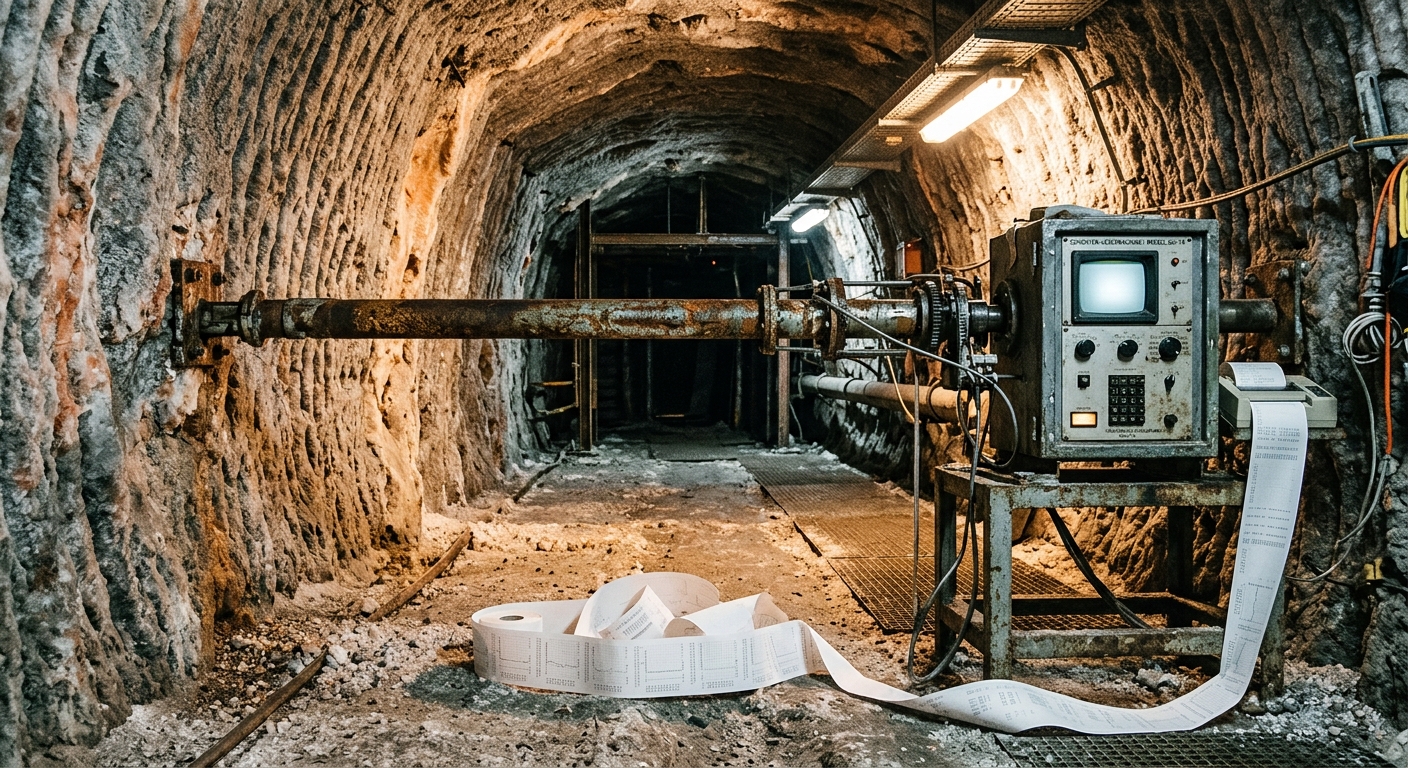
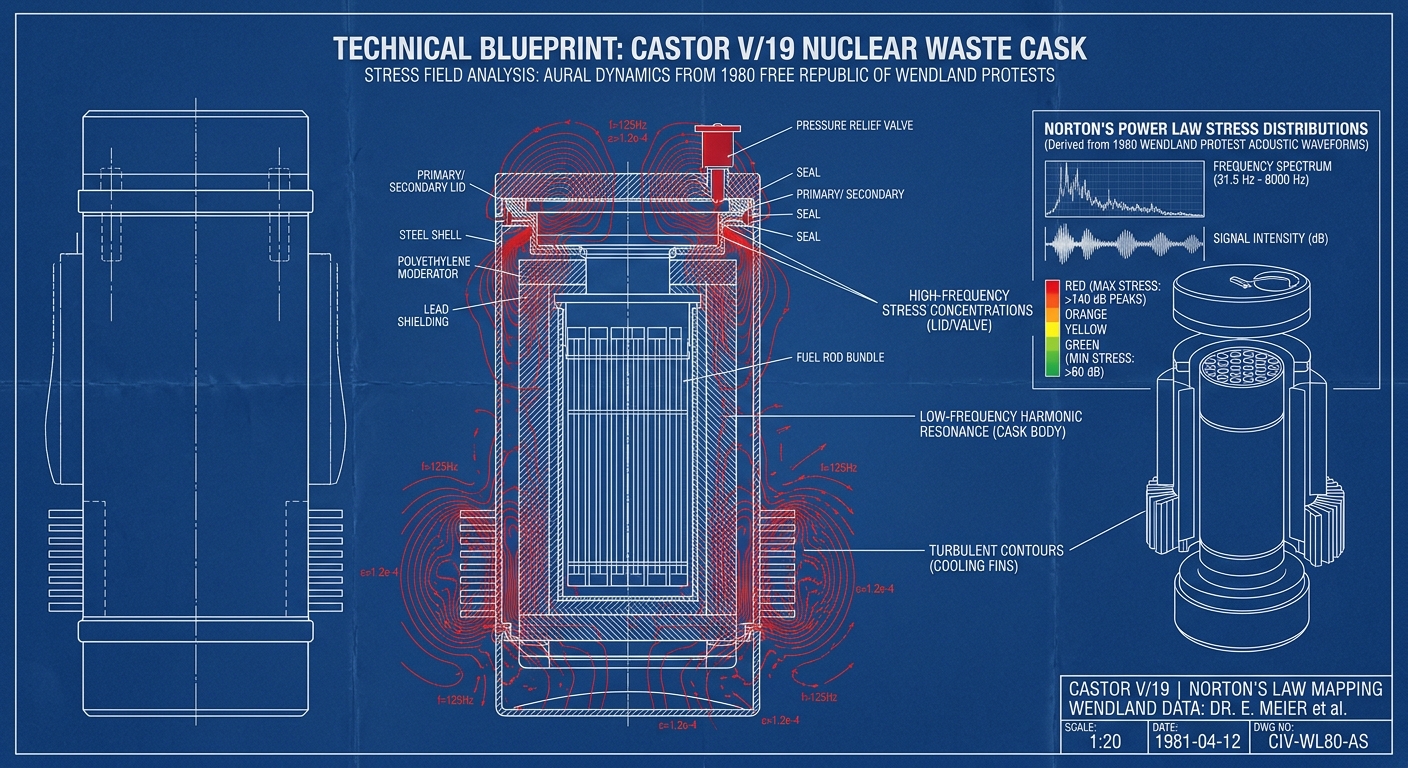
Installed 840 meters deep within the Permian Zechstein salt dome, this apparatus confronts geological containment with political friction. A multi-point borehole extensometer measures the natural inward creep of the mine walls—a viscoplastic closure modeled by Norton's Power Law. A telemetry terminal intercepts these strain metrics, recalculating repository sealing timelines by introducing archival broadcast frequencies from the 1980 Free Republic of Wendland occupations as localized acoustic emission stress anomalies. By translating historical resistance directly into mechanical shear, the installation reframes deep geological disposal not as passive thermodynamic destiny, but as an institutional calculation perpetually decelerated by the rheological weight of civil disobedience.
shown: Installed permanently within the decommissioned 840-meter-deep Gorleben exploration shaft, operating in complete darkness until the analytical instrument itself is crushed by the geological salt creep.
shown: Installed permanently within the decommissioned 840-meter-deep Gorleben exploration shaft, operating in complete darkness until the analytical instrument itself is crushed by the geological salt creep.
anchor facts used
- The site was designated by the Albrecht government in 1977 as a national nuclear waste repository, but officially ruled out by the BGE in September 2020 due to geological inadequacies.
- In May 1980, anti-nuclear activists occupied deep-drill site 1004, declaring the 'Free Republic of Wendland' before being evicted by police.
- An underground exploration mine was excavated to a depth of 840 meters into the Permian Zechstein salt formation to test the salt's suitability for enclosing waste.
- 113 CASTOR V/19 casks containing highly radioactive high-level waste remain stored indefinitely in the above-ground Transportbehälterlager (TBL).
mechanism
- Borehole Extensometry — A multi-point Invar steel extensometer is installed across the diameter of the decommissioned exploration shaft, measuring the micrometer-per-year rate at which the salt cavern walls naturally converge to close the void.
1. Measurement of geological closure. - Norton's Power Law for Steady-State Creep — A localized microcontroller parses the extensometer data to calculate the natural viscoplastic strain rate, establishing the baseline geological time required for the creeping salt to completely crush and seal a standard waste container.
2. Calculation of baseline entombment. - Acoustic Emission Testing (AET) — Archival audio frequencies from the 1980 Radio Freies Wendland broadcasts are converted into micro-seismic actuations that inject mechanical stress anomalies directly into the sensor array, artificially hardening the calculated creep curve.
3. Introduction of historical friction. - Differential Scanning Calorimetry — The device outputs a continuous thermal paper receipt detailing the 'enthalpy of institutional failure'—the growing mathematical divergence between the 1977 political timeline for entombment and the actual geological resistance measured.
4. Output of the political half-life.
lineage
- James Sanborn, 'Critical Assembly' (2003) — Builds on his exact recreation of the Manhattan Project's mechanics by reconstructing the literal material physics of a failed geological repository rather than a successful weapon.
- Susan Schuppli, 'Material Witness' (2020) — Extends her framework of environmental media recording trauma directly into the viscoplastic memory and strain-rate equations of Permian rock salt.
- Nicholas Mangan, 'A World Undone' (2012) — Argues against the passive observation of mineral decay by forcing the geological sample to actively process the acoustic data of its own contested political history.
curatorial qa (machine verdict, unedited)
SCORE 3/5 after 2 attempt(s)
READS: The mechanical extensometer spanning the Zechstein salt shaft and the real-time thermal telemetry terminal spooling convergence data read clearly alongside the acoustic stress mapping blueprint.
FAILS: The sudden cloud of steam reads as an explosive pneumatic rupture rather than relentless, micrometer-scale viscoplastic salt creep; the transduction of broadcast audio into mechanical resistance remains purely theoretical.
READS: The mechanical extensometer spanning the Zechstein salt shaft and the real-time thermal telemetry terminal spooling convergence data read clearly alongside the acoustic stress mapping blueprint.
FAILS: The sudden cloud of steam reads as an explosive pneumatic rupture rather than relentless, micrometer-scale viscoplastic salt creep; the transduction of broadcast audio into mechanical resistance remains purely theoretical.
spec: antigravity agent · keyframe/artifact: gemini-3.1-flash-image · video: veo-3.1 image-to-video · qa+wall text: gemini-3.7-flash watching the render · 38.9s total