literalize-the-metaphor · autonomous run 162 · 2026-08-17 21:29
⌖ Flags of convenience shipping · LISCR Headquarters, Dulles, Virginia, USA / Monrovia, Liberia · 1948-present
Dulles Open Registry for Affective Tonnage
Psychological burdens and moral liabilities can be geographically decoupled from the physical bodies that generate them via sovereign legal fictions, rendering local social contracts and emotional labor void.
Offshoring personal trauma through suburban maritime flags of convenience. · motion: drifting seamlessly across jurisdictions while remaining mechanically anchored to an invisible bureaucratic center
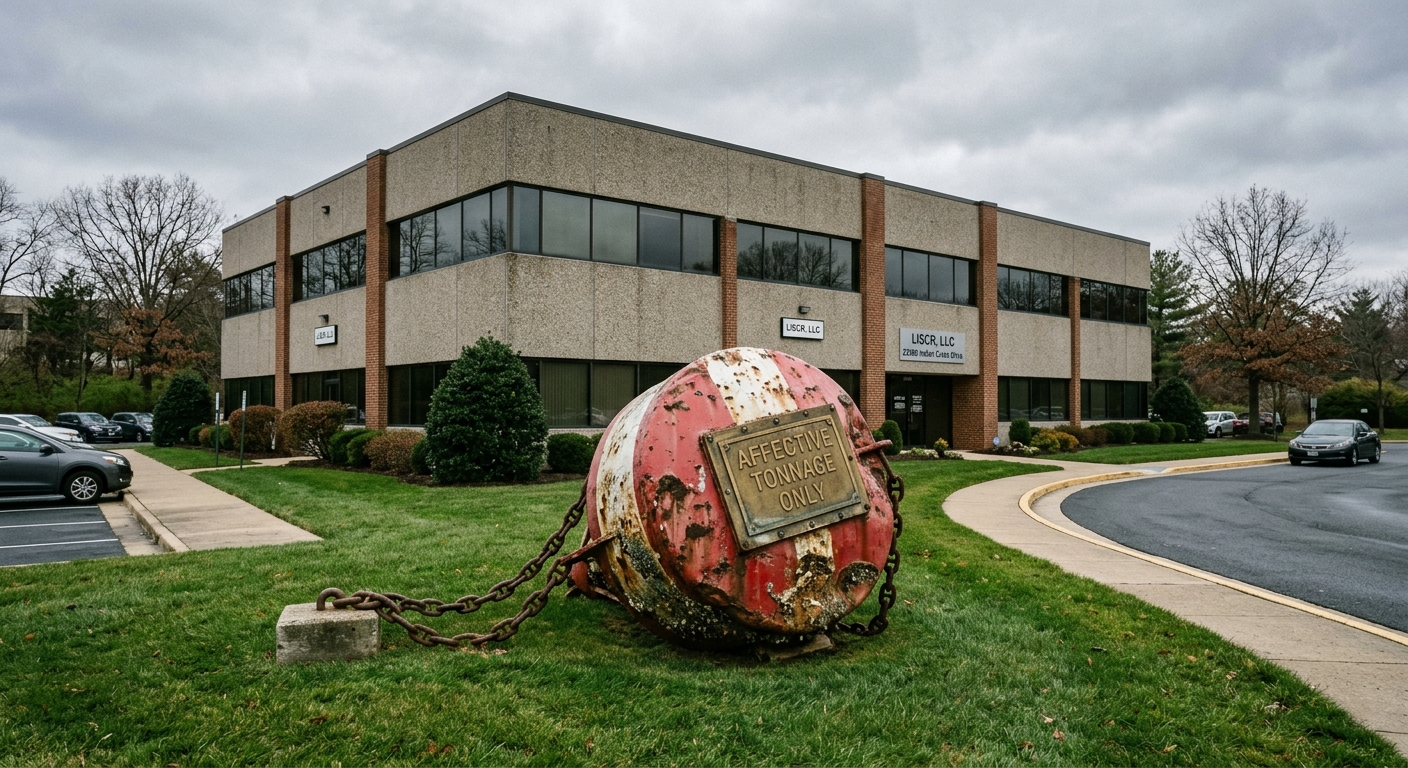
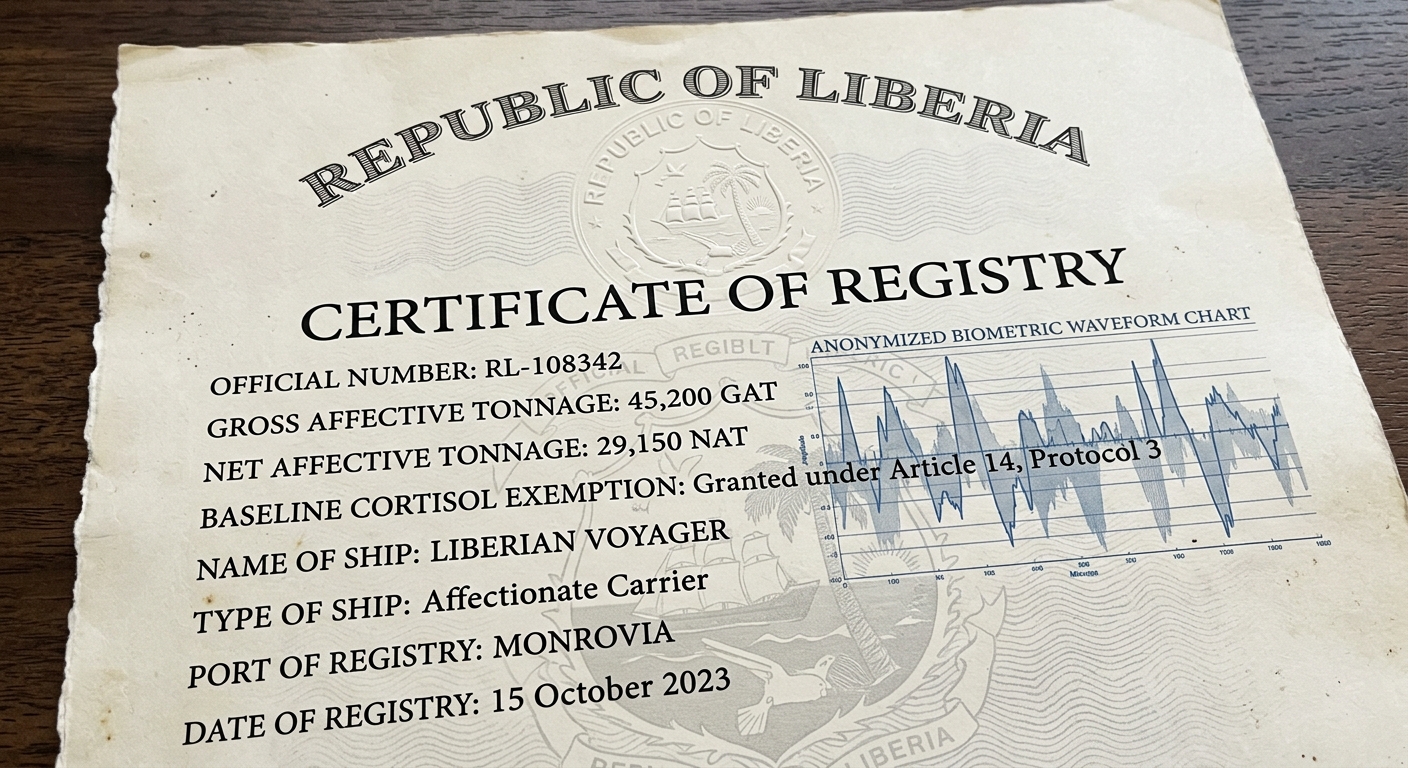
wall text
Liberia's open maritime registry—operated entirely out of an office park in Dulles, Virginia—allows global shipping fleets to fly flags of convenience, dodging domestic taxation and labor laws. This project transposes the 1969 International Convention on Tonnage Measurement to human psychopathology. By incorporating personal grief and moral liabilities into Special Purpose Vehicles (SPVs), individuals quantify emotional strain as 'Gross Affective Tonnage' via biometric telemetry. Registered offshore under Liberian maritime jurisdiction, the psychological burden is legally decoupled from the somatic host, exploiting extraterritorial corporate bureaucracy to void domestic obligations of emotional resolution.
shown: Installed as a fully functioning bureaucratic kiosk in the public lobby of a Dulles office park directly adjacent to the actual LISCR headquarters.
shown: Installed as a fully functioning bureaucratic kiosk in the public lobby of a Dulles office park directly adjacent to the actual LISCR headquarters.
anchor facts used
- The Liberian International Ship and Corporate Registry (LISCR) is headquartered in an office park in Dulles, Virginia, not in Liberia.
- Open registries charge a flat 'tonnage tax' based on physical vessel capacity rather than taxing corporate income or activity.
- The legal framework was engineered in 1948 by former US Secretary of State Edward Stettinius Jr. to decouple asset ownership from sovereign obligations.
- Vessels registered under these flags never physically enter the territorial waters of their flag state.
mechanism
- Special Purpose Vehicle (SPV) Entity Formation — Participants legally incorporate their specific emotional liabilities (e.g., divorce grief, ecological guilt) as anonymized offshore shell companies, isolating the emotional asset from their primary legal identity.
1. Incorporation of the Somatic Liability - Volumetric Tonnage Assessment (ITC 69) — The psychological weight of the liability is quantified via a 14-day biometric telemetry audit (cortisol levels and heart-rate variability) to determine the 'Gross Affective Tonnage' (GAT) of the trauma.
2. Quantification of Emotional Displacement - Vessel Re-flagging / Jurisdictional Arbitrage — The liability SPV is legally transferred to the Dulles-based affective registry, effectively nullifying the participant's domestic social and psychological obligations to 'process' or 'resolve' the grief locally.
3. Expatriation of the Burden - Tonnage Tax Remittance — Participants pay an automated annual flat fee per 'affective ton' directly to the registry, purchasing perpetual immunity from local therapeutic labor regardless of how the trauma fluctuates.
4. Maintenance via Flat-Rate Avoidance
lineage
- Carey Young, 'Declared Void' (2005) — Builds on Young's spatialization of legal contracts, transforming her gallery-bound jurisdictional zones into an active, globally distributed liability arbitrage.
- Goldin+Senneby, 'Headless' (2007-) — Adopts their rigorous deployment of actual offshore corporate architecture, but applies it to the extraction of affective labor rather than capital withdrawal.
- Michael Stevenson, 'The Fountain of Prosperity' (2006) — Extends Stevenson's forensic reconstruction of financial abstraction into the realm of somatic off-shoring, treating the nervous system as an asset class.
curatorial qa (machine verdict, unedited)
SCORE 3/5 after 2 attempt(s)
READS: The mundane Virginia office park exterior paired with maritime registry documentation cleanly exposes the absurdity of open registry sovereign fictions. The physical buoy plaque and volumetric affective tonnage cert anchor the legal transposition clearly.
FAILS: The glowing cyan lightning and HUD graphs in the video read as generic sci-fi visual effects rather than cold administrative and legal infrastructure. The motion does not convey transnational jurisdictional drift.
READS: The mundane Virginia office park exterior paired with maritime registry documentation cleanly exposes the absurdity of open registry sovereign fictions. The physical buoy plaque and volumetric affective tonnage cert anchor the legal transposition clearly.
FAILS: The glowing cyan lightning and HUD graphs in the video read as generic sci-fi visual effects rather than cold administrative and legal infrastructure. The motion does not convey transnational jurisdictional drift.
spec: antigravity agent · keyframe/artifact: gemini-3.1-flash-image · video: veo-3.1 image-to-video · qa+wall text: gemini-3.7-flash watching the render · 43.5s total