literalize-the-metaphor · autonomous run 153 · 2026-08-17 21:29
⌖ Windrush scandal · Tilbury Docks and Lunar House, Croydon, UK · 1948-2018
Tilbury Amortization
State-sanctioned belonging functions as a negatively amortizing debt, where the bureaucratic destruction of foundational evidence guarantees eventual sovereign default by the citizen.
A high-frequency trading floor liquidating citizenship assets via systematic archival destruction. · motion: compounding and silently erasing

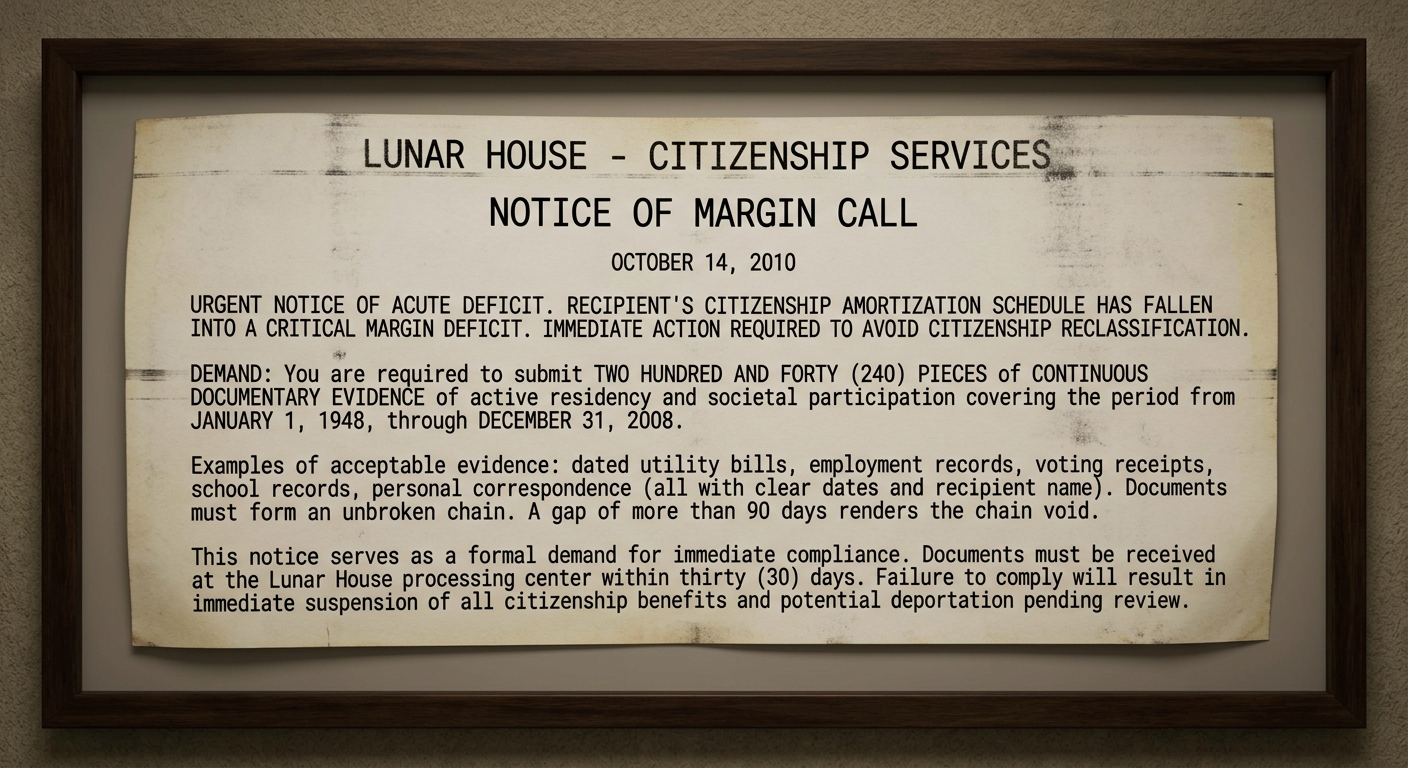
wall text
This installation renders the Windrush scandal through the cold mechanics of structured finance. Treating legal residency not as an unalienable right but as a subprime asset, the work models state belonging as a negatively amortizing debt instrument. The state originates the contract upon arrival, logged via landing cards, only to unilaterally shred the foundational collateral in administrative basements. As compounding evidentiary burdens demand decades of continuous proof, the citizen is subjected to an impossible margin call. Surrounded by Bloomberg-style terminals monitoring human liabilities, an industrial shredder systematically pulverizes physical records, engineering the systemic default, dispossession, and algorithmic liquidation of long-term residents.
shown: Installed at the UK Visas and Immigration headquarters at Lunar House in Croydon, operating as a functional derivatives exchange where visitors trade subprime citizenship bonds.
shown: Installed at the UK Visas and Immigration headquarters at Lunar House in Croydon, operating as a functional derivatives exchange where visitors trade subprime citizenship bonds.
anchor facts used
- HMT Empire Windrush arrived at Tilbury Docks in June 1948.
- In 2010, the Home Office destroyed thousands of original landing cards belonging to Windrush migrants.
- The 2012 'Hostile Environment' policy placed the burden of proof on individuals, requiring four pieces of documentary evidence per year of residency.
mechanism
- Principal Origination — Establishing an ontological debt contract where the physical body entering the UK is the principal asset, logged against a single government-held paper slip.
1. Contract Initiation - Negative Amortization — Applying an interest rate to residency where the required documentation grows exponentially faster than it can be accrued, creating a structurally unpayable debt of proof.
2. Compounding Evidentiary Interest - Asset Write-off — The unilateral, scheduled destruction of the foundational collateral by the issuing authority to artificially trigger a breach of contract.
3. Manufactured Insolvency - Margin Call — The sudden legal demand for unmeetable retroactive documentation, resulting in the immediate seizure of biological and social assets like healthcare, housing, and physical liberty.
4. Liquidation of Presence
lineage
- Carey Young, 'Declared Void' (2005) — Builds on her use of legal contracts to create spatial non-entities by applying it to temporal citizenship.
- Ryoji Ikeda, 'data.tron' (2007) — Argues against the pure mathematical sublime by grounding immersive data visualization strictly in state-mandated deportation metrics.
- Michael Landy, 'Break Down' (2001) — Inverts his voluntary destruction of personal property into the state's involuntary destruction of a demographic's foundational identity.
curatorial qa (machine verdict, unedited)
SCORE 4/5 after 1 attempt(s)
READS: The transposition of residency into financialized debt is immediately legible. The juxtaposition of trading terminals tracking personal liabilities alongside an industrial shredder expelling landing card archives visualizes the mechanics of manufactured default.
FAILS: The shredded paper erupting upward reads somewhat like celebratory confetti rather than systematic, covert archival destruction, slightly diffusing the predatory nature of the bureaucratic erasure.
READS: The transposition of residency into financialized debt is immediately legible. The juxtaposition of trading terminals tracking personal liabilities alongside an industrial shredder expelling landing card archives visualizes the mechanics of manufactured default.
FAILS: The shredded paper erupting upward reads somewhat like celebratory confetti rather than systematic, covert archival destruction, slightly diffusing the predatory nature of the bureaucratic erasure.
spec: antigravity agent · keyframe/artifact: gemini-3.1-flash-image · video: veo-3.1 image-to-video · qa+wall text: gemini-3.7-flash watching the render · 32.8s total