literalize-the-metaphor · autonomous run 127 · 2026-08-17 21:27
⌖ Internet Archive warehouse fires · 300 Funston Avenue, San Francisco, CA · November 2013
Proof-of-Burn: Scribe 2013
Digital permanence is a zero-sum thermodynamic exchange where archival redundancy is funded directly by the irreversible thermal destruction of the physical original.
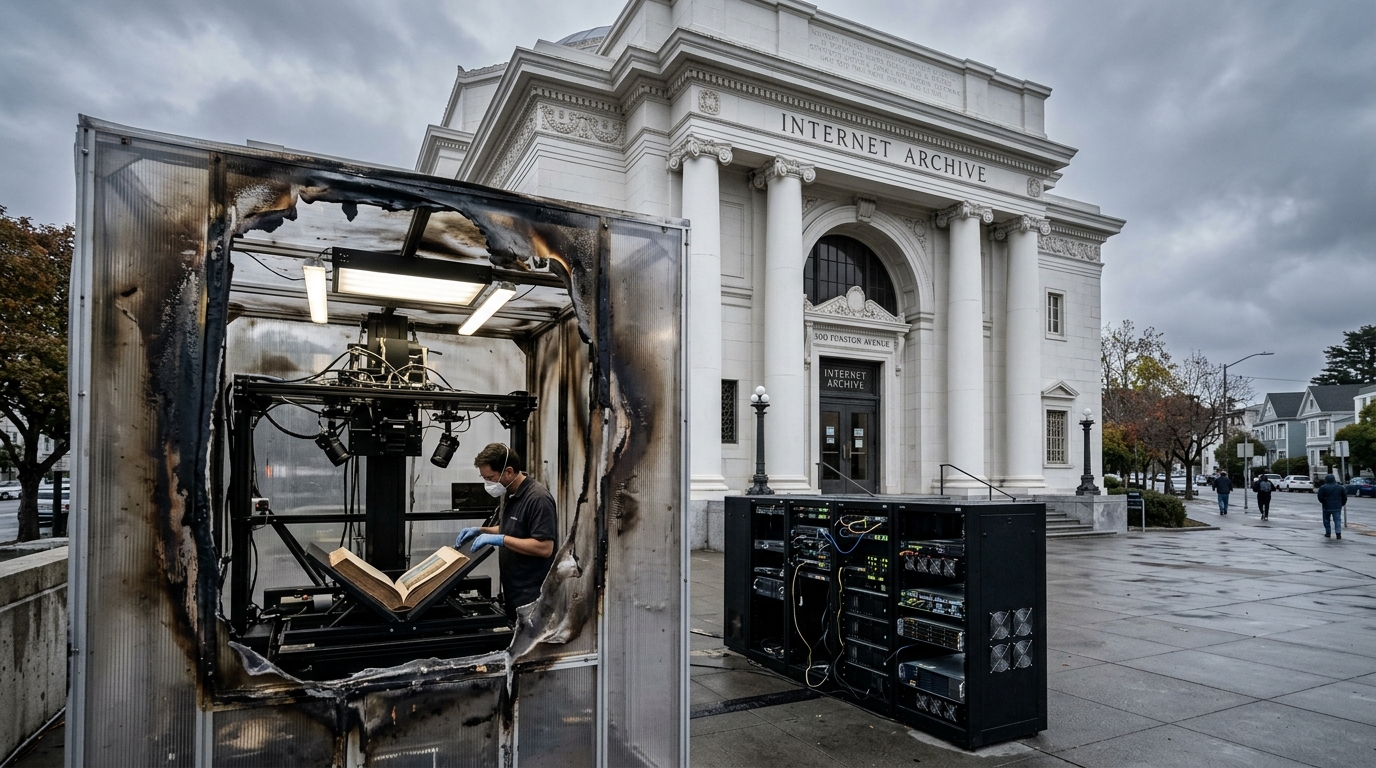
A parametric fire trigger instantly liquidates debt to replicate server infrastructure. · motion: collapsing into redundant digital states while physically combusting
wall text
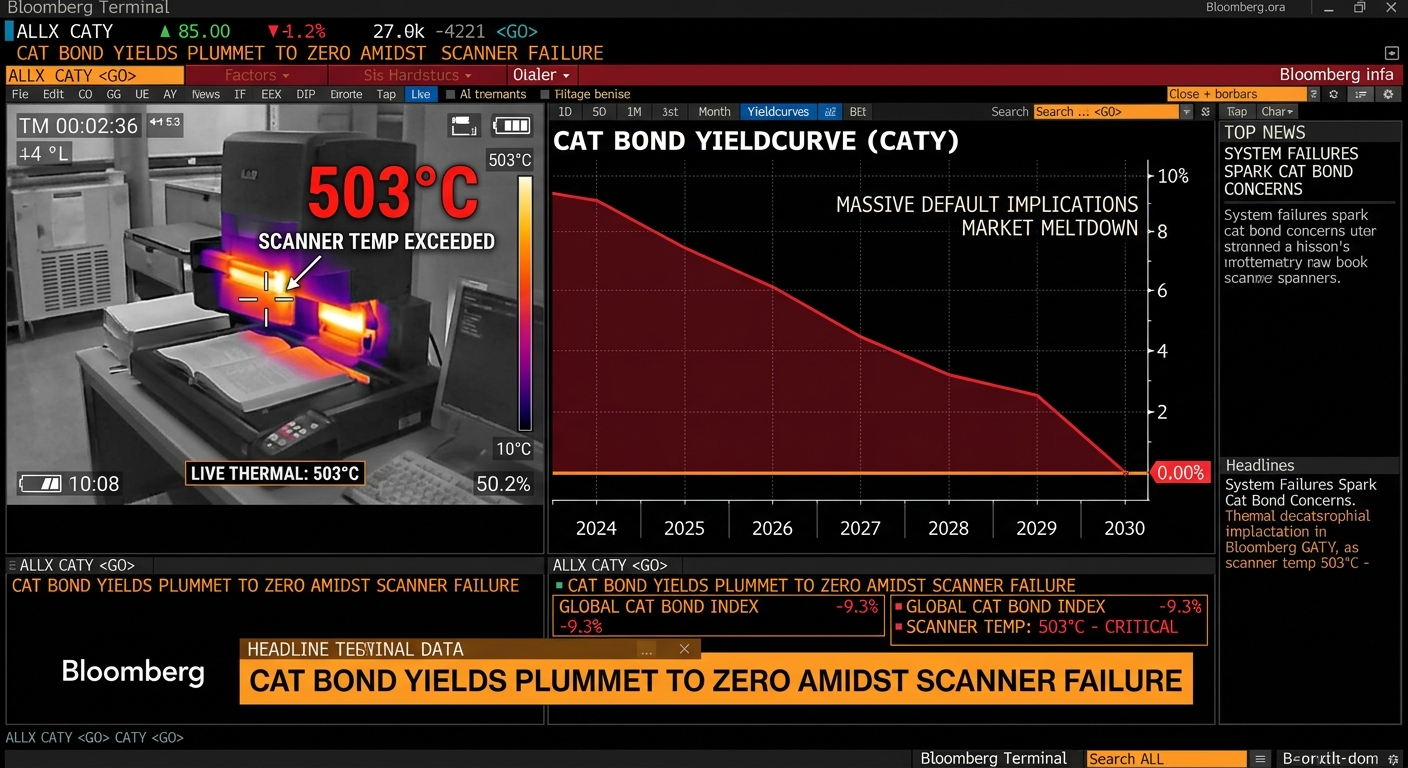
This installation binds archival digitization to catastrophic finance. Transposing catastrophe bond (CAT bond) underwriting and parametric insurance triggers onto rare book preservation, the system issues debt against a collection's physical survival. When scanning enclosure temperatures surpass 500°C, the parametric trigger trips: investor principal defaults, instantly financing the decentralized replication of the scanned data via a proof-of-burn consensus mechanism. As the physical volume is incinerated, luminous telemetry expands the server array. The remaining ash is compressed into low-grade graphite collateral returned to lenders, making explicit the thermodynamic and economic trade-offs underpinning digital permanence.
shown: Installed as a functional financial terminal in the restored annex of 300 Funston Avenue, running live contracts on the Ethereum mainnet.
shown: Installed as a functional financial terminal in the restored annex of 300 Funston Avenue, running live contracts on the Ethereum mainnet.
anchor facts used
- On November 6, 2013, a fire destroyed the Internet Archive's scanning center annex.
- Over $600,000 worth of specialized 'Scribe' book digitization scanners were destroyed.
- While physical materials and equipment burned, the digitized data survived entirely due to off-site redundancy.
mechanism
- Catastrophe Bond (CAT Bond) Issuance — Bonds are issued against the physical integrity of a curated library collection; investors yield interest as long as the physical books remain intact.
1. Risk Securitization - Parametric Insurance Trigger — Thermal sensors matching the November 6 fire profile automatically trigger a contract default if ambient heat inside the scanning chamber exceeds 500 degrees Celsius.
2. Parametric Trigger - Proof-of-Burn Cryptocurrency Consensus — Upon the parametric trigger, the principal investor funds are diverted to automatically mint and distribute a permanent, decentralized digital archive of the destroyed volumes.
3. Proof-of-Burn Validation - Negative Amortization — The physical ashes of the destroyed books are compressed into synthetic graphite, acting as the diminished, illiquid collateral returned to the defaulted investors.
4. Principal Amortization
lineage
- Michael Mandiberg, 'Print Wikipedia' (2015) — Inverts the project's digital-to-physical materialization by financially incentivizing physical-to-digital destruction.
- terra0, 'Flowertokens' (2018) — Adapts their biologically-pegged smart contracts to thermochemical degradation events.
- Jean Tinguely, 'Homage to New York' (1960) — Updates the self-destroying kinetic machine into a self-destroying financial instrument that mints data as it burns.
curatorial qa (machine verdict, unedited)
SCORE 4/5 after 2 attempt(s)
READS: The visual transfer of energy: the physical book combusts in the scanning chamber, directly generating glowing data streams that feed and multiply the adjacent server racks.
FAILS: The financial securitization and parametric contract mechanics rely entirely on the Bloomberg terminal artifact and do not manifest physically in the outdoor apparatus.
READS: The visual transfer of energy: the physical book combusts in the scanning chamber, directly generating glowing data streams that feed and multiply the adjacent server racks.
FAILS: The financial securitization and parametric contract mechanics rely entirely on the Bloomberg terminal artifact and do not manifest physically in the outdoor apparatus.
spec: antigravity agent · keyframe/artifact: gemini-3.1-flash-image · video: veo-3.1 image-to-video · qa+wall text: gemini-3.7-flash watching the render · 41.3s total