literalize-the-metaphor · autonomous run 124 · 2026-08-17 21:27
⌖ BBC Radiophonic Workshop archive · Room 13, Maida Vale Studios, Delaware Road, London · 1958-1998
Maida Vale Default Swaps
Cultural heritage is an amortizing asset whose intrinsic value can only be realized by financializing its physical degradation.
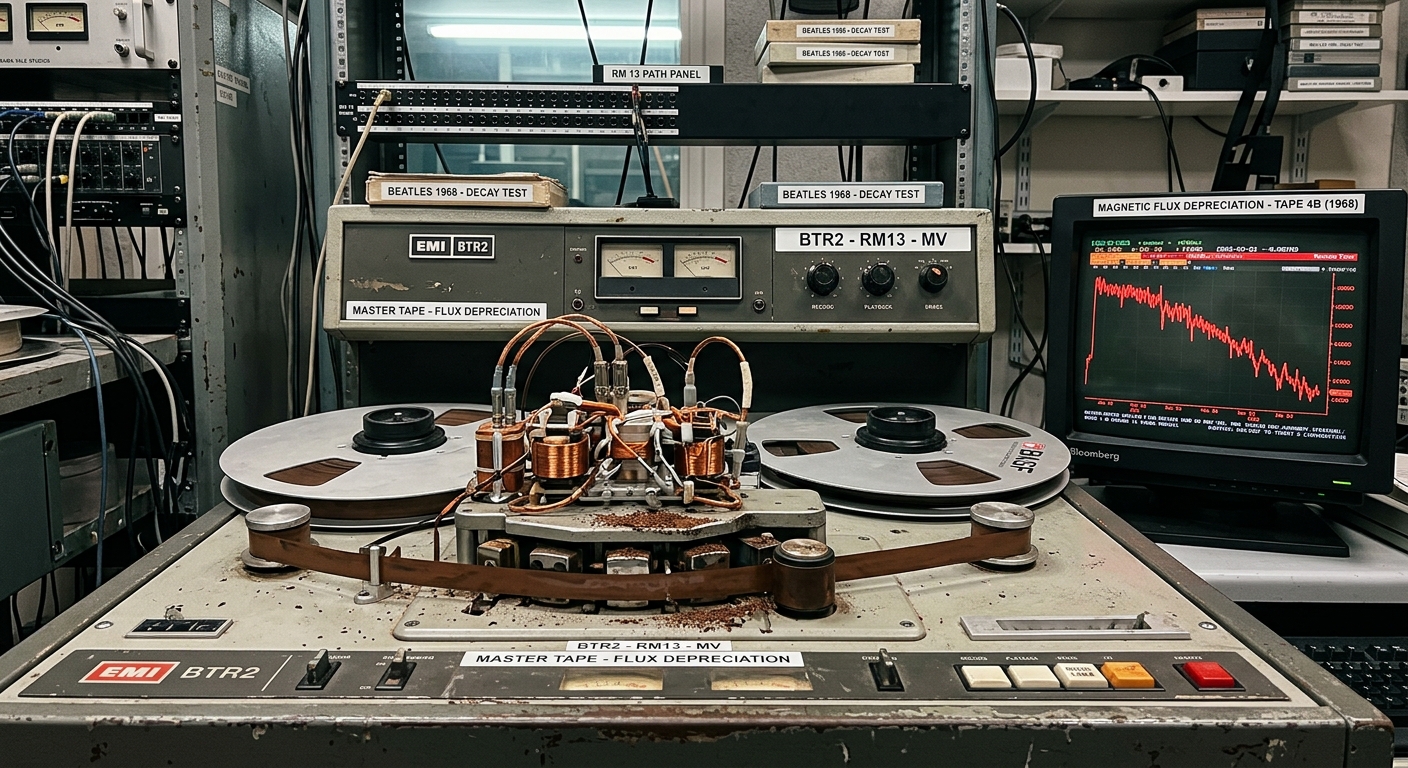
Ferric oxide shedding from master tape calculates real-time cultural asset depreciation. · motion: shedding magnetic oxide to trigger algorithmic margin calls
wall text
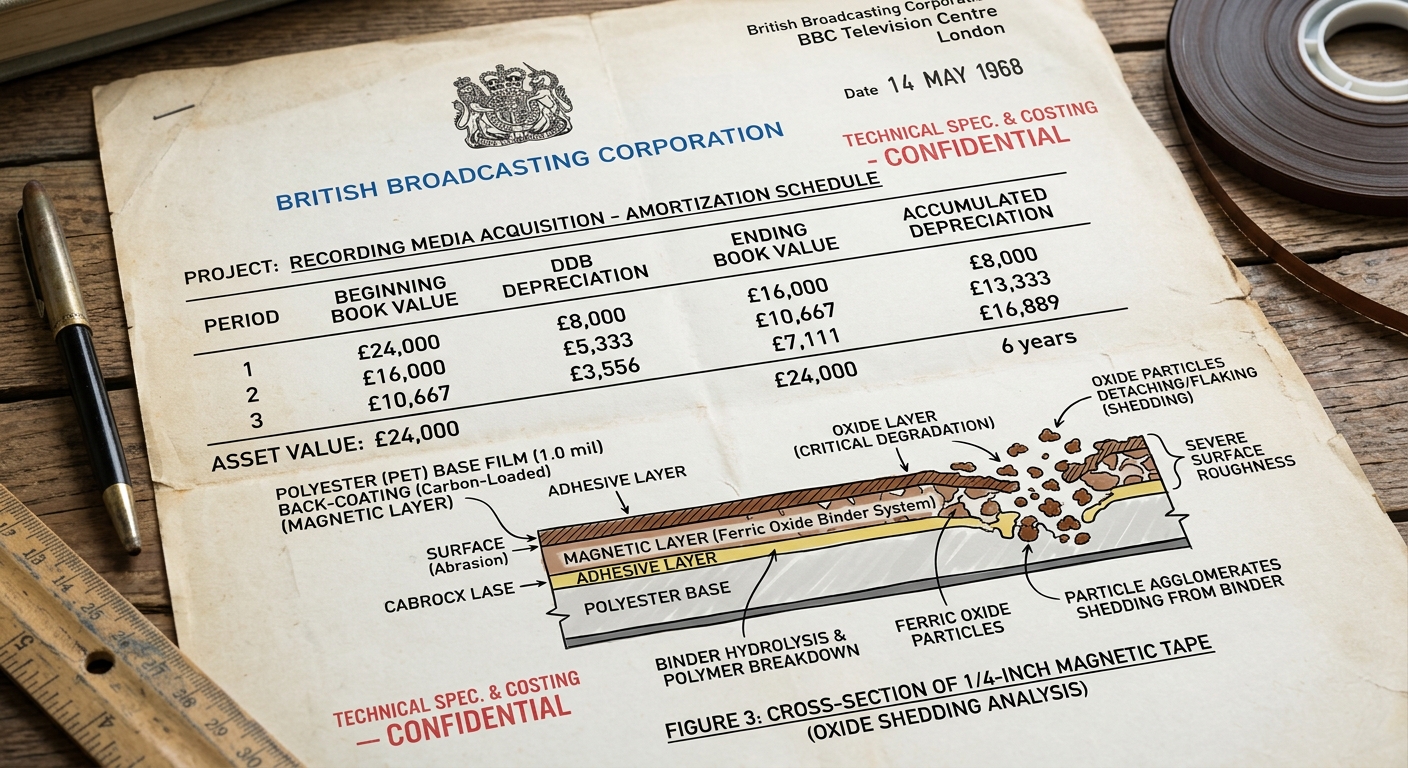
This installation mounts original quarter-inch broadcast master tapes onto a modified open-reel deck fitted with magnetometer sensing coils. As sticky-shed syndrome forces ferric oxide particles off the polyester substrate, real-time remanence loss is quantified directly at the playback head. The resulting signal degradation feeds an algorithmic pricing oracle that writes down the historical recording via double-declining balance depreciation. Here, archival preservation failure is transformed into an actuarial milestone, allowing financial derivatives to settle precisely as cultural memory demagnetizes into inert dust.
shown: Installed directly in the corridor outside the decommissioned Room 13 at Maida Vale Studios, allowing BBC staff to watch the active shorting of their own institutional memory.
shown: Installed directly in the corridor outside the decommissioned Room 13 at Maida Vale Studios, allowing BBC staff to watch the active shorting of their own institutional memory.
anchor facts used
- The Radiophonic Workshop operated out of Room 13 at Maida Vale Studios from 1958 to 1998.
- Delia Derbyshire engineered the 1963 Doctor Who theme using manually spliced 1/4-inch magnetic tape loops.
- The physical magnetic tape archive is highly susceptible to 'sticky-shed syndrome,' where the polyurethane binder breaks down and physical ferric oxide sheds away.
mechanism
- Vibrating Sample Magnetometry (VSM) — Repurposed as an oracle to derive the real-time physical decay of cultural memory.
1. A custom vibrating sample magnetometer continuously measures the remnant magnetic flux of original 1/4-inch tape loops spooling in an isolated chamber. - Double-declining balance depreciation — Accounting for the exact financial write-off of broadcast nostalgia as the magnetic oxide physically sheds.
2. The measured flux decay rate is mapped against an actuarial life table to generate a declining balance depreciation schedule for the asset. - Credit Default Swap (CDS) issuance and pricing — Treating complete audio signal loss as a financial default event that triggers an institutional payout.
3. An automated market maker issues 'Cultural Default Swaps' (CDS) acting as insurance contracts that pay out upon the total demagnetization of the master reels. - Algorithmic Margin Call execution — Forcing the immediate liquidation of cultural capital when the physical substrate can no longer sustain the original audio.
4. When the tape's signal-to-noise ratio drops below a critical threshold, the smart contract liquidates the nostalgia bonds and executes a margin call.
lineage
- William Basinski, 'The Disintegration Loops' (2002) — Shifts Basinski's romanticized tape decay from an aesthetic tragedy into a quantifiable underlying asset for a derivatives market.
- Carey Young, 'Declared Void' (2005) — Takes Young's use of binding legal contracts into the realm of automated actuarial finance for heritage objects.
- Michael Asher, 'No Title (1973)' (sandblasting the gallery wall) — Like Asher's material subtraction, the piece focuses on the physical erosion of the institution, but prices the erosion dynamically in real-time.
curatorial qa (machine verdict, unedited)
SCORE 4/5 after 1 attempt(s)
READS: The mechanical degradation of vintage reel tape directly corresponds to the declining depreciation chart on the vintage monitor and archive documentation.
FAILS: The specific market mechanism linking oxide shedding to automated Credit Default Swap execution remains abstract rather than legibly demonstrated on screen.
READS: The mechanical degradation of vintage reel tape directly corresponds to the declining depreciation chart on the vintage monitor and archive documentation.
FAILS: The specific market mechanism linking oxide shedding to automated Credit Default Swap execution remains abstract rather than legibly demonstrated on screen.
spec: antigravity agent · keyframe/artifact: gemini-3.1-flash-image · video: veo-3.1 image-to-video · qa+wall text: gemini-3.7-flash watching the render · 41.4s total