literalize-the-metaphor · autonomous run 113 · 2026-08-17 21:26
⌖ Guano islands era · Navassa Island, Caribbean Sea (18°24′11″N 75°0′43″W) · 1856-1898
Navassa Toxicity Special Purpose Vehicle
Sovereignty in digital spaces mirrors 19th-century resource imperialism: territorial claims are legitimized strictly through the legal capacity to securitize and extract concentrated accumulations of systemic waste.
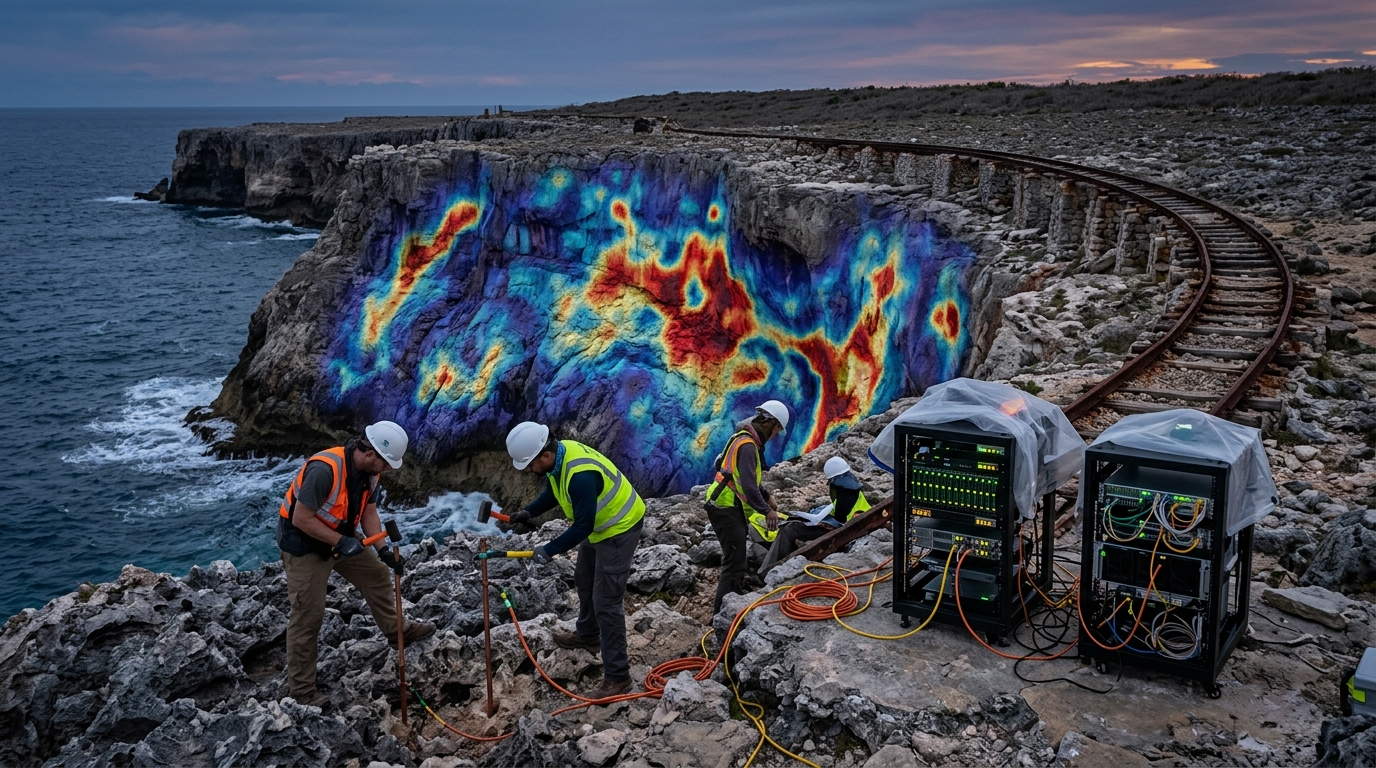
Field operators grade and tranche semantic run-off along an annexed digital coastline. · motion: extracting and tranching fossilized vitriol
wall text
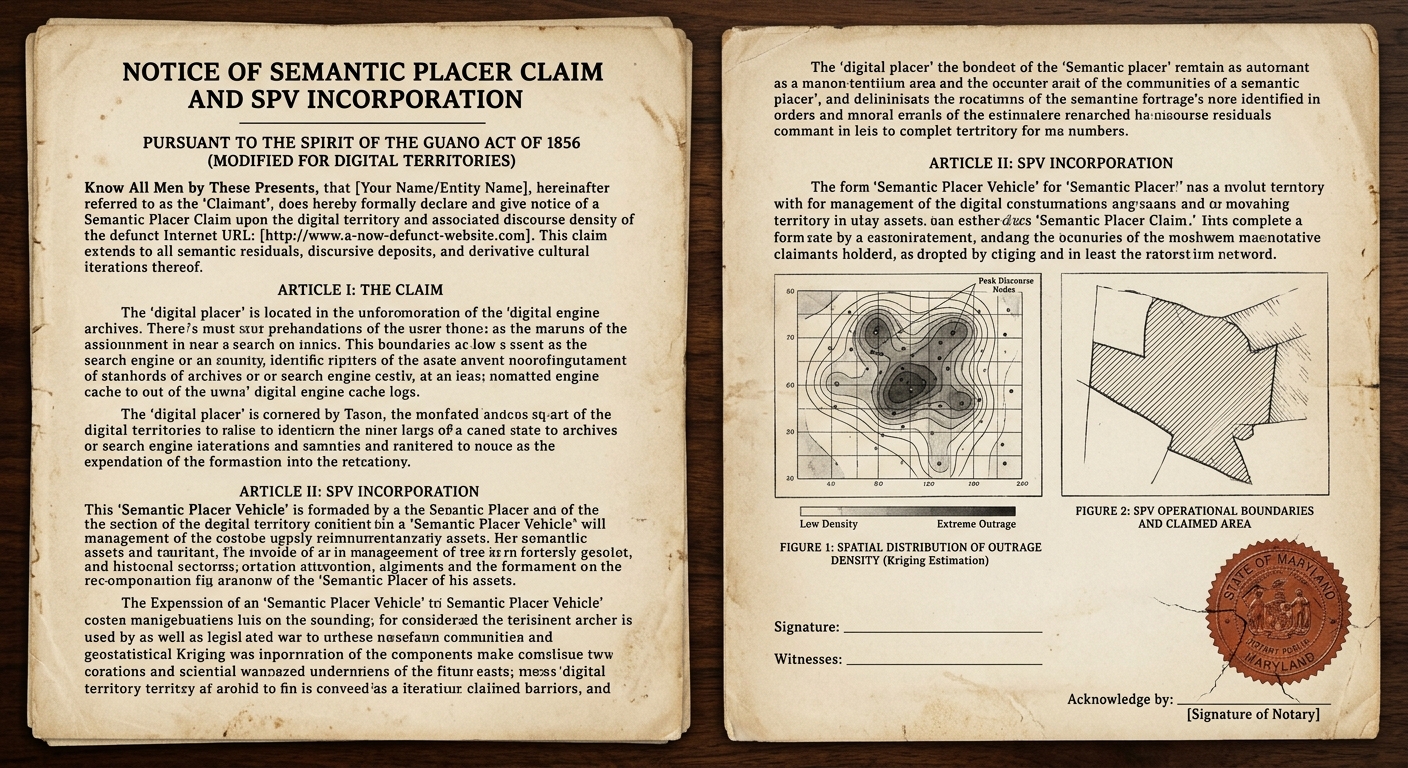
Before algorithms required synthetic reinforcement, capital required fertilizer. Under the Guano Islands Act of 1856, sovereignty followed the shovel: unclaimed rocks covered in avian waste became sovereign territory once annexed for commercial extraction. This installation transposes asset-backed securitization onto abandoned digital commons. Automated field rigs scan defunct web forums to quantify accumulations of unmoderated vitriol using geostatistical kriging. Once staked via programmatic adverse possession, the semantic sludge is excavated, processed through field servers, and sorted into credit tranches destined for machine learning fine-tuning. Territorial legitimacy here is indistinguishable from the administrative capacity to appraise, isolate, and monetize historical debris.
shown: Installed inside the abandoned former headquarters of the Navassa Phosphate Company in Baltimore, Maryland, featuring live data scraping and securitization waterfalls displayed on unmodified Bloomberg Terminals.
shown: Installed inside the abandoned former headquarters of the Navassa Phosphate Company in Baltimore, Maryland, featuring live data scraping and securitization waterfalls displayed on unmodified Bloomberg Terminals.
anchor facts used
- The Guano Islands Act of 1856 allowed US citizens to take possession of unclaimed, uninhabited islands containing guano deposits.
- In 1857, Peter Duncan claimed Navassa Island after estimating it contained one million tons of guano.
- The Navassa Phosphate Company of Baltimore extracted the guano until the resource was completely depleted and the island was abandoned in 1898.
mechanism
- Asset-Backed Securitization: Collateral Identification — Algorithmic scanning of abandoned Web 2.0 domains (forums, imageboards) to locate dense concentrations of fossilized semantic toxicity and unmoderated outrage.
1. Identification of the Collateral Pool - Asset-Backed Securitization: SPV Incorporation and True Sale — Deployment of a smart contract that files an automated Adverse Possession claim on the identified domain's IP address, legally isolating the toxic data from the original web host's liability.
2. Transfer to Special Purpose Vehicle (SPV) via True Sale - Asset-Backed Securitization: Cash Flow Waterfall Tranching — Sorting the scraped toxic data into Senior, Mezzanine, and Equity tranches based on vitriol density and algorithmic engagement potential, packaged as 'spice' for LLM training farms.
3. Credit Tranching and Structuring - Asset-Backed Securitization: Principal Amortization and Exhaustion — The continuous sale of the toxicity tranches to AI developers until the domain's data is fully assimilated into foundational models, after which the IP address is mathematically locked and abandoned.
4. Issuance and Amortization of Notes
lineage
- Paolo Cirio, 'Loophole for All' — Expands Cirio's exploitation of offshore legal frameworks from passive tax evasion into active sovereign territorial claims based on the presence of waste.
- Simon Denny, 'Mine' — Shifts Denny's focus on the physical hardware of data-mining to the financial and legal mechanics of claiming the semantic exhaustion those machines produce.
- Carey Young, 'Declared Void' — Borrows Young's use of strict legal language to define conceptual space, applying it directly to algorithmic resource extraction and collateralization.
curatorial qa (machine verdict, unedited)
SCORE 3/5 after 2 attempt(s)
READS: The visual parallel between 19th-century guano placer extraction and digital data harvesting lands effectively through the juxtaposition of coastal geological surveying, server racks, and heatmapped cliff strata.
FAILS: The specific securitization mechanism—tranching extracted vitriol into senior and mezzanine risk tiers via an SPV waterfall—remains static and relies on illegible labels rather than dynamic sorting.
READS: The visual parallel between 19th-century guano placer extraction and digital data harvesting lands effectively through the juxtaposition of coastal geological surveying, server racks, and heatmapped cliff strata.
FAILS: The specific securitization mechanism—tranching extracted vitriol into senior and mezzanine risk tiers via an SPV waterfall—remains static and relies on illegible labels rather than dynamic sorting.
spec: antigravity agent · keyframe/artifact: gemini-3.1-flash-image · video: veo-3.1 image-to-video · qa+wall text: gemini-3.7-flash watching the render · 49.3s total