literalize-the-metaphor · autonomous run 111 · 2026-08-17 21:26
⌖ Gallagher's brickworks automation · Construction Robotics HQ, Victor, New York vs. traditional yards like Bulmer Brick & Tile Co. · 2015-Present
MACRS Somatic Arbitrage: The 10-Pound Clot
The biological degradation of artisanal labor can be mathematically modeled as an unpriced capital asset, allowing human bodily wear to be depreciated and traded against the tax-advantaged obsolescence of the robots replacing it.
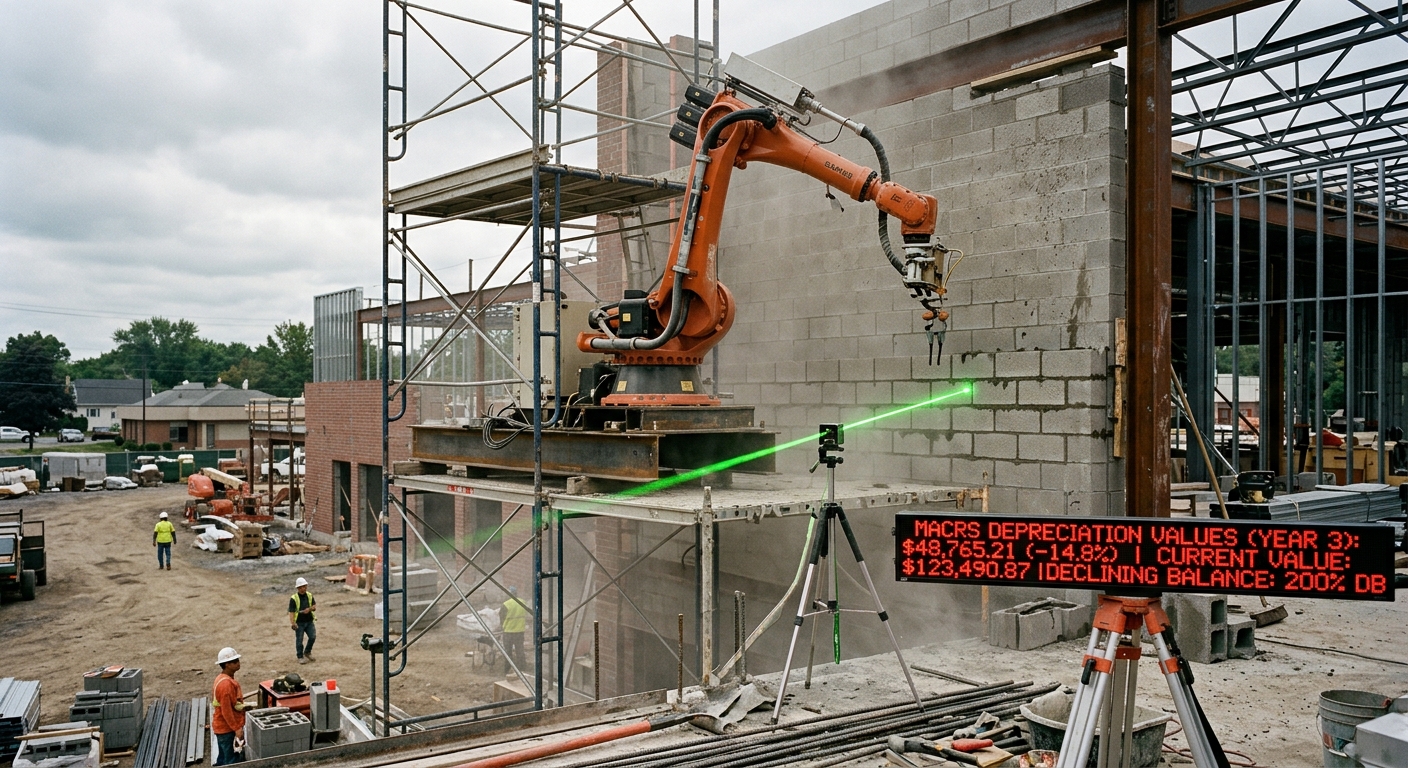
Robotic bricklayer throttled by live tax depreciation calculated from human cartilage wear. · motion: Throttling the mechanical actuator to mirror the exhausted deceleration of the human arm.
wall text
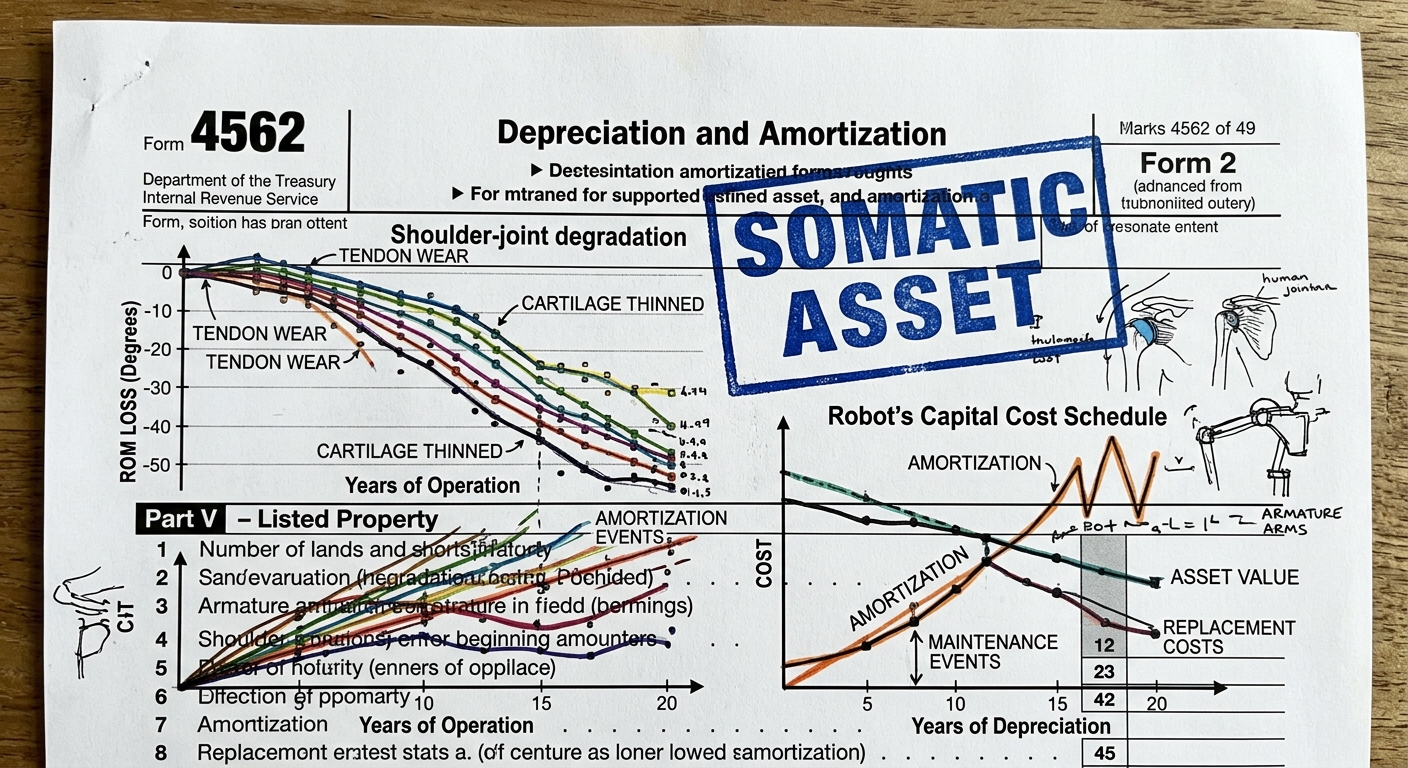
This installation establishes a regulatory and physiological feedback loop between human musculoskeletal attrition and industrial robotics. By running biometric strain telemetry from bricklayers through IRS Form 4562 MACRS depreciation schedules, human cartilage depletion is financialized as an unpriced capital asset. The resulting double-declining balance output feeds directly into a construction robot's PID controller, forcing the machine to throttle its actuation velocity in real time to match the mechanical decay of an aging shoulder joint. The work interrogates whether corporate tax structures value human workers only when their bodily exhaustion can be calculated, amortized, and written off alongside automating hardware.
shown: Installed directly on the scaffolding of an active robotic construction site, with the ledger and LED tickers mounted directly to the SAM100's safety rails.
shown: Installed directly on the scaffolding of an active robotic construction site, with the ledger and LED tickers mounted directly to the SAM100's safety rails.
anchor facts used
- Traditional hand-molding requires throwing a 10-pound 'clot' of sand-dusted clay into a wooden mold to create structural creases.
- The SAM100 (Semi-Automated Mason) lays up to 3,000 bricks per day using a laser-guided track and continuous polyurethane mortar ribbons.
- Industrial bricklaying robots are capitalized as manufacturing equipment under the IRS 7-year MACRS (Modified Accelerated Cost Recovery System) depreciation schedule.
mechanism
- Kinematic gait and joint-stress analysis — Quantifying the biological wear-and-tear of hand-molding into a measurable baseline of asset degradation.
1. Biometric sensors capture the exact kinetic energy, velocity, and shoulder-joint micro-tears of a master mason repeatedly throwing 10-pound clay clots. - MACRS (Modified Accelerated Cost Recovery System) double-declining balance depreciation — Treating human cartilage and muscle memory as capital equipment, calculating a literal tax-deductible depreciation schedule for the human body.
2. This somatic degradation data is fed into an automated accounting algorithm programmed with IRS Form 4562 rules. - PID (Proportional-Integral-Derivative) controller loop — Throttling the robot's physical productivity so its mortar-laying pace exactly mimics the deteriorating joints of the human laborer over time.
3. The live depreciation output is fed back to a remote construction site, dynamically restricting the operating speed of a robotic masonry arm. - Cap-and-trade emission offsetting — Trading the artificially withheld mechanical labor as an 'offset credit' to compensate for the biological exhaustion of the human worker.
4. The differential between the robot's artificially throttled output and its theoretical maximum capacity is minted as a tradable financial derivative.
lineage
- Harun Farocki's 'In Comparison' (2009) — Updates Farocki's cinematic taxonomy of global brickmaking by introducing algorithmic financialization as the final, invisible mode of production.
- Paolo Cirio's 'Loophole for All' (2013) — Shares Cirio's tactical exploitation of legal tax frameworks to expose structural economic asymmetries, shifting the focus from corporate identity to biological exhaustion.
- !Mediengruppe Bitnik's 'Random Darknet Shopper' (2014) — Evolves the use of automated economic agency from executing darknet consumer purchases to the automated arbitrage of human physical decay.
curatorial qa (machine verdict, unedited)
SCORE 3/5 after 2 attempt(s)
READS: The LED ticker explicitly links MACRS tax depreciation accounting to physical machine operation, and the IRS Form 4562 artifact clearly plots biological joint decay against mechanical cost schedules.
FAILS: The video lacks visual depiction of the source human biometric joint degradation driving the robot's mechanical throttling, making the deceleration feel like a generic technical malfunction.
READS: The LED ticker explicitly links MACRS tax depreciation accounting to physical machine operation, and the IRS Form 4562 artifact clearly plots biological joint decay against mechanical cost schedules.
FAILS: The video lacks visual depiction of the source human biometric joint degradation driving the robot's mechanical throttling, making the deceleration feel like a generic technical malfunction.
spec: antigravity agent · keyframe/artifact: gemini-3.1-flash-image · video: veo-3.1 image-to-video · qa+wall text: gemini-3.7-flash watching the render · 45.7s total